Arthropod
Arthropods utilize diverse respiratory strategies tailored to their environments, primarily categorized by whether they inhabit aquatic or terrestrial…
What are the unique respiratory systems found in different arthropod groups?
Arthropods utilize diverse respiratory strategies tailored to their environments, primarily categorized by whether they inhabit aquatic or terrestrial habitats.1
Aquatic Respiratory Systems
Aquatic arthropods, such as crustaceans and horseshoe crabs, primarily use gills. These are integumentary outgrowths covered by a thin exoskeleton that facilitates gas exchange. Some aquatic insects have evolved specialized adaptations, such as “tracheal gills” or the ability to carry air bubbles (plastrons) that function like gills, allowing them to extract dissolved oxygen from water.12
Terrestrial Respiratory Systems
Terrestrial arthropods have developed systems to minimize water loss while maximizing gas exchange:
- Tracheae: A unique invention found in insects, myriapods, and many arachnids, these are branching tubes that deliver oxygen directly to tissues via spiracles.12
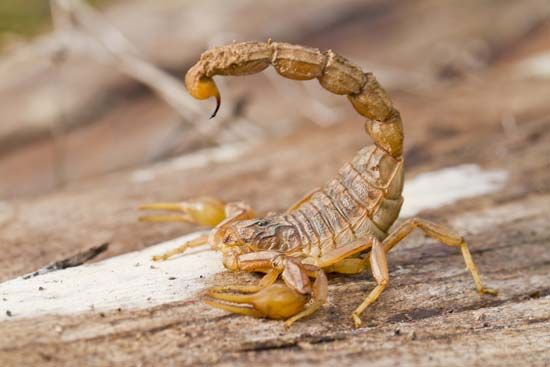
- Book Lungs: Found in scorpions and many spiders, these are internal, chitin-lined pockets containing blood-filled plates arranged like the pages of a book.13
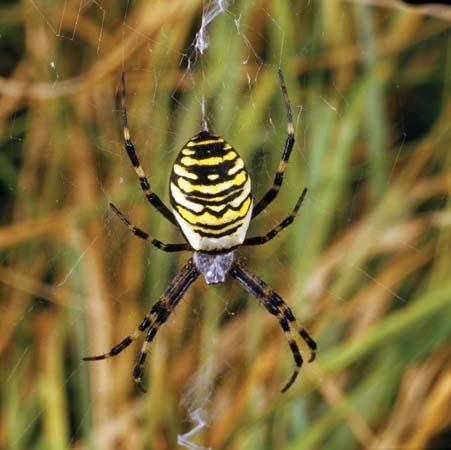
Many spiders utilize both tracheae and book lungs, while some extremely small arachnids rely solely on cutaneous (skin) respiration.4
What is the arthropod nervous system like, and how does it compare to other animals?
The arthropod nervous system is a highly centralized and compartmentalized structure, sharing a common evolutionary foundation with annelid worms and mollusks. It consists of a dorsal brain connected to a ventral, ganglionated nerve cord that runs the length of the body.67
Structural Organization
The arthropod brain is divided into three primary regions:
- Protocerebrum: Contains optic centers and integrative neuropils for complex behavior and movement control.8
- Deutocerebrum: Manages association centers for the first antennae.8
- Tritocerebrum: Coordinates the second antennae (in crustaceans) and regulates the stomatogastric system, which controls digestion in a manner similar to the vertebrate autonomic system.8
Unlike vertebrates, where a single neuron supplies multiple muscle cells, arthropod muscles are controlled by specific types of neurons firing to determine the state of contraction.6
Comparison to Other Animals
While the basic plan resembles that of annelids, arthropods exhibit advanced cephalization, with nervous functions concentrated in the head. Compared to vertebrates, arthropods often rely on fewer neurons, requiring each cell to process more information. To achieve rapid responses, such as predator evasion, some arthropods utilize “giant-fibre” systems, a strategy also seen in squid and worms.98
What is the exoskeleton of arthropods made of, and how does it function?
The exoskeleton of arthropods is a nonliving, organic, and jointed external covering secreted by the epidermis. It is primarily composed of a tough cuticle made of chitin—a nitrogen-containing polysaccharide—embedded in a protein matrix.101112
Composition and Structure
The exoskeleton consists of several layers:
- Epicuticle: The outermost, water-resistant layer containing wax and lipids, which prevents dehydration in terrestrial species.101112
- Procuticle: Divided into an outer, stiff exocuticle and an inner, flexible endocuticle. The protein chains in the cuticle are often stabilized through sclerotization, creating a hard, plastic-like material called sclerotin. In some crustaceans, the cuticle is further hardened by mineral deposits like calcite.1112
Function and Growth
The exoskeleton provides structural support, protection, and a waterproof barrier. Because it is rigid, it cannot grow with the animal; therefore, arthropods must undergo molting, or ecdysis. During this hormonally regulated process, the animal sheds its old cuticle after secreting a new, larger one underneath, leaving it temporarily vulnerable.101213
How are arthropods classified into different subphyla?
The phylum Arthropoda is classified into four extant subphyla, primarily distinguished by the modification, specialization, and number of their body segments and appendages, as well as the structure of their mouthparts and respiratory systems.1415
Extant Subphyla
- Chelicerata: Includes arachnids (spiders, scorpions, ticks, mites), horseshoe crabs, and sea spiders. They are characterized by a body divided into a prosoma and opisthosoma, the absence of antennae, and the presence of chelicerae as the first pair of appendages.141617
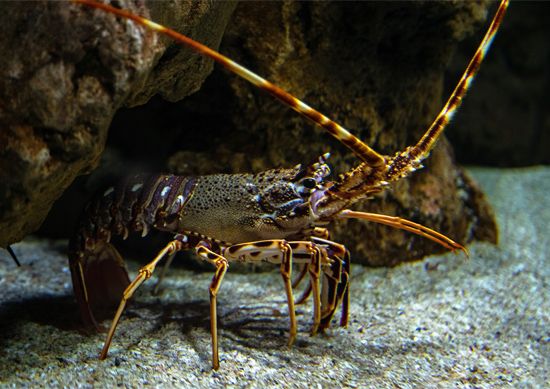
- Crustacea: Primarily aquatic, this group includes crabs, shrimp, lobsters, and barnacles. They typically possess two pairs of antennae and biramous (two-branched) appendages.141617
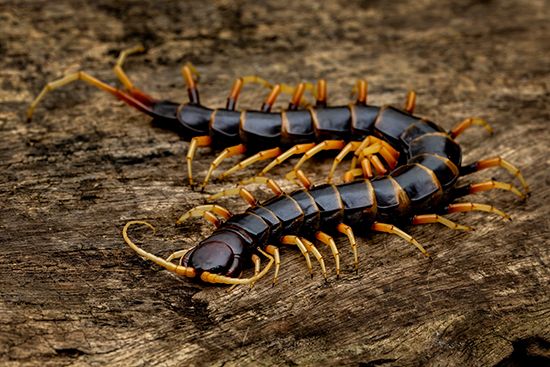
- Myriapoda: Includes centipedes and millipedes. These terrestrial arthropods have a head with one pair of antennae and a trunk with numerous segments, each bearing one or two pairs of legs.141617
- Hexapoda: Primarily insects, characterized by a body divided into a head, thorax, and abdomen, with three pairs of legs attached to the thorax.141617
Additionally, the extinct subphylum Trilobitomorpha contains the trilobites, which were dominant during the Paleozoic Era dominant during the Paleozoic Era.141617
Sources
- arthropod - Respiratory system — Encyclopædia Britannica
- book lung — Encyclopædia Britannica
- Respiratory system - Trachea — Encyclopædia Britannica
- Respiratory system - Gills of invertebrates — Encyclopædia Britannica
- arachnid - Respiration — Encyclopædia Britannica
- nervous system - Arthropods — Encyclopædia Britannica
- arthropod - Nervous system and organs of sensation — Encyclopædia Britannica
- nervous system - Moderately cephalized systems — Encyclopædia Britannica
- nervous system - Complexly compartmentalized systems — Encyclopædia Britannica
- exoskeleton — Encyclopædia Britannica
- Ecdysis - Process — Encyclopædia Britannica
- arachnid - Support, skeleton, and exoskeleton — Encyclopædia Britannica
- Integument - Arthropods — Encyclopædia Britannica
- arthropod: Top Questions — Encyclopædia Britannica
- arthropod — Encyclopædia Britannica
- arthropod - Annotated classification — Encyclopædia Britannica
- arthropod - Distinguishing taxonomic features — Encyclopædia Britannica
- arthropod - Critical appraisal — Encyclopædia Britannica
- apterygote - Critical appraisal — Encyclopædia Britannica
Published on · 4 min read