Bread Crumb Sponge
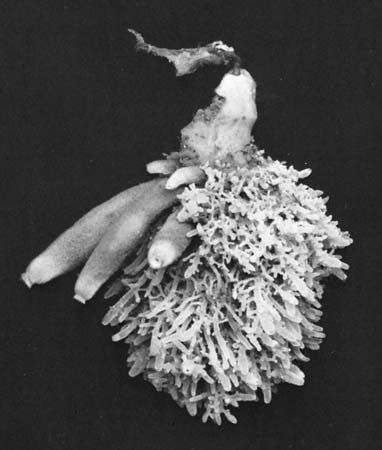
The bread crumb sponge (Halichondria panicea) is a common sponge belonging to the class Demospongiae. It earns its name from its tendency to crumble when…
What is bread crumb sponge?
The bread crumb sponge (Halichondria panicea) is a common sponge belonging to the class Demospongiae. It earns its name from its tendency to crumble when handled.1
This organism typically encrusts hard surfaces and seaweed in shallow subtidal regions or along the shore, often appearing in shaded crevices. Its coloration ranges from light yellow to dark green. The surface of the sponge is marked by numerous conical protuberances, each featuring an opening at the top.1
The sponge functions by using the rhythmic beating of flagella—whiplike hairs on its inner body wall—to draw water through minute pores. It extracts oxygen and food particles from this water before expelling it through the holes at the top of its conical structures.1
How do sponges feed and breathe?
Sponges lack specialized respiratory or digestive organs, relying instead on a sophisticated water-current system to sustain their life processes.45
Feeding and Digestion
Sponges are primarily filter feeders that capture bacteria, microorganisms, and organic debris from the water. The movement of flagella on specialized cells called choanocytes creates a current that draws water through pores and into internal chambers. Once captured, food particles are ingested by choanocytes and transferred by amoebocytes for intracellular digestion. While most species filter-feed, some cladorhizid sponges are carnivorous, using hair-like structures to capture prey.6
Oxygen Uptake and Excretion
Sponges do not possess respiratory organs; instead, they obtain oxygen through direct exchange between their tissues and the surrounding water as it circulates through the canal system. This same system is responsible for removing metabolic wastes, such as ammonia, which are expelled through the oscula and the sponge’s surface.45
What are the different classes of sponges?
There are three primary classes of living sponges within the phylum Porifera, categorized largely by the composition and structure of their skeletons.7
Class Calcarea
Also known as calcareous sponges, these are characterized by skeletons composed entirely of calcium carbonate spicules. They are typically small, often dull in color, and are primarily found in shallow, temperate waters on rocky bottoms.78
Class Hexactinellida
Commonly referred to as glass sponges, this class is defined by a skeleton made of siliceous spicules—often six-rayed—that frequently form delicate, geometric networks. They lack spongin and are found exclusively in marine environments, typically at great depths.79
Class Demospongiae
This is the most abundant and diverse group, comprising the majority of living sponge species. Their skeletons consist of siliceous spicules, spongin fibers, or a combination of both. They exhibit a wide range of forms and sizes, from thin encrustations to large, massive structures, and include the freshwater sponge family.710
What is the role of sponges in marine ecosystems?
Sponges play a vital role in marine ecosystems by acting as complex biological hubs that support diverse communities and influence their physical environment.
Ecological Associations
Sponges often serve as hosts for a wide array of organisms. Thousands of individuals, including crustaceans, nematode and polychaete worms, and bivalve mollusks, may inhabit a single sponge for shelter or nourishment. Furthermore, sponges engage in significant symbiotic relationships with algae. These algae benefit from the protection the sponge provides, while the sponge utilizes the algae as a source of oxygen and food. Some crustaceans, such as hermit crabs, even use sponges for camouflage and protection against predators, which are often deterred by the sponge’s disagreeable taste and smell.5
Environmental Impact
Sponges also shape their physical surroundings. Certain species, such as those in the family Clionidae, excavate galleries in coral reefs and limestone, which can weaken these structures and make them more susceptible to wave abrasion. Conversely, the presence of diverse sponge populations can help stabilize the environmental microclimate for other organisms by buffering against extreme fluctuations in temperature and light.11
Sources
- bread crumb sponge — Encyclopædia Britannica
- bread crumb sponge — Merriam-Webster
- crumb-of-bread sponge — Merriam-Webster
- sponge - Feeding and digestion — Encyclopædia Britannica
- sponge - Form and function — Encyclopædia Britannica
- sponge - Oxygen uptake and excretion — Encyclopædia Britannica
- sponge - Annotated classification — Encyclopædia Britannica
- glass sponge — Encyclopædia Britannica
- calcareous sponge — Encyclopædia Britannica
- Demospongiae — Merriam-Webster
- sponge - Associations with other organisms — Encyclopædia Britannica
- sponge - Habitats — Encyclopædia Britannica
- Are sponges considered animals? — Encyclopædia Britannica
Published on · 3 min read