Acorn Worm
Acorn worms are soft-bodied marine invertebrates that primarily inhabit U-shaped burrows within soft sand or mud along the seashore and in deeper waters.
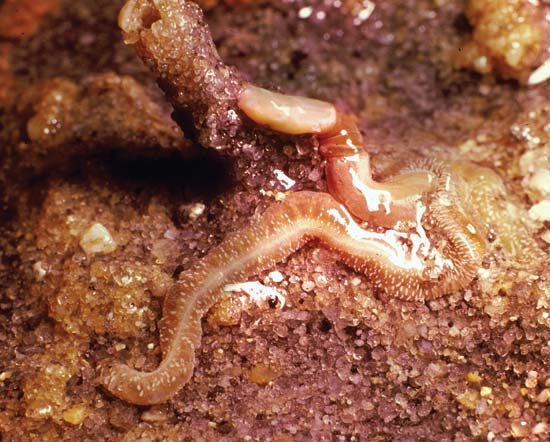
How do acorn worms move and burrow in their environment?
Acorn worms are soft-bodied marine invertebrates that primarily inhabit U-shaped burrows within soft sand or mud along the seashore and in deeper waters.1
To navigate and burrow into their environment, these animals utilize their specialized front end, which consists of a muscular proboscis and a collar. The proboscis, a short, conical structure, acts as the primary tool for pushing through and displacing sediment. While most species remain within their burrows, some deepwater species are capable of swimming freely over the ocean floor.12
The movement and sensory responses of these worms are supported by a primitive nervous system concentrated in the collar, which links to a network of nerve cells within the epidermis. This system allows for rapid responses, such as abrupt contractions of the anterior trunk when the proboscis is stimulated.3
What are the key characteristics that define acorn worms and hemichordates?
Hemichordates are a group of marine invertebrates that were historically misidentified as being closely related to chordates due to a structure in their mouth cavity that was mistaken for a notochord. Modern molecular studies have clarified that they are more closely related to echinoderms than to chordates.2
Key Characteristics of Hemichordates
- Body Plan: The body and coeloms are divided into three distinct regions: the proboscis, collar, and trunk.1
- Nervous System: They lack a central nervous system. Instead, nerve tissue is concentrated in the collar and linked to a network of cells within the epidermis.1
- Feeding: All hemichordates are suspension feeders, capturing algae and minute animals from the water.1
- Development: Many species undergo a larval stage known as a tornaria, which uses cilia to swim.21
Defining Features of Acorn Worms
Acorn worms, which belong to the class Enteropneusta, are a specific type of hemichordate defined by the following:
- Morphology: They are solitary, bilaterally symmetrical, and wormlike, often featuring brilliant colors.1
- Proboscis and Collar: Their common name derives from the acorn-like appearance of their muscular proboscis and collar, which are used for burrowing into mud or sand.21
- Respiration: Many species possess a pharynx perforated by numerous paired gill slits.21
How have acorn worms contributed to our understanding of chordate evolution?
Acorn worms (class Enteropneusta) have played a significant role in scientific discussions regarding chordate evolution, primarily due to shared anatomical features that suggest a common ancestry.
Historically, researchers identified a tubular outgrowth in the acorn worm’s mouth cavity—now called a stomochord—and mistakenly classified it as a rudimentary notochord, the defining dorsal supporting axis of chordates. While this specific homology has been rejected because the structures differ in origin and function, the comparison remains a cornerstone of evolutionary study.15
Acorn worms and chordates share several key characteristics that likely originated before the two groups diverged:
- Gill Slits: Both phyla possess pharyngeal gill slits, a feature not found in other animal phyla.24
- Deuterostome Development: Both belong to the deuterostomes, meaning their mouth does not arise from the blastopore, and their coelom develops as outpouchings of the gut.24
These similarities support the theory that hemichordates are among the closest living relatives to chordates, providing essential insights into the early evolutionary transitions of complex animal life.21
What is the typical habitat and geographical distribution of acorn worms?
Acorn worms are exclusively marine invertebrates found in diverse aquatic environments across the globe. Their habitat and distribution are characterized by the following:
- Depth Range: These animals inhabit a wide vertical range, extending from the intertidal zones along the seashore down to depths exceeding 3,200 meters (10,500 feet).1
- Substrate Preferences: Most species are benthic, living within U-shaped burrows constructed in soft substrates such as sand or mud.1
- Mobility: While the majority of species are burrowers that remain within the sediment, some deepwater species are known to swim freely over the ocean floor.1
Because they are soft-bodied and rely on specific sediment types or marine conditions, their distribution is largely dictated by the availability of suitable seafloor environments.1
Sources
- acorn worm — Encyclopædia Britannica
- hemichordate — Encyclopædia Britannica
- Circulatory system - Hemichordata — Encyclopædia Britannica
- Chordate - General features — Encyclopædia Britannica
- Chordate - Evolution and paleontology — Encyclopædia Britannica
- stomochord — Merriam-Webster
- acorn worm — Merriam-Webster
Published on · 3 min read