Calcareous Sponge
A calcareous sponge is any member of the class Calcarea, a group of sponges distinguished by skeletons composed entirely of calcium carbonate…
What is calcareous sponge?
A calcareous sponge is any member of the class Calcarea, a group of sponges distinguished by skeletons composed entirely of calcium carbonate spicules—needlelike structures that provide structural support.12
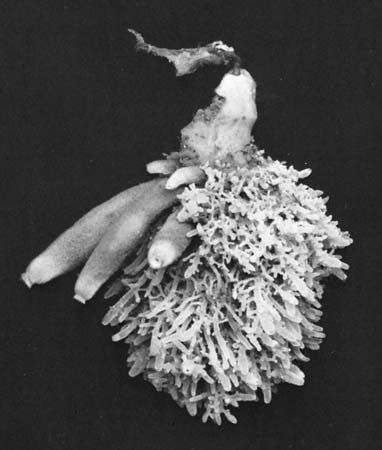
These sponges are typically small, rarely exceeding 15 cm (6 inches) in length, and are usually dull in color. They are primarily found in temperate, shallow waters on the rocky bottoms of continental shelves, ranging from the intertidal zone to depths of about 200 meters, though some species inhabit deeper waters. Morphologically, they may appear as vase-shaped structures, loose networks of thin tubes, or irregular massive colonies.12
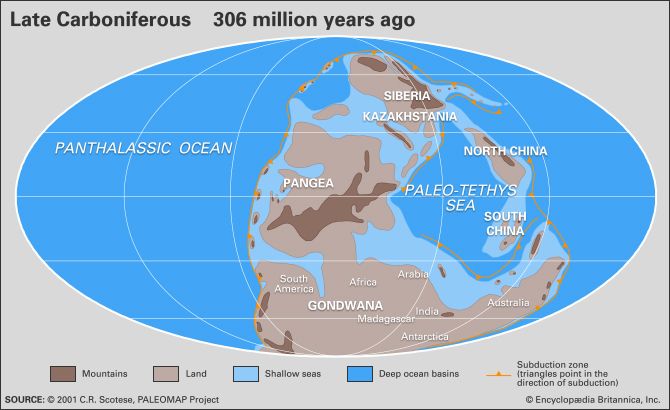
The class is divided into two subclasses, Calcinea and Calcaronea, which are differentiated by their larval types and the cellular structure of their flagella. While they appear in the fossil record as early as the Carboniferous Period, their calcareous spicules are easily dissolved, making well-preserved fossil specimens relatively rare.23
How do calcareous sponges differ from glass sponges?
Calcareous sponges and glass sponges differ primarily in their skeletal composition and preferred habitats. These distinctions are summarized below:
Skeletal Composition
- Calcareous Sponges (Class Calcarea): Their skeletons are composed entirely of calcium carbonate in crystalline forms, such as calcite or aragonite. These spicules are typically monoaxon (one axis), though triaxon and tetraxon forms also occur.5
- Glass Sponges (Class Hexactinellida): Their skeletons consist of silica spicules, which are essentially made of silicic acid. These spicules are often connected in a continuous, delicate geometric network that resembles glass after the soft parts of the sponge decay. A defining characteristic is the presence of triaxon spicules with three orthogonal axes, resulting in six rays.52
Habitat and Distribution
- Calcareous Sponges: These are generally found in temperate, shallow waters on rocky bottoms, ranging from the intertidal zone to depths of approximately 200 meters.2
- Glass Sponges: These organisms typically inhabit much deeper environments, occurring mainly on muddy sea bottoms at great depths. They often use bundles of large spicules to anchor themselves into the soft, muddy substrate.25
What role do spicules play in the structure of a sponge?
Spicules are essential components of a sponge’s skeleton, providing both structural support and protection. These mineralized units are classified into two primary functional categories:7
- Megascleres: These larger spicules function primarily to provide structural support for the sponge’s body.7
- Microscleres: These smaller, often highly specialized spicules serve a protective role, sometimes forming an armor-like layer around the sponge, while also contributing to overall support.76
Spicules can be scattered throughout the sponge’s body or united to form fibers. Their composition varies by class: calcareous sponges utilize calcium carbonate, while Demospongiae and glass sponges (Hexactinellida) utilize silica. In some species, these spicules are connected in continuous networks to create rigid, delicate structures, or they may form large bundles that act as stalks to anchor the sponge to the seafloor.6
How do sponges feed without having a mouth or digestive system?
Sponges lack a mouth and digestive system, instead relying on a highly efficient water-current system to obtain nutrients. This system circulates water through a network of canals and chambers, bringing in oxygen and food particles, such as bacteria, microorganisms, and organic debris.89
Most sponges are filter feeders. The movement of flagella on specialized cells called choanocytes creates a constant flow of water, drawing it into the sponge through pores. Once inside, food particles are captured by the choanocytes. These particles are then transferred to thesocytes (specialized amoebocytes) for distribution throughout the sponge. Digestion occurs intracellularly within both the choanocytes and thesocytes.9
While most species filter feed, some, such as cladorhizid sponges, are carnivores that capture prey using hair-like structures on their bodies. Additionally, sponges can absorb dissolved organic substances directly from the water.9
Sources
- calcareous sponge — Encyclopædia Britannica
- sponge - Evolution and paleontology — Encyclopædia Britannica
- sponge - Habitats — Encyclopædia Britannica
- sponge - Annotated classification — Encyclopædia Britannica
- glass sponge — Encyclopædia Britannica
- sponge - Mineral skeletons — Encyclopædia Britannica
- sponge - Skeleton — Encyclopædia Britannica
- sponge - Form and function — Encyclopædia Britannica
- sponge - Feeding and digestion — Encyclopædia Britannica
Published on · 3 min read