Bivalve
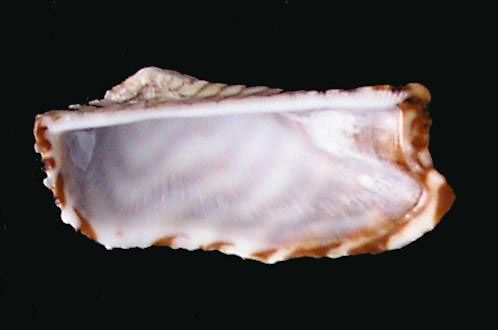
Bivalves are mollusks characterized by a shell composed of two halves, or valves, joined at a hinge by an elastic ligament at a hinge by an elastic ligament.
What is the structure and function of a bivalve’s shell?
Bivalves are mollusks characterized by a shell composed of two halves, or valves, joined at a hinge by an elastic ligament at a hinge by an elastic ligament.1
Structure
The shell is primarily composed of calcium carbonate embedded in an organic matrix, both secreted by the mantle. The outermost layer is the periostracum, which serves as a substrate for calcium carbonate deposition. Internally, the shell may feature layers of calcite, aragonite, or nacre, depending on the species. A hinge plate with interlocking teeth ensures proper valve alignment and prevents shear when the shell is closed.23
Function
The shell serves as a protective enclosure for the animal’s soft body. Its morphology is highly adapted to the bivalve’s specific habitat and lifestyle:145
- Protection: Thick, ribbed, or ornamented shells provide defense against predators and environmental damage.45
- Locomotion: Laterally compressed, smooth shells reduce drag, facilitating rapid burrowing or, in the case of scallops, swimming via jet propulsion.45
- Attachment: Some species use the shell to cement themselves to hard surfaces, while others utilize byssal threads for anchorage.41
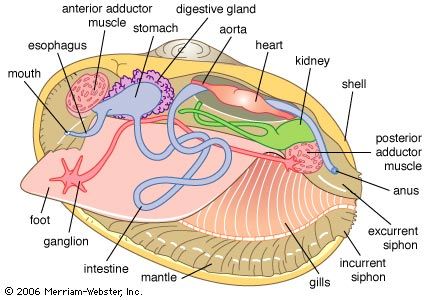
What are some common examples of bivalves and where can they be found?
Bivalves are a diverse class of mollusks comprising over 15,000 species, including clams, oysters, mussels, and scallops.7 They are found worldwide in virtually all aquatic environments, ranging from shallow coastal seas to abyssal depths, as well as in freshwater streams and rivers.72
Common Examples and Habitats
- Clams: Typically found burrowing into sand or mud in both saltwater and freshwater habitats. They use a muscular foot to dig and extend siphons to feed.8
- Oysters: Sessile animals that live in marine and brackish coastal waters. They cement themselves to hard surfaces, often forming reefs.8
- Mussels: Inhabit both freshwater and saltwater. Freshwater mussels often form dense beds in flowing streams, while marine mussels anchor themselves to rocks, piers, and ships using strong byssal threads.8
- Scallops: Primarily marine bivalves that can be found on soft sediments or attached to substrates. Unlike many other bivalves, they are capable of swimming by using jet propulsion.38
Bivalves are absent from terrestrial environments, though some species can withstand temporary drought.2
What are the defining characteristics of bivalve mollusks?
Bivalve mollusks, members of the class Bivalvia, are defined by several key biological and anatomical characteristics:
- Shell Structure: The most prominent feature is a shell divided into two halves, or valves, which are connected at a hinge by an elastic ligament. These valves are secreted by the mantle, a specialized organ that also forms the hinge teeth.711
- Feeding and Respiration: Most bivalves are filter feeders. They utilize modified respiratory gills, known as ctenidia, to trap microscopic food particles from the water. In many species, these organs serve both for gas exchange and as the primary mechanism for collecting nutrients.712
- Anatomical Simplification: Unlike most other mollusks, bivalves have lost the head and the radula (a rasping organ used for feeding). This reflects their largely sedentary, deposit-feeding, or suspension-feeding lifestyle.7
- Musculature: They possess adductor muscles used to close the valves. The arrangement of these muscles, along with the hinge structure and mantle fusion, are critical features used by scientists to classify different species.611
How do bivalves feed and what role do they play in aquatic ecosystems?
Bivalves employ diverse feeding strategies, though the vast majority are filter feeders that strain organic material from the water column.1413
Feeding Mechanisms
- Suspension Feeding: Most modern bivalves use modified gills called ctenidia to collect food. Cilia on the gill filaments create water currents, trapping particles like bacteria, algae, and plant detritus in mucus, which is then transported to the mouth via labial palps.813
- Detritivory: Primitive bivalves, such as palaeotaxodonts, are detritivores that collect loose organic material from the sediment surface using specialized structures called palp proboscides.8
- Specialized Strategies: Some species have evolved unique methods. For example, giant clams host symbiotic zooxanthellae (algae) within their mantle tissue for nutrition. Conversely, some deep-sea bivalves, such as certain Anomalodesmata, act as predators, using their siphons to create pressure changes that draw small prey into the mantle cavity.8
Ecological Roles
Bivalves are essential components of aquatic ecosystems, serving as primary consumers that exploit organic material. Their high population densities allow them to play a significant role in nutrient cycling. However, their feeding habits can also have major environmental impacts:139
- Bioerosion: Many species contribute to the breakdown of calcium carbonate rocks, corals, and wood.15
- Food Web Dynamics: As primary consumers, they are a vital food source for many predators, including crustaceans, starfish, and snails.13
- Environmental Indicators: Because they concentrate particles from the water, they can accumulate toxins, such as those from red tides, or industrial pollutants, making them important indicators of water quality.15
- Invasive Impact: Species like the zebra mussel can drastically alter food webs and threaten native biodiversity when introduced to new environments.15
Sources
- bivalve - The shell — Encyclopædia Britannica
- bivalve - Size range and diversity of structure — Encyclopædia Britannica
- What’s the difference between clams, mussels, and oysters? — Encyclopædia Britannica
- bivalve - Annotated classification — Encyclopædia Britannica
- bivalve - External features — Encyclopædia Britannica
- bivalve - The mantle and musculature — Encyclopædia Britannica
- bivalve — Encyclopædia Britannica
- bivalve - Ecology and habitats — Encyclopædia Britannica
- bivalve - Distribution and abundance — Encyclopædia Britannica
- mollusk - Distribution and abundance — Encyclopædia Britannica
- bivalve - Classification — Encyclopædia Britannica
- bivalve - Reproduction and life cycles — Encyclopædia Britannica
- bivalve - Food and feeding — Encyclopædia Britannica
- Filter feeding — Encyclopædia Britannica
- bivalve - Importance — Encyclopædia Britannica
Published on · 4 min read