Breadfruit
Breadfruit (Artocarpus altilis) is a tree in the mulberry family (Moraceae) known for its large, starchy fruits, which serve as a staple food in the South…
What is breadfruit and where does it originate?
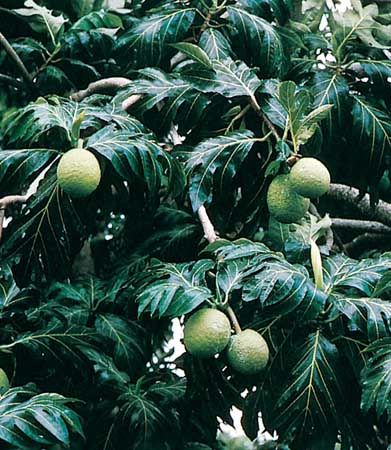
Breadfruit (Artocarpus altilis) is a tree in the mulberry family (Moraceae) known for its large, starchy fruits, which serve as a staple food in the South Pacific and other tropical regions. The tree typically grows 12 to 18 meters tall and produces round, greenish-brown fruits with a fibrous pulp that is rarely eaten raw but can be roasted, boiled, fried, or ground into flour.1
The species is considered indigenous to the Malay Archipelago, where it has been cultivated since ancient times. It spread across the South Pacific in prehistoric eras and was later introduced to the West Indies in the 18th century via the voyages of Captain William Bligh, following recommendations by Captain James Cook. While the tree is now grown in various tropical areas, it is sensitive to frost and cannot survive in colder climates.1
How is breadfruit traditionally prepared and consumed in different cultures?
Breadfruit is a versatile, starchy staple that is rarely consumed raw due to its texture and composition. Across various cultures, it is prepared using several culinary techniques:
- Cooking Methods: The fruit is commonly roasted, baked, boiled, or fried. It can also be dried and processed into flour for various uses.1
- Fermentation (Polynesia): In islands such as Tahiti and the Marquesas, where breadfruit serves as a primary staple, it is traditionally preserved through fermentation. The fruit is allowed to become overripe, beaten into a pulp, wrapped in hibiscus leaves, and buried in well-drained pits. This process creates a sour-tasting paste that remains edible and nutritious for years, often used to add flavor to fresh breadfruit preparations.2
- Market and Household Use: In the West Indies and parts of the American mainland, breadfruit is frequently sold in markets and prepared in home kitchens as a dietary staple.1
Beyond its culinary applications, the breadfruit tree is highly valued for its utility; its wood is used for furniture and canoe hulls, while its milky sap serves as a natural glue and caulking material for boats.12
How is breadfruit being used to address food security issues in tropical regions?
Breadfruit (Artocarpus altilis) serves as a significant staple food in many tropical regions due to its high starch content and versatility. Historically, its potential as a reliable food source was recognized by explorers like James Cook, who advocated for its introduction to the West Indies to support populations in colonial territories.1
In traditional Polynesian cultures, breadfruit has long been essential to food security through advanced preservation techniques. In islands such as Tahiti and the Marquesas, surplus harvests were processed by fermenting the fruit in large, well-drained underground pits. This method allowed the breadfruit to be stored for years, providing a stable, nutritious food source that remained edible even during periods when fresh crops were unavailable.2
While the provided search results highlight its historical role as a staple and its use in traditional preservation, they do not contain specific information regarding modern agricultural initiatives or contemporary programs currently using breadfruit to address global food security issues.
How does the breadfruit tree look, and what are its characteristics?
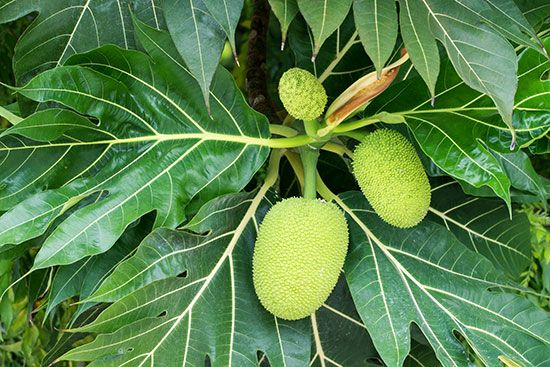
The breadfruit tree (Artocarpus altilis) is a member of the mulberry family that typically reaches heights of 12 to 18 meters (40 to 60 feet). It is characterized by large, glossy green leaves that are three- to nine-lobed toward the apex.1
The tree produces both male and female flowers on the same plant:
- Male flowers: Appear in dense, club-shaped catkins.
- Female flowers: Grouped together to form a large, prickly head on a spongy receptacle.
The resulting fruit is roundish, measuring 10 to 20 centimeters (4 to 8 inches) in diameter. These fruits are greenish to brownish green in color and contain a white, somewhat fibrous starch-rich pulp.1
Because the tree cannot tolerate frost, it is restricted to tropical climates. While it is a vital food source, the tree is also valued for its utility; its fibrous inner bark is used to make cloth, its wood is used for furniture and canoes, and its milky sap provides natural glue and caulking material.1
Sources
- breadfruit — Encyclopædia Britannica
- Polynesian culture - Gardening of Polynesian culture — Encyclopædia Britannica
Published on · 3 min read