Cabo Verde
The official language of Cabo Verde is Portuguese, a legacy of its history as a Portuguese colonial territory until 1975. However, the most widely spoken…
What are the main languages spoken in Cabo Verde, and how do they reflect the country’s cultural heritage?
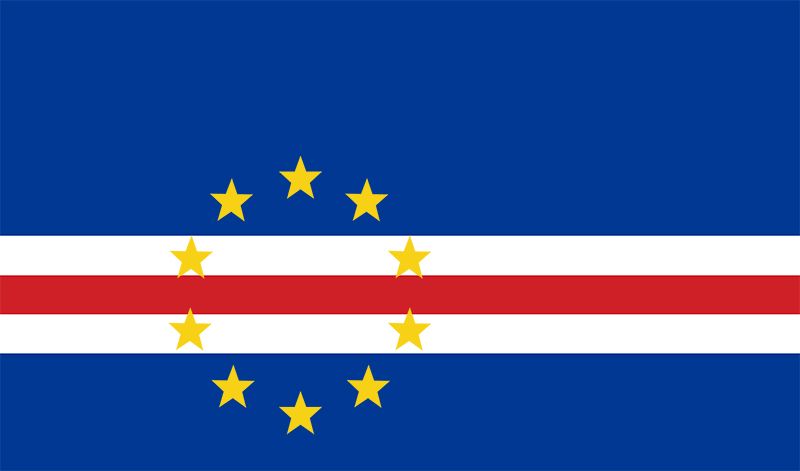
The official language of Cabo Verde is Portuguese, a legacy of its history as a Portuguese colonial territory until 1975. However, the most widely spoken language is Crioulo, one of the oldest Portuguese-based creole languages.12
These languages reflect the nation’s unique cultural synthesis:
- Colonial Heritage: Portuguese remains the language of formal administration and education, representing the country’s historical ties to Portugal.13
- National Identity: Crioulo emerged in slave depots as a result of contact between European settlers and African populations. It serves as a powerful symbol of Cabo Verdean identity, distinct from its colonial past.324
- Artistic Expression: The evolution of this identity is evident in literature and the arts. While early works were rooted in Portuguese traditions, the mid-20th-century Claridade movement marked a shift toward asserting a unique national character, with later writers increasingly incorporating Crioulo into their work.4
This linguistic blend mirrors the broader cultural fusion of African and European influences found in the country’s music, such as the morna and batuko.4
What unique aspects of Cabo Verdean culture, such as music and cuisine, distinguish it from other African nations?
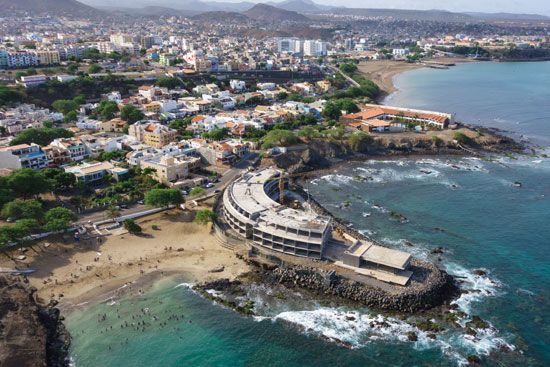
Cabo Verdean culture is defined by a unique synthesis of African and European influences, shaped by its history as a colonial entrepôt and its development of a distinct national identity. While the provided search results do not contain specific information regarding traditional cuisine, they highlight several key aspects of the country’s artistic and cultural life that distinguish it from other African nations.
Musical Traditions
Cabo Verdean music is a hallmark of its cultural fusion:
- The Morna: Often compared to Portuguese fado, this genre is a uniquely Cabo Verdean art form characterized by themes of love, separation, and longing for home.25
- African Roots: Traditions such as batuko—a genre featuring polyrhythm and call-and-response performed by women—demonstrate the preservation and rebirth of African musical styles.2
- Diverse Styles: The country also features the fast-paced funana, which utilizes the gaita (an accordion-like instrument), and the finaçon, often performed by women.26
Cultural Synthesis
The nation’s identity is marked by a deliberate break from purely Portuguese traditions. The Claridade movement (1936–1960) was instrumental in establishing a unique Cabo Verdean literary identity, shifting focus toward the local Crioulo culture and language. Furthermore, while the population is predominantly Roman Catholic, religious practice is frequently enriched with African elements, such as drumming and traditional dance during the celebration of saints’ days.278
Where is Cabo Verde located, and what are its main geographical features?
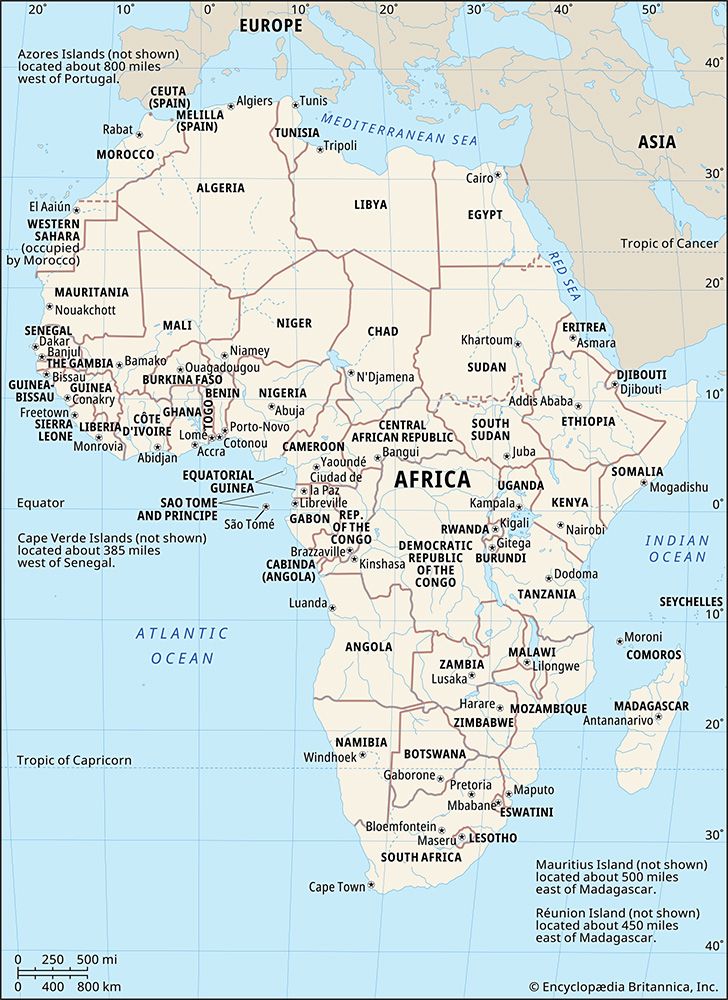
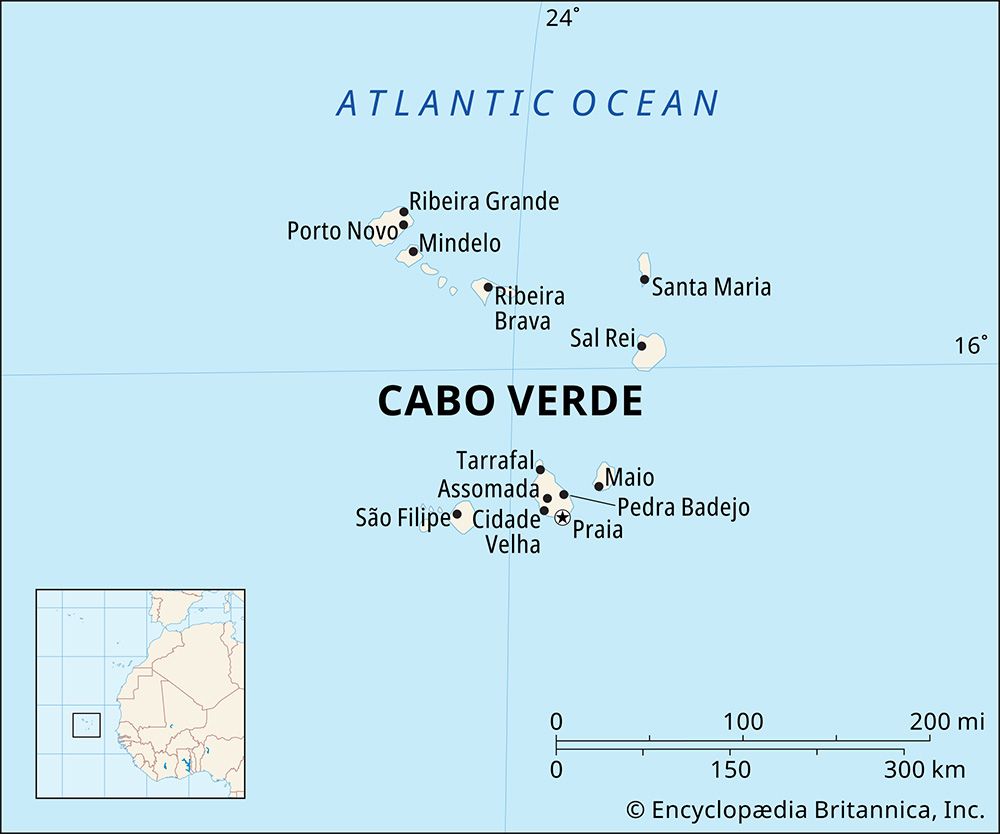
Cabo Verde is an archipelago located in the Atlantic Ocean, approximately 385 miles (620 km) off the west coast of Africa. It is situated between 14°30′ and 17°30′ N and between 22°30′ and 25°30′ W.1011
The country consists of nine inhabited islands, one uninhabited island, and various islets, organized into two groups:10
- Barlavento (Windward) Islands: Located to the north, this group includes Santo Antão, São Vicente, Santa Luzia, São Nicolau, Sal, and Boa Vista.10
- Sotavento (Leeward) Islands: Located to the south, this group includes Maio, Santiago, Fogo, and Brava.10
The climate is generally moderate and characterized by extreme aridity, with precipitation levels being highly unpredictable due to the influence of the intertropical convergence zone. While the islands experience stable temperatures, the mountainous regions can receive more moisture when the Guinea Current brings heat and humidity during the summer months.12
How has Cabo Verde’s economy developed since independence, and what are its main industries?
Following independence in 1975, Cabo Verde’s economy was initially characterized by significant state intervention and the creation of numerous state-owned enterprises, which ultimately hindered economic growth.13
Beginning in the mid-1990s, the country underwent dramatic structural reforms to transition toward a market economy. This shift involved the widespread privatization of state-owned entities, including banks, utilities, and tourism-sector businesses. While the country experienced strong growth in the years leading up to 2020, the COVID-19 pandemic caused a significant economic contraction due to a decline in tourism and consumption.1314
Main Industries and Economic Sectors
Cabo Verde’s economy is service-oriented, focusing on commerce, trade, transport, and public services. Key economic drivers include:13
- Tourism: An increasingly vital sector that has become a primary engine for growth.1314
- Remittances and Revenue: Income from international airports and remittances from the diaspora are essential for maintaining a positive balance of payments.13
- Manufacturing: Small-scale industries exist, including textiles, sewing, ceramics, pharmaceuticals, and beverage production.15
- Fishing: The processing of frozen seafood, such as lobster, and tuna canning are profitable activities, though the country’s full fishing potential remains under-exploited.1516
- Agriculture: Limited by severe, recurrent droughts, agriculture is largely restricted to subsistence and small-scale commercial farming of crops like corn, sugarcane, and potatoes.16
Sources
- Cabo Verde: Country Facts — Encyclopædia Britannica
- Cabo Verde - The arts — Encyclopædia Britannica
- Guinea-Bissau - Ethnic and linguistic groups — Encyclopædia Britannica
- creole languages — Encyclopædia Britannica
- Cabo Verde - Cultural life — Encyclopædia Britannica
- Cabo Verde - Religion of Cabo Verde — Encyclopædia Britannica
- Guinea-Bissau - Cultural milieu — Encyclopædia Britannica
- Cabo Verde - Early and colonial history — Encyclopædia Britannica
- Eugénio Tavares — Encyclopædia Britannica
- Cabo Verde - Land — Encyclopædia Britannica
- Cabo Verde - Climate — Encyclopædia Britannica
- Cabo Verde — Encyclopædia Britannica
- Cabo Verde - Economy — Encyclopædia Britannica
- Cabo Verde - Manufacturing — Encyclopædia Britannica
- Cabo Verde - Resources and power — Encyclopædia Britannica
- Cabo Verde - Agriculture, forestry, and fishing — Encyclopædia Britannica
- Cabo Verde - Transportation and telecommunications — Encyclopædia Britannica
- history of Cabo Verde — Encyclopædia Britannica
Published on · 4 min read