Cape Breton Highlands National Park
The Cape Breton Highlands region holds deep historical and cultural significance, primarily as the ancestral territory of the Mi’kmaq First Nation, who refer…
What is the historical significance of the Cape Breton Highlands region?
The Cape Breton Highlands region holds deep historical and cultural significance, primarily as the ancestral territory of the Mi’kmaq First Nation, who refer to the island as Unama’ki. For centuries before European arrival, the Mi’kmaq maintained a seasonally nomadic lifestyle, deeply connected to the land and coastal resources.12
The region’s history is also defined by its role in early European exploration and colonial shifts. Cape Breton Island is believed to be the first land encountered by John Cabot during his 1497–98 voyage. Throughout the 18th century, the island—then known as Île Royale—became a focal point of imperial competition between the French and the British, eventually being ceded to Britain in the 1763 Treaty of Paris.1
In 1936, a significant portion of the northern highlands was established as the Cape Breton Highlands National Park, preserving the area’s unique topography and wilderness. Today, the region remains a vital center for the preservation of Scottish and Acadian cultural traditions, including Celtic music and Gaelic folk arts.34
How does Cape Breton Highlands National Park compare to other national parks in Nova Scotia or Atlantic Canada?
Cape Breton Highlands National Park is distinguished from other parks in Nova Scotia and Atlantic Canada primarily by its dramatic elevation and unique topography. While Kejimkujik National Park is also a popular destination for wilderness experiences, the Highlands park features the highest point in the province, rising over 1,700 feet (518 meters) above sea level.163
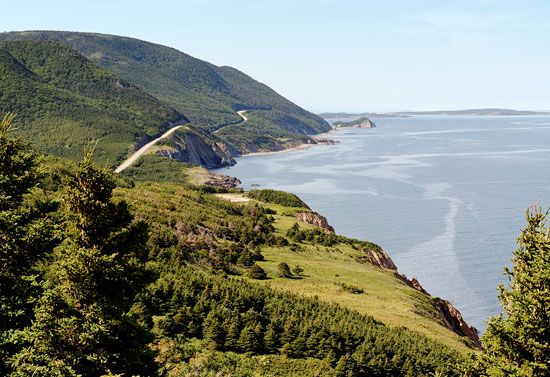
The park’s landscape is defined by an undulating plateau characterized by muskeg, lakes, and heath, which contrasts with the forested slopes of fir, spruce, birch, and poplar. Unlike many other historic sites in the national parks system—such as the Fortress of Louisbourg, Port Royal, or the Alexander Graham Bell National Historic Site—which focus on cultural and colonial history, Cape Breton Highlands is primarily celebrated for its scenic and recreational wilderness. Furthermore, the park is uniquely integrated with the Cabot Trail, a 185-mile scenic highway that provides access to its rugged coastal and upland terrain.163
Where is Cape Breton Highlands National Park located and what are its main geographical features?
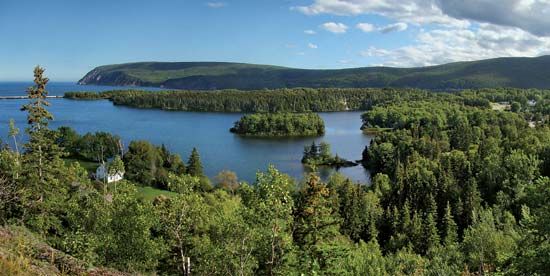
Cape Breton Highlands National Park is located on the northern section of Cape Breton Island in Nova Scotia, Canadaplace/Nova-Scotia), Canada. Established in 1936, the park occupies 367 square miles (951 square km) and is situated between the Atlantic Ocean and the Gulf of St. Lawrence.16
The park’s geography is defined by several distinct features:
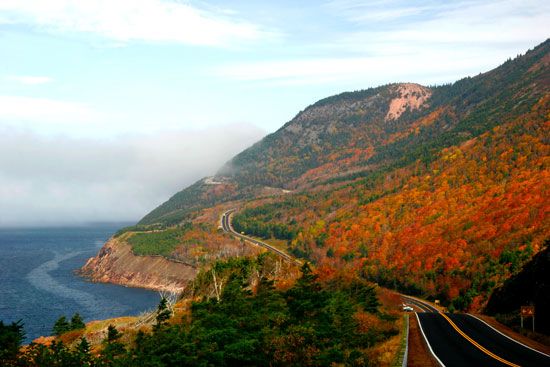
- Topography: The landscape consists of an undulating plateau that averages 1,200 feet (370 meters) above sea level, with its highest point reaching 1,745 feet (532 meters), the highest elevation in Nova Scotia.16
- Formation: The irregular terrain was shaped by long-term river erosion followed by glacial action during the Ice Age.1
- Vegetation: The area is primarily covered by forests of fir, spruce, birch, and poplar, while the central plateau features muskeg, lakes, and heath.1
- Access: The scenic Cabot Trail highway encircles most of the region, providing access to the rugged coastal and upland areas.16
What are some popular activities and attractions for visitors to the park?
Visitors to Cape Breton Highlands National Park primarily enjoy the area for its scenic beauty and recreational opportunities within its rugged wilderness.1
Key attractions and activities include:
- Scenic Touring: The Cabot Trail, a 185-mile (298-km) highway, is the primary way to experience the park. It encircles most of the region, offering dramatic views as it traverses the coastline and the upland plateau.61
- Outdoor Recreation: The park serves as a major destination for those seeking outdoor activities in a landscape defined by forests, muskeg, lakes, and heath.61
- Nature Observation: Visitors can explore the diverse environment, which supports various mammals and bird species, including numerous seabirds.6
While the park is a premier location for these activities, it is important to note that the interior plateau remains largely uninhabited, with human activity concentrated along the narrow coastal fringe.1
Sources
- Cape Breton Highlands National Park — Encyclopædia Britannica
- Cape Breton Island — Encyclopædia Britannica
- Nova Scotia - Cultural life — Encyclopædia Britannica
- Mi’kmaq — Encyclopædia Britannica
- Nova Scotia — Encyclopædia Britannica
- Cape Breton Highlands — Encyclopædia Britannica
Published on · 3 min read