Cape Saint Vincent
Cape Saint Vincent, located on the southwesternmost point of Portugal, has served as a significant site for naval engagements throughout history due to its…
What role did Cape Saint Vincent play in naval battles throughout history?
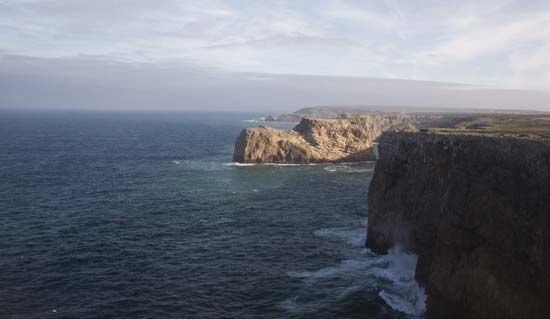
Cape Saint Vincent, located on the southwesternmost point of Portugal, has served as a significant site for naval engagements throughout history due to its strategic position on the Atlantic Ocean.1
The most notable conflict associated with the cape is the Battle of Cape St. Vincent, which took place on February 14, 1797. During this engagement, a British fleet commanded by Admiral John Jervis faced a numerically superior Spanish fleet.12
The battle is particularly famous for the actions of Commodore Horatio Nelson. Recognizing that the British fleet would be unable to maneuver quickly enough to prevent the Spanish squadrons from uniting, Nelson broke formation without orders to intercept the second Spanish division. By holding the enemy squadrons apart and engaging multiple ships simultaneously, Nelson allowed the rest of the British fleet to arrive in support. The superior efficiency of British gunnery proved decisive, resulting in a significant victory. This triumph earned Jervis the earldom of St. Vincent and secured a knighthood for Nelson.21
How has Cape Saint Vincent influenced Portuguese culture and literature?
The premise that Cape Saint Vincent has a documented, direct influence on Portuguese literature and culture is not supported by the provided search results. While the cape is a significant geographical and historical landmark, the available information focuses on its role as a site for naval battles and its association with Henry the Navigator, who established a naval observatory and school for navigators near the nearby settlement of Sagres around 1420.13
Historically, the cape was known to the Greeks and Romans as the Sacred Promontory due to the presence of a shrine there. Today, the region is primarily characterized by its economic reliance on tourism, pastoralism, and fishing, rather than as a central theme in literary or cultural discourse.1
Because the provided knowledge base does not contain information regarding the specific influence of Cape Saint Vincent on Portuguese literature or broader cultural identity, I cannot offer further details on that topic.
What is the historical importance of Cape Saint Vincent in maritime navigation?
Cape Saint Vincent holds significant historical importance in maritime navigation primarily due to its role as a center for exploration during the 15th century. Located on the southwesternmost point of Portugal, the promontory—often paired with nearby Sagres Point—served as the base for Henry the Navigator.1
Around 1420, Henry the Navigator established a naval observatory and a school for navigators near the town of Sagres, specifically at Vila do Infante. This institution became a focal point for the development of maritime knowledge and the sponsorship of voyages that expanded European understanding of the African coast and the Atlantic. By centralizing the study of navigation and the organization of maritime expeditions, the region played a foundational role in the Age of Discovery, facilitating the exploration of the Guinea coast and the eventual discovery of the Cape Verde Islands.13
Beyond its navigational legacy, the cape has long been a landmark for mariners, known to the Greeks and Romans as the Sacred Promontory.1
Are there any lighthouses at Cape Saint Vincent, and what is their history?
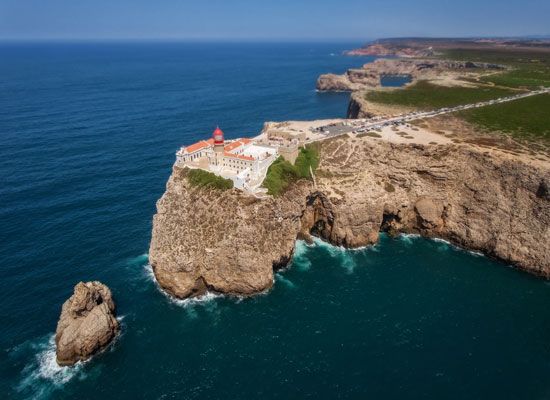
Yes, there is a lighthouse located at Cape Saint Vincent. It serves as a prominent landmark on the promontory, situated above the large rock that characterizes the southwesternmost point of Portugal.1
While the provided information confirms the existence of the lighthouse as a navigational aid at this historic site, it does not detail the specific construction dates or the architectural history of the structure itself. The cape has long been a significant location for mariners, historically known to the Greeks and Romans as the Sacred Promontory due to a shrine that once stood there.1
Sources
- Cape Saint Vincent — Encyclopædia Britannica
- Horatio Nelson - Battles of Cape St. Vincent and the Nile — Encyclopædia Britannica
- Henry the Navigator - Final maritime ventures of Henry the Navigator — Encyclopædia Britannica
- Saint Vincent, Cape — Merriam-Webster
Published on · 3 min read