Carlsbad Caverns National Park
Visitors to Carlsbad Caverns National Park can explore the park's namesake cavern through several accessible routes and experiences:
What are some of the most popular tours and activities available for visitors at Carlsbad Caverns?
Visitors to Carlsbad Caverns National Park can explore the park’s namesake cavern through several accessible routes and experiences:
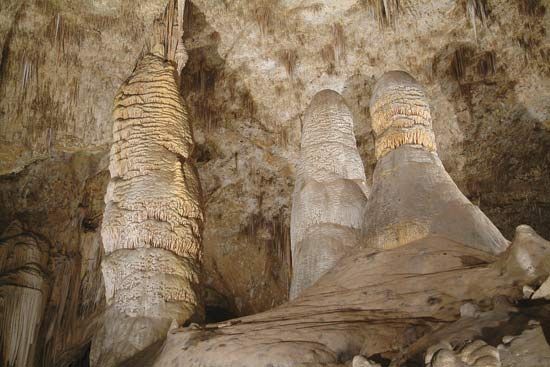
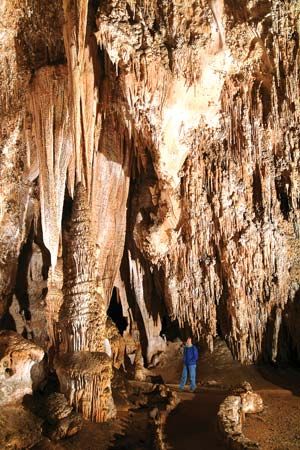
- Self-Guided Exploration: Visitors can walk into the cavern or take an elevator to the 755-foot level to explore the Big Room. This massive chamber features notable formations such as the Giant Dome, the Twin Domes, and the Bottomless Pit.1
- Bat Flight Viewing: During the summer months, visitors can observe a colony of approximately one million Mexican free-tailed bats as they swarm out of the cave entrance at sunset to feed.1
- Cave Tours: While the main cavern has 3 miles of passages open to the public, the park also encompasses other significant sites like Slaughter Canyon Cave, which contains the Monarch, one of the world’s tallest columns.1
Please note that while early explorers like James Larkin White once provided tours via bat-guano buckets, modern access is strictly managed to preserve the cave environment.1
Where is Carlsbad Caverns National Park located, and when was it established?
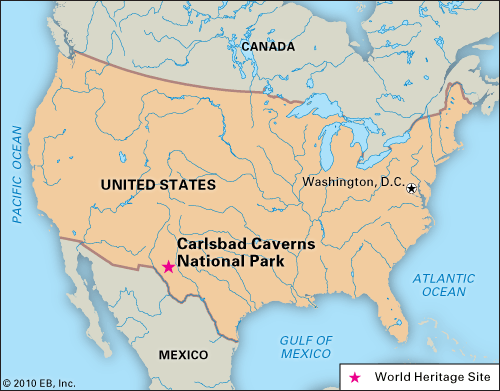
Carlsbad Caverns National Park is located in the Chihuahuan Desert of southeastern New Mexico, near the base of the Guadalupe Mountains.1
Regarding its establishment, the site was first designated as a national monument in 1923. It was subsequently elevated to national park status in 1930 and was later proclaimed a UNESCO World Heritage site in 1995.1
What types of wildlife can be found in and around Carlsbad Caverns National Park?
The wildlife in and around Carlsbad Caverns National Park is diverse, reflecting the park’s location within the Chihuahuan Desert.
Underground Wildlife
The most iconic inhabitants of the park are the bats. During the summer months, a colony of approximately one million Mexican free-tailed bats resides in the section of the caverns known as Bat Cave. Each evening at sunset, these bats emerge from the cave entrance to feed in the surrounding desert environment.1
Surface Wildlife
The surface area of the park serves as a sanctuary for various desert-dwelling animals. Notable wildlife found in the park includes:
- Mammals: Mule deer, coyotes, bobcats, and pumas (mountain lions).1
- Reptiles: The area is home to rattlesnakes.1
The broader Chihuahuan Desert region further supports a vast array of biodiversity, including over 130 species of mammals, 170 species of amphibians and reptiles, and 300 species of birds, such as the Mexican gray wolf and the black-tailed prairie dogwolf) and the black-tailed prairie dog.2
What conservation efforts are in place to protect Carlsbad Caverns National Park?
Conservation efforts at Carlsbad Caverns National Park are focused on preserving both the delicate underground cave systems and the surrounding desert ecosystem.
A significant legislative action occurred in 1993 when the U.S. Congress established a cave protection zone encompassing approximately 10 square miles (25 square km) around Lechuguilla Cave. This measure was implemented to safeguard the cave’s unique underwater formations and extensive passages from external disturbances.
Furthermore, the park serves as a protected sanctuary for native Chihuahuan Desert flora and fauna. By maintaining the park as a protected area, authorities ensure the preservation of habitats for species such as mule deer, coyotes, and the large colony of Mexican free-tailed bats that inhabit the caverns. These efforts are essential to maintaining the ecological integrity of the site, which was recognized for its global significance when it was proclaimed a UNESCO World Heritage site in 1995.1
Sources
- Carlsbad Caverns National Park — Encyclopædia Britannica
- Chihuahuan Desert: Top Questions — Encyclopædia Britannica
Published on · 3 min read