Cave of the Patriarchs
The Cave of the Patriarchs, also known as the Sanctuary of Abraham or Haram al-Khalil, is a sacred site located in the West Bank city of Hebron. It is…
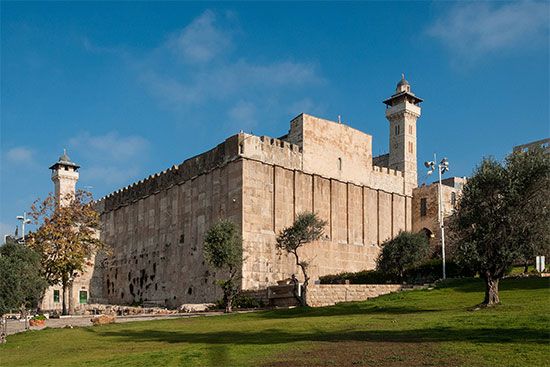
What is Cave of the Patriarchs?
The Cave of the Patriarchs, also known as the Sanctuary of Abraham or Haram al-Khalil, is a sacred site located in the West Bank city of Hebron. It is traditionally believed to be the burial place of the biblical patriarchs and matriarchs: Abraham, Sarah, Isaac, Rebekah, Leah, and Jacob.12
The site holds profound religious significance:
- Judaism: It is considered the second holiest site after the Temple Mount. According to Genesis, Abraham purchased the cave of Machpelah as a burial plot, marking his first land acquisition in Canaan.1
- Islam and Christianity: The site is a major place of pilgrimage for Muslims and Christians as well. Both the Hebrew name (Hevron) and Arabic name (Al-Khalil) refer to Abraham as the “friend of God”.1
The complex features a massive enclosure built by Herod the Great, which remains the only fully intact Herodian structure today. Following the 1994 massacre of Muslim worshippers by a Jewish extremist, the site was partitioned to separate Jewish and Muslim prayer areas.1
Who are the specific biblical figures buried in the Cave of the Patriarchs?
According to the Hebrew Bible, the Cave of the Patriarchs (also known as the cave of Machpelah) is the burial site of three couples, consisting of the following biblical patriarchs and matriarchs:
The site is located in the West Bank city of Hebron and is considered a place of significant religious importance for Judaism, Christianity, and Islam.1
Why is the city of Hebron considered significant in the history of the Middle East?
The city of Hebron is a site of profound historical and religious significance in the Middle East, serving as a major center for Judaism, Christianity, and Islam.41
Religious and Historical Importance
Hebron is one of the four holy cities of Judaism and is revered in Islam as one of the four holiest cities alongside Mecca, Medina, and Jerusalem.4 Its significance is primarily tied to the Cave of the Patriarchs, the burial place of the biblical patriarchs and matriarchs Abraham, Sarah, Isaac, Rebekah, Leah, and Jacob.lical-figure), and Jacob. Historically, the city served as the capital of David for seven and a half years before he captured Jerusalem.51
Modern Context and Conflict
In modern times, Hebron has become a focal point of the Israeli-Palestinian conflict. Following the Six-Day War in 1967, the city came under Israeli occupation, and the subsequent return of Jewish settlers to the city has led to persistent friction. The 1994 massacre of Muslim worshippers at the Cave of the Patriarchs by a Jewish extremist remains a defining moment of violence, leading to the partition of the site and ongoing security tensions.15
What are the main differences between the Jewish and Islamic traditions regarding this site?
The Cave of the Patriarchs holds deep religious significance for both Jews and Muslims, with traditions that emphasize different spiritual connections to the site.
Jewish Traditions
In Jewish belief, the site is rooted in the Hebrew Bible, which recounts Abraham purchasing the cave as a burial plot for his wife, Sarah. This transaction represents the first instance of land ownership by Abraham’s descendants in Canaan. Beyond the biblical narrative, the Midrash text Pirkei de-Rabbi Eliezer suggests that Abraham discovered the burial place of Adam and Eve within the cave. Furthermore, the Zohar, a foundational text of Jewish mysticism, posits that the cave contains the entrance to the Garden of Eden.
Islamic Traditions
Islamic lore focuses on the construction and spiritual history of the site. According to these accounts, Solomon commanded jinn to build the edifice surrounding the cave. Additionally, some traditions regarding the Isrāʾ—the night journey of Muhammad from Mecca to Jerusalem—suggest that the Prophet visited the site during his travels.
Sources
- Cave of the Patriarchs — Encyclopædia Britannica
- Abraham - The Genesis narrative in the light of recent scholarship of Abraham — Encyclopædia Britannica
- Rebekah — Encyclopædia Britannica
- Hebron: Top Questions — Encyclopædia Britannica
- Hebron — Encyclopædia Britannica
Published on · 3 min read