Chongming Island
Chongming Island serves as a vital resource for the Shanghai municipality through its significant contributions to both agriculture and land development.
How does Chongming Island contribute to Shanghai’s ecology and economy?
Chongming Island serves as a vital resource for the Shanghai municipality through its significant contributions to both agriculture and land development.
Economic Contribution
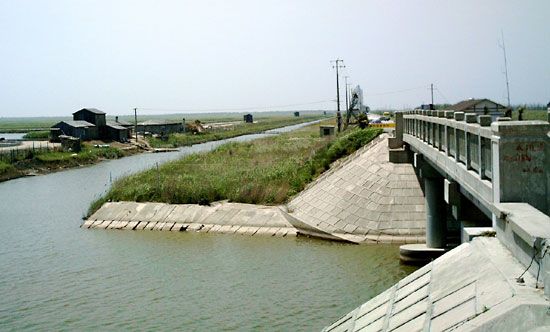
Following extensive land reclamation efforts that began in the late 1950s, the island was transformed from a struggling fishing outpost into a productive agricultural hub. By utilizing irrigation and drainage systems on diked mudflats, the island initially focused on cotton cultivation to manage soil salinity. Once the land was stabilized, it transitioned to producing essential goods—including grains, fruits, vegetables, and poultry—to supply the urban markets of nearby Shanghai.1
Ecological and Land Development
The island’s formation is a natural process driven by the accumulation of silt carried by the Yangtze River. To protect this land from flooding and environmental instability, significant infrastructure projects have been implemented, including the construction of protective dikes and the planting of tree belts. These efforts have successfully reclaimed extensive mudflat areas, integrating them into the region’s productive landscape.1
What are the main industries and economic activities on Chongming Island?
The economic activities on Chongming Island have evolved significantly over time, transitioning from subsistence-based survival to a structured agricultural system that supports the Shanghai municipality.
Historical Economic Context
Historically, the island’s economy was limited. By the time of World War II, the population relied primarily on fishing and the cultivation of soybeans to survive. Earlier in its history, the island also served as a site for salt production, with a salt directorate established as early as 1222.1
Modern Agricultural Industries
Following land reclamation efforts that began in the late 1950s, the island’s economy shifted toward large-scale agriculture:
- Cotton Cultivation: Initially used as a primary crop on reclaimed mudflats, cotton was essential for managing soil salinity due to its resistance to alkaline conditions.1
- Food Production: Once the soil was stabilized, the island transitioned to producing a variety of goods for the urban markets of Shanghai, including:
- Grains
- Fruits
- Vegetables
- Poultry1
These activities are supported by extensive irrigation and drainage infrastructure developed to maintain the productivity of the reclaimed land.1
How was Chongming Island formed and how has it changed over time?
Chongming Island was formed by the continuous accumulation of silt deposited by the Yangtze River as it flows from its upper and middle courses into the estuary. Initially appearing as three distinct sandbanks in the 7th century, these landmasses gradually merged to form the island.1
Historical Evolution
The island’s development has been marked by significant administrative and environmental changes:
- Early Settlement: A garrison was established in the 10th century, followed by the creation of a salt directorate in 1222. It achieved prefectural status under the Yuan dynasty before being demoted to county status during the Ming dynasty.1
- Environmental Challenges: Historically, the island was highly susceptible to flooding, necessitating the construction of protective dikes. By the time of World War II, the population had declined significantly, relying on subsistence fishing and soybean farming.1
Modern Transformation
Post-1949, large-scale reclamation efforts transformed the island. Engineers repaired sea defenses and planted protective tree belts. Beginning in 1959, extensive mudflats were diked and equipped with irrigation systems. By initially planting salt-resistant cotton, the land was successfully reclaimed and eventually converted into a productive agricultural hub for Shanghai.1
How is Chongming Island connected to mainland Shanghai?
The provided search results do not contain information regarding the specific infrastructure or transportation links connecting Chongming Island to mainland Shanghai. While the articles discuss the island’s history, agricultural development, and general geography, they do not mention bridges, tunnels, or ferry services that facilitate travel between the island and the mainland.
Sources
- Chongming Island — Encyclopædia Britannica
- bridge - Danyang-Kunshan Grand Bridge — Encyclopædia Britannica
Published on · 3 min read