Churchill River
The Churchill River is the largest river in Labrador, which is the mainland portion of the province of Newfoundland and Labrador, Canada.
Where is the Churchill River located in Newfoundland and Labrador, Canada?
The Churchill River is the largest river in Labrador, which is the mainland portion of the province of Newfoundland and Labrador, Canada.12
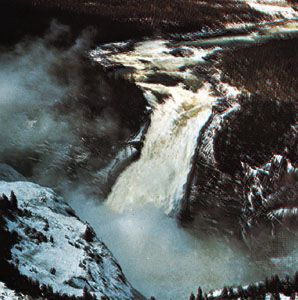
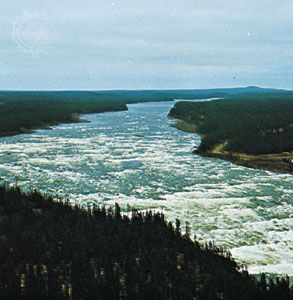
The river originates from several river-lakes located on the central plateau of western Labrador, a region known for its extensive iron-ore deposits. From there, it flows eastward for more than 200 miles (300 km) to Churchill Falls, a site of major hydroelectric power generation. Beyond the falls, the river continues through a deep canyon for another 250 miles (400 km), passing near Goose Bay before reaching its mouth at Lake Melville (Hamilton Inlet), which connects to the Atlantic Ocean](https://www.britannica.com/place/Lake-Melville) (Hamilton Inlet), which connects to the Atlantic Ocean.132
What role does the Churchill River play in hydroelectric power generation?
The Churchill River is a vital source of hydroelectric power in Canada, characterized by a series of cataracts and a significant water discharge of 30,000 to 40,000 cubic feet per second.15
Key aspects of its role in power generation include:
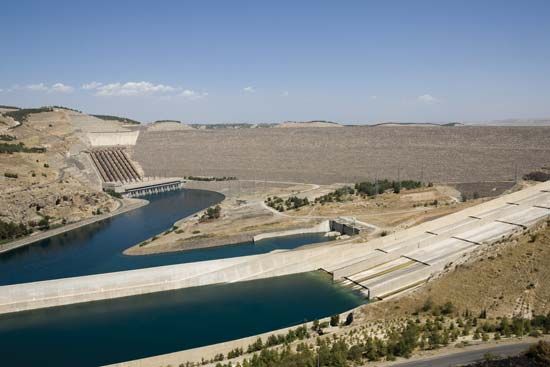
- Churchill Falls Power Project: Completed in 1974, this facility is one of the largest hydroelectric installations in the world. It leverages the river’s 245-foot drop at Churchill Falls to generate massive amounts of electricity.165
- Industrial Support: The river’s hydroelectric capacity, including an earlier plant at Menihek (1954) on the Ashuanipi stream, provides essential power for mining establishments in western Labrador.1
- Provincial Infrastructure: The publicly owned corporation Newfoundland and Labrador Hydro manages the Churchill Falls installation. Much of the energy produced there is sold to Hydro-Québec under a long-term contract.6
The river’s steep descent—dropping 1,100 feet within a 16-mile stretch—makes it an exceptionally efficient resource for energy production.5
How long is the Churchill River, and what are its major tributaries?
The Churchill River in Labrador has a total length of more than 450 miles (700 km). It flows for over 200 miles (300 km) from its origin on the central plateau of western Labrador to Churchill Falls, and continues for another 250 miles (400 km) through a deep canyon to its mouth at Lake Melville.1
Regarding its tributaries, the provided search results identify the Ashuanipi as a source stream of the river, where a hydroelectric plant was established in 1954. The search results do not provide a comprehensive list of other major tributaries.1
What indigenous groups have historically lived along the Churchill River?
The Innu people have historically inhabited the vast Labrador plateau, a region encompassing the area around the Churchill River.
The Innu are traditionally divided into two groups based on their environmental adaptations:
- Naskapi (Northern Innu): These groups lived on the Labrador plateau, hunting caribou and supplementing their diet with fish and small game. They referred to themselves as Nenenot, or “true, real people.”8
- Montagnais (Southern Innu): These groups traditionally occupied the forested areas paralleling the northern shores of the Gulf of St. Lawrence, subsisting on moose, salmon, eel, and seal.8
Additionally, the Inuit have a historical presence in the broader region, with populations residing in settlements north of the Hamilton Inlet and in communities such as Akudlik near the mouth of the Churchill River in Manitoba.79
Sources
- Churchill River — Encyclopædia Britannica
- Quebec - Resources and power — Encyclopædia Britannica
- Labrador — Encyclopædia Britannica
- Newfoundland and Labrador - Relief, drainage, and soils — Encyclopædia Britannica
- Churchill Falls — Encyclopædia Britannica
- Newfoundland and Labrador - Resources and power — Encyclopædia Britannica
- Churchill — Encyclopædia Britannica
- Newfoundland and Labrador - Labrador — Encyclopædia Britannica
- Innu — Encyclopædia Britannica
Published on · 2 min read