Ems River
Sorry, the Britannica knowledge base does not contain information regarding the specific tributaries of the Ems River.
What are some of the main tributaries of the Ems River?
Sorry, the Britannica knowledge base does not contain information regarding the specific tributaries of the Ems River.
What are the major cities and towns situated along the Ems River?
The Ems River flows through northwestern Germany, passing through the states of North Rhine-Westphalia and Lower Saxony.
Key locations situated along or associated with the river include:
- Emden: Located at the river’s estuary, this city sits immediately north of the Dollart, a baylike enlargement where the river flows before reaching the North Sea before reaching the North Sea.1
- Lingen: This town marks the southern boundary of the Emsland region, which extends northward along the lower course of the river toward the estuary.1
It is important to note that while the town of Bad Ems is located in western Germany, it is situated southeast of Koblenz and is distinct from the Ems River in northwestern Germany.2
Where is the Ems River located in Germany, and what are its main features?
The Ems River is located in northwestern Germany, rising on the southern slope of the Teutoburger Forest. It flows for 230 miles (371 km) in a generally northwest and north direction through the states of North Rhine-Westphalia and Lower Saxony.
Key Features
- Course and Estuary: The river terminates at the Dollart, a baylike enlargement of its estuary, before passing Emden and the island of Borkum to reach the North Sea. Its flow is characterized by a marked winter maximum and summer minimum.1
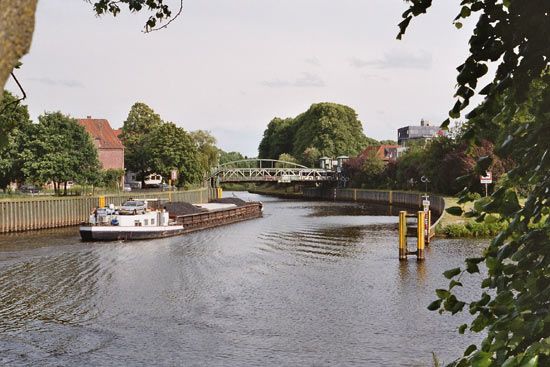
- Commercial Importance: Between 1892 and 1899, the river was canalized to integrate with the Dortmund-Ems Canal. This system provides a vital waterborne outlet for the Ruhr industrial district, facilitating the transport of coal, coke, and raw materials.14
- Regional Impact: The river defines the Emsland region, where its floodplain and surrounding areas have been reclaimed for agriculture and petroleum extraction.2
How has the Ems River historically been used for transportation and commerce?
Historically, the Ems River has served as a critical artery for German commerce, particularly following its canalization between 1892 and 1899. This engineering effort integrated the river into the Dortmund-Ems Canal system, establishing a vital waterborne link between the Ruhr industrial district and the North Sea at Emden.14
The waterway facilitates a robust exchange of goods:
- Northward Traffic: Primarily consists of coal, coke, stone, and gravel originating from the Ruhr and Aachen coalfields.14
- Southward Traffic: Primarily consists of imported raw materials, such as iron ore, as well as grain and sugar.14
The canal system further enhances connectivity by linking the Ems to the Mittelland Canal and the Rhine River, ensuring that industrial goods can be transported entirely within German territory.14
Sources
- Ems River — Encyclopædia Britannica
- Emsland — Encyclopædia Britannica
- Ems — Merriam-Webster
- Dortmund-Ems Canal — Encyclopædia Britannica
Published on · 2 min read