Common Loon
The common loon (Gavia immer) is an aquatic bird that functions primarily as a predator within its lake and coastal ecosystems. These birds are highly…
What role do common loons play in their ecosystem?
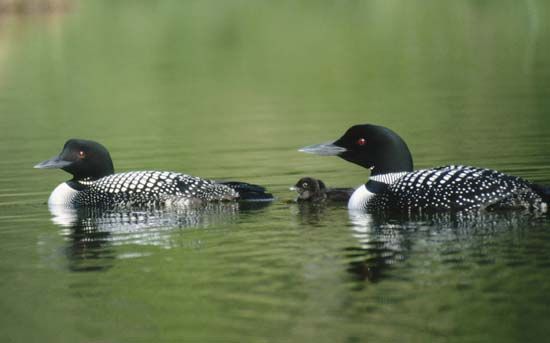
The common loon (Gavia immer) is an aquatic bird that functions primarily as a predator within its lake and coastal ecosystems. These birds are highly adapted for life in the water, capable of diving to depths of 60 meters (200 feet) to hunt for their primary food sources, which include fishes, crustaceans, and insects.1
By consuming these aquatic organisms, common loons play an active role in the food web of northern wooded lakes and coastal environments. Beyond their dietary habits, they are territorial animals, with males using distinct vocalizations—such as the “yodel”—to defend their breeding grounds from other loons. While they are iconic symbols of the wilderness, the provided information does not detail specific broader ecological impacts beyond their status as aquatic predators.12
Where can common loons be found, and what are their preferred habitats?
Common loons (Gavia immer) are primarily found in North America, where they are the most abundant loon species. Their distribution varies significantly by season:12
- Summer Breeding Range: They inhabit northern wooded lakes across Canada, Alaska, and parts of the northern United States, as well as coastal areas of western and southern Greenland.2
- Winter Range: During the winter, they migrate to coastal environments, including the Atlantic and Pacific coasts of the United States, Mexico’s Baja California peninsula, and the western coasts of several European countries.2
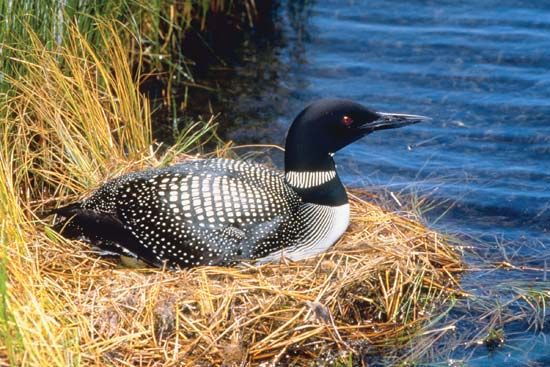
Preferred Habitats Common loons are almost entirely aquatic birds. Because they are strong fliers but require a broad expanse of water to achieve takeoff, they are typically restricted to large lakes during the breeding season. They build their nests as heaps of vegetation located at the water’s edge. Their physical structure—with legs positioned far back on the body—makes walking on land awkward, further reinforcing their reliance on aquatic environments for survival and movement.1
How do common loons communicate, and what are their typical vocalizations?
Common loons (Gavia immer) are well-known for their haunting, distinctive vocalizations, which are capable of carrying long distances across the water. These calls serve various social and survival functions:12
- Wail: This mournful cry is used to call to a mate and locate them through their response.12
- Yodel: A complex call used by males in the aggressive defense of their territory. Each male possesses a unique version of this call that remains consistent year after year.12
- Tremolo: A series of 8–10 notes that resembles human laughter. It is typically heard in the spring during the defense of territory or chicks. Notably, this is the only call a common loon makes while in flight, and it is often combined with other vocalizations.12
- Hoot (or “kwuuk”): A softer call used by parents to communicate with chicks that have strayed too far away.12
These vocalizations are so iconic that they have influenced various cultural interpretations, such as being viewed as an omen of death by the Ojibwa or a spirit of a warrior by the Cree.12
What are the breeding and nesting habits of common loons?
Common loons (Gavia immer) exhibit specific breeding and nesting behaviors adapted to their aquatic lifestyle. During the breeding season, they are typically found in pairs on northern wooded lakes.12
Nesting Habits
- Nest Construction: Loons build their nests as simple heaps of vegetation located directly at the water’s edge, allowing for easy access to the lake.1
- Clutch Size: Females typically lay two olive-brown spotted eggs, though rarely three may be laid.1
- Incubation: Both parents share the responsibility of incubating the eggs.1
Development and Care
- Hatching: The eggs hatch in approximately 30 days.1
- Precocial Nature: Common loons are precocial birds, meaning the chicks are well-developed at birth. As soon as their down is dry, they enter the water with their parents.1
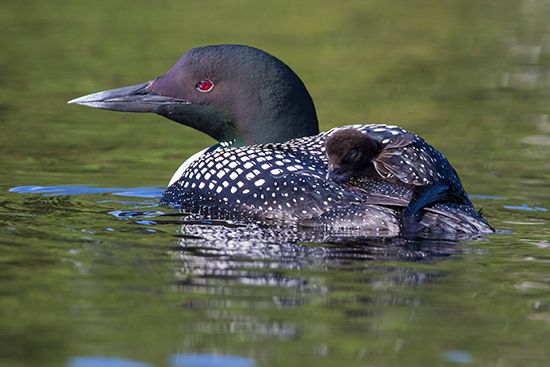
- Parental Care: Parents are highly attentive, often allowing the young to swim on their backs for protection and rest. They also use specific vocalizations, such as the “hoot” or “kwuuk,” to communicate with and guide chicks that have strayed too far.12
Sources
- loon — Encyclopædia Britannica
- common loon — Encyclopædia Britannica
- common loon — Merriam-Webster
Published on · 3 min read