Cormorant
There are approximately 26 to 30 species of cormorants, which are glossy black water birds belonging to the family Phalacrocoracidae. While they share common…
What different species of cormorants exist, and how do they differ?
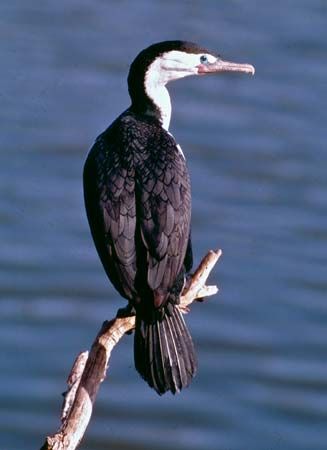
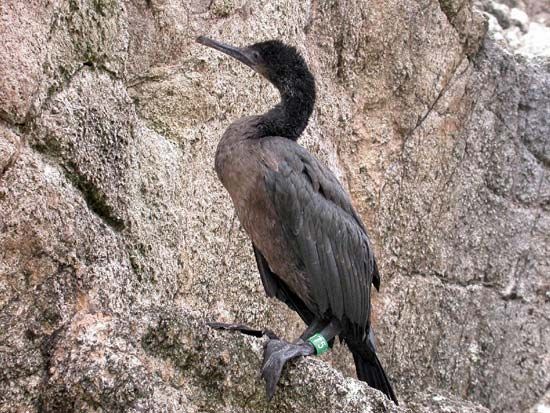
There are approximately 26 to 30 species of cormorants, which are glossy black water birds belonging to the family Phalacrocoracidae. While they share common traits such as a long hook-tipped bill, patches of bare skin on the face, and a small gular sac, they differ in size, distribution, and specific ecological roles.
Key species include:
- Great Cormorant (Phalacrocorax carbo): The largest and most widespread species, reaching up to 100 cm (40 inches) in length. It is found globally, ranging from Canada and Iceland to Eurasia, Australia, and New Zealand.1
- Japanese Cormorant (P. capillatus): Slightly smaller than the great cormorant, this species is also known for being trained for fishing.1
- Peruvian Cormorant (Guanay, P. bougainvillii) and Cape Cormorant (P. capensis): These are noted primarily for their importance as producers of guano, which is highly valued as a fertilizer.1
Cormorants are specialized for underwater swimming and possess wettable plumage that traps little air, allowing them to submerge easily from the surface.23
Where are cormorants typically found, and what habitats do they prefer?
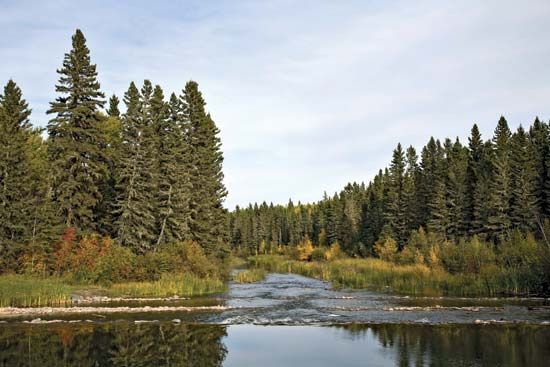
Cormorants are widely distributed water birds that typically inhabit seacoasts, lakes, and various river systems. Unlike some other marine birds that prefer remote oceanic islands, cormorants are generally found closer to continental landmasses.16
Their habitat selection is primarily driven by the availability of safe nesting sites and proximity to suitable feeding waters. Because they are colonial breeders, they require areas that are free from mammalian predators. Their preferred nesting locations include:6
- Cliffs: Often used for nesting, sometimes in dispersed patterns where space is limited.6
- Trees and Bushes: They frequently nest in trees or bushes, particularly those standing in or near water.16
- Islands: They commonly utilize islands located within lakes or offshore from continental coasts.6
When feeding, cormorants are specialized for underwater swimming, allowing them to pursue fish in both shallow and deeper waters. They are highly adaptable to various aquatic environments, ranging from inland freshwater bodies to coastal marine zones, provided they have access to protected sites for resting and reproduction.716
What adaptations do cormorants have for their aquatic lifestyle?
Cormorants possess several specialized adaptations that make them highly efficient for an aquatic lifestyle and underwater hunting:
- Wettable Plumage: Unlike many other water birds that have water-repellent feathers to maintain buoyancy, cormorants have large contour feathers that are wettable and trap very little air. This reduces their buoyancy, allowing them to submerge easily from the surface without needing an aerial dive.1
- Diving Efficiency: Their body structure is optimized for pursuing fish underwater. While their dives are typically short—often lasting less than half a minute—they are capable of reaching significant depths to hunt both free-swimming and bottom-dwelling fish.21
- Specialized Respiration: To facilitate underwater activity, cormorants have evolved to close their external nostrils. Instead, they breathe through secondary external nostrils located at the angle of the mouth, where a horny flap known as the jugal operculum allows air to enter when the bill is closed.1
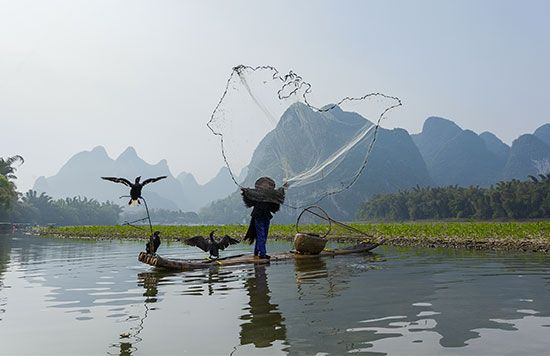
- Post-Dive Maintenance: Because their feathers become waterlogged, cormorants are frequently observed in a characteristic spread-wing posture. This behavior allows them to dry their wings after hunting.1
How do cormorants hunt and what is their primary diet?
Cormorants are specialized underwater swimmers that primarily hunt by actively pursuing their prey. Their diet consists mainly of fish, often those of little commercial value, though some species also consume mollusks and other invertebrates.12
When hunting, cormorants utilize two main strategies:
- Individual Pursuit: They dive and swim underwater to chase down free-swimming or bottom-dwelling fish.2
- Cooperative Fishing: When targeting schooling fish, cormorants often engage in mass fishing. A flock will form a long line at a right angle to the fish’s movement, effectively herding the prey. As the line advances, birds that fall behind will fly forward to land at the front of the formation, maintaining the pressure on the school.2
Unlike anhingas, which lie in wait to stab their prey, cormorants rely on their agility and speed to capture fish directly. Their diving behavior is closely linked to water depth, with most dives lasting less than 30 seconds, followed by a brief period of rest at the surface.2
Sources
- Cormorant — Encyclopædia Britannica
- Pelecaniform - Feeding ecology — Encyclopædia Britannica
- caddisfly - Annotated classification — Encyclopædia Britannica
- Pelecaniform - Distinguishing characteristics — Encyclopædia Britannica
- scorpion - Distinguishing taxonomic features — Encyclopædia Britannica
- Coraciiform - Habitat selection and ecological diversity — Encyclopædia Britannica
- Pelecaniform - Reproduction — Encyclopædia Britannica
- Integument - Birds — Encyclopædia Britannica
Published on · 4 min read