Crustacean
Yes, there are several land-dwelling crustaceans, though they represent a small portion of the group's total diversity. While most crustaceans are aquatic…
Are there any land-dwelling crustaceans, and how have they adapted to life on land?
Yes, there are several land-dwelling crustaceans, though they represent a small portion of the group’s total diversity. While most crustaceans are aquatic, various species have successfully colonized terrestrial environments through significant evolutionary adaptations.12
Terrestrial Adaptations
To survive away from water, these animals have developed specialized mechanisms to manage respiration and prevent dehydration:
- Respiration: Land-dwelling decapods, such as land crabs, have evolved larger, more vascularized branchial chambers that allow them to breathe air. These chambers are often specialized to keep the gills moist, which is essential for gas exchange. Other terrestrial crustaceans, such as wood lice, utilize invaginated structures known as pseudotracheae for respiration.32
- Desiccation Resistance: Terrestrial decapods have evolved mechanisms to protect against overheating and water loss while regulating internal fluid concentrations. Because many terrestrial crustaceans lack a waxy, water-repellent cuticle, they often inhabit damp environments like leaf mold, soil, or areas beneath logs and stones to minimize the risk of drying out.24
- Reproduction: Despite their terrestrial lifestyle, many land crabs must return to the water to spawn, as their larvae require an aquatic environment to hatch and develop.12
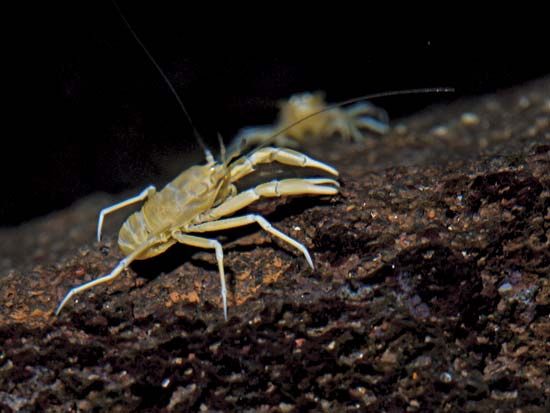
What are the main characteristics that define crustaceans as a group of arthropods?
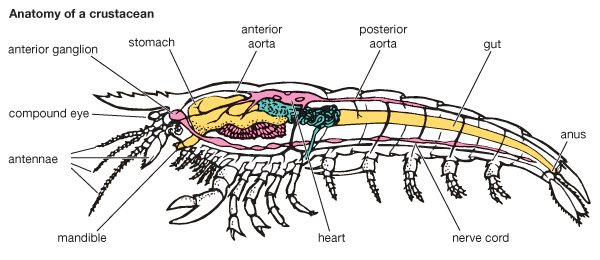
Defining the subphylum Crustacea is challenging because the group exhibits immense diversity in form and lifestyle. However, as members of the phylum Arthropoda, they share fundamental characteristics common to all arthropods, alongside specific traits that distinguish them from other groups.47
Key Characteristics
- Segmented Body and Exoskeleton: Like all arthropods, crustaceans possess a segmented body and a protective, nonliving exoskeleton (or cuticle) composed of chitin and protein, often reinforced with calcium salts. This exoskeleton necessitates a process called molting (ecdysis) to allow for growth.87
- Jointed Appendages: The name “arthropod” means “jointed feet,” reflecting the presence of paired, jointed appendages. In crustaceans, these appendages are highly diverse and are thought to have evolved from a common multibranched or double-branched (biramous) limb structure.79
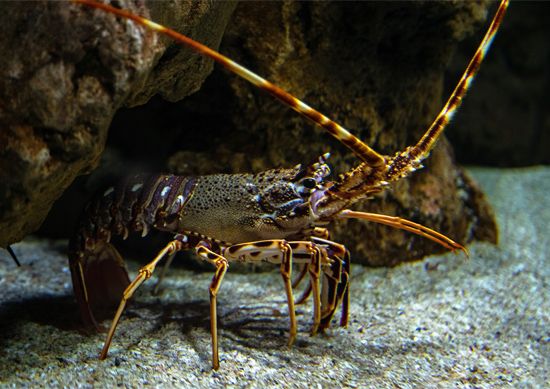
- Distinctive Head Appendages: A primary feature distinguishing crustaceans from other arthropods is the presence of two pairs of sensory appendages in front of the mouth: the antennules (antennae 1) and the antennae (antennae 2). Additionally, they possess paired appendages near the mouth that function as jaws, known as mandibles4.49
- Body Plan: While the number of body segments (somites) varies, many crustaceans follow a plan where segments are fused to form a head, thorax, and abdomen. Many also feature a carapace—a protective shield arising from the head that may cover the thorax or enclose the body.101
How have crustaceans adapted to various aquatic environments, from oceans to freshwater?
Crustaceans have successfully colonized a vast array of aquatic environments, from the open ocean and deep-sea trenches to freshwater lakes and rivers, by evolving specialized physiological and behavioral mechanisms to manage their internal environments.1
Osmoregulation and Salinity Balance
Because their respiratory surfaces are permeable, crustaceans must manage the osmotic pressure caused by differences in salt concentration between their body fluids and the surrounding water. To survive in varying salinities, they employ two primary strategies:3
- Osmoconformers: These organisms allow their internal osmotic concentration to change to match their environment.3
- Osmoregulators: These crustaceans maintain constant internal salt concentrations despite external fluctuations. This process is energy-intensive and involves the active transport of inorganic ions, such as sodium and chloride, through specialized organs including the gills and antennal glands (often called “green glands”).312
In freshwater environments, where the surrounding water is less concentrated than their body fluids, crustaceans must actively pump ions into their bodies and produce large quantities of dilute urine to excrete excess water.3
Respiratory Adaptations
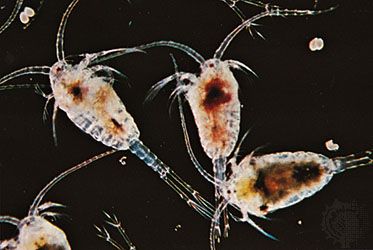
Gas exchange is a critical challenge in aquatic life. While smaller crustaceans like copepods rely on diffusion across their thin integument, larger species utilize specialized gills.13
- Ventilation: Crustaceans often use specialized appendages to create respiratory currents, ensuring a constant flow of water over their gills.1413
- Efficiency: In oxygen-poor environments, some species can increase their ventilation rates, though this comes at a higher metabolic cost. Conversely, some species, such as the square-backed crab (Sesarma), adapt to unfavorable conditions by reducing their activity and oxidative metabolism.14
These diverse adaptations allow crustaceans to thrive in niches ranging from high-altitude mountain lakes to the extreme pressures of oceanic trenches.1
What roles do crustaceans play in aquatic ecosystems and food chains?
Crustaceans are fundamental components of aquatic ecosystems, occupying diverse roles that sustain complex food webs and ecological interactions.17
Primary Roles in Food Chains
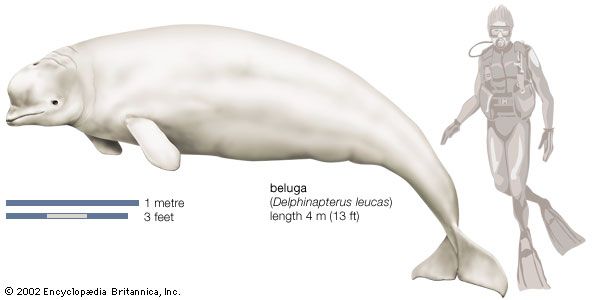
- Primary Consumers: Planktonic crustaceans, such as copepods and krill, serve as a critical link in the food chain by grazing on microscopic plants. They are so numerous that they often form the primary food source for larger animals, including fish, seabirds, and whales.171819
- Predators: Many crustaceans, particularly crabs, act as significant predators. Their predatory behavior drives evolutionary adaptations in their prey; for example, many marine mollusks have developed thick, ornamented shells to protect themselves from the powerful pincers of crabs.17
- Benthic Scavengers and Prey: Bottom-dwelling (benthic) crustaceans serve as a vital food source for various fish and whale species, while simultaneously helping to process organic matter on the seafloor.17
Ecological Interactions
- Symbiosis: Crustaceans often engage in complex mutualistic relationships. For instance, hermit crabs may form associations with sea anemones, providing the anemones with transport while receiving protection from predators in return.1
- Parasitism: Some crustaceans function as parasites, infesting other aquatic animals ranging from sea anemones to whales. Additionally, certain freshwater species serve as intermediate hosts for flatworms, such as the lung fluke.17
Sources
- crustacean - Distribution and abundance — Encyclopædia Britannica
- malacostracan - Respiration — Encyclopædia Britannica
- decapod — Encyclopædia Britannica
- crustacean — Encyclopædia Britannica
- crustacean - Evolution and paleontology — Encyclopædia Britannica
- arthropod - Excretory system and water balance — Encyclopædia Britannica
- crustacean - Exoskeleton — Encyclopædia Britannica
- crustacean - Appendages — Encyclopædia Britannica
- arthropod — Encyclopædia Britannica
- malacostracan - Size range and diversity of structure — Encyclopædia Britannica
- crustacean - General features — Encyclopædia Britannica
- Respiratory system - Gills of invertebrates — Encyclopædia Britannica
- Biosphere - Salinity — Encyclopædia Britannica
- Endocrine system - Osmoregulation — Encyclopædia Britannica
- crustacean - The respiratory system — Encyclopædia Britannica
- crustacean - Size range and diversity of structure — Encyclopædia Britannica
- crustacean - Ecology — Encyclopædia Britannica
- plankton - Zooplankton — Encyclopædia Britannica
- cnidarian - Associations — Encyclopædia Britannica
- crustacean - Importance to humans — Encyclopædia Britannica
Published on · 4 min read