Danube River
The Danube River serves as a vital economic artery for the ten countries along its course, primarily functioning as a major route for freight transport.…
What are the main economic and transportation uses of the Danube River in modern times?
The Danube River serves as a vital economic artery for the ten countries along its course, primarily functioning as a major route for freight transport. Since World War II, navigation has been significantly enhanced through dredging and the construction of key infrastructure, such as the Danube–Black Sea Canal and the Main–Danube Canal, which connects the river to the Rhine and the North Sea.1
Beyond transportation, the river is essential for:
- Hydroelectricity: The river is tapped for power, most notably through the Iron Gate project, which also improved navigation in a historically difficult stretch.1
- Industrial and Residential Use: The water supports industrial processes and provides municipal water supplies for major cities like Vienna, Budapest, and Belgrade.1
- Agriculture: The river facilitates irrigation in regions across Slovakia, Hungary, Serbia, and Bulgaria.1
While historically significant for fishing, these activities have declined due to pollution, which also impacts the river’s suitability for drinking and irrigation.1
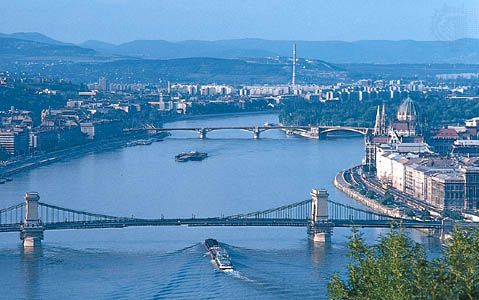
What is the geographical course of the Danube River, and which countries does it flow through?
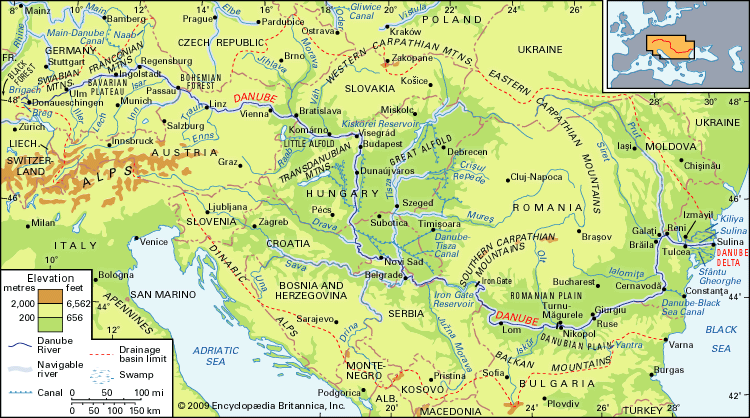
The Danube River originates in the Black Forest of Germany, where the Breg and Brigach streams unite at Donaueschingen. From there, it flows eastward for approximately 1,770 miles (2,850 km) before emptying into the Black Sea via a vast delta.5
The river’s course is divided into three distinct sections:
- Upper Course: From the source to the Hungarian Gates, passing through Germany and Austria.5
- Middle Course: From the Hungarian Gates to the Iron Gate gorge, traversing Slovakia, Hungary, Croatia, Serbia, and Romania.5
- Lower Course: From the Iron Gate to the Black Sea, flowing past Bulgaria and Romania, with a brief stretch touching the territory of Moldova.5
In total, the Danube flows through or borders ten countries: Germany, Austria, Slovakia, Hungary, Croatia, Serbia, Romania, Bulgaria, Moldova, and Ukraine. Its journey concludes as it spreads into a delta, splitting into three main channels—the Chilia, Sulina, and Sfântu Gheorghe—before reaching the sea.15
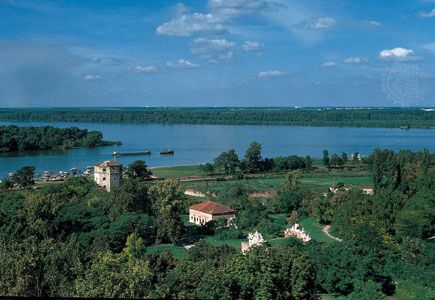
How has the Danube River’s role in transportation and trade evolved from ancient times to the present day?
The role of the Danube River in transportation and trade has evolved significantly from a strategic military barrier to a central artery for international commerce.
Ancient and Medieval Foundations
In antiquity, the river served as a vital boundary for the Roman Empire, where a fleet patrolled its waters and fortresses protected the frontier. While Greek sailors engaged in trade along the lower course as early as the 7th century BCE, the river’s primary function for centuries remained defensive. During the Middle Ages and the expansion of the Ottoman Empire, the river continued to be defined by a string of fortresses used for military control.3
The Shift to Trade
The transition toward a commercial waterway began in the 18th and 19th centuries. The Habsburg dynasty recognized the river’s economic potential, and by 1830, the first riverboat trip from Vienna to Budapest signaled the end of the Danube’s role as a primary defensive line. This era saw the rise of international cooperation, formalized by agreements like the Treaty of Paris, which established the first Danubian Commission to supervise the river as an international waterway.3
Modern Integration
In the 20th and 21st centuries, the Danube became a fully integrated economic corridor. Following World War II, navigation was modernized through extensive dredging and the construction of major infrastructure, such as the Iron Gate project, which improved both power generation and navigation. The completion of the Main–Danube Canal in 1992 was a landmark achievement, linking the Danube to the Rhine and providing a continuous route from the North Sea to the Black Sea. Today, the river is the most important freight transport route for the ten countries along its banks, supporting industrial growth and regional connectivity.167
What are some of the most important historical events or conflicts associated with the Danube River?
The Danube River has served as a critical theater for military conflict and political maneuvering throughout history, acting as both a defensive barrier and a strategic prize for competing empires.
Ancient and Medieval Eras
In antiquity, the river functioned as the northern frontier of the Roman Empire, where a dedicated fleet patrolled its waters and fortified settlements—such as Vindobona (Vienna) and Aquincum (Budapest)—anchored the border. During the Middle Ages, these fortresses remained vital, and new structures like the castle at Werfenstein were built to maintain control over the region.3
The Ottoman-Habsburg Conflicts
The Danube was central to the centuries-long struggle between the Ottoman Empire and the Habsburg dynasty. A pivotal moment occurred during the Siege of Vienna in 1683, where the failure of the Ottoman advance triggered a major European coalition. Subsequent conflicts, including the wars of the Holy League, led to a series of treaties—such as the Treaty of Carlowitz (1699) and the Treaty of Belgrade—that gradually pushed the Ottoman boundary back along the river.79
The Napoleonic Era
During the Napoleonic Wars, the river was the site of the Battle of Ulm in 1805. Napoleon’s forces crossed the Danube to encircle Austrian troops, leading to a decisive French victory that paved the way for his entry into Vienna and the subsequent Battle of Austerlitz.10
Sources
- Danube River - The economy — Encyclopædia Britannica
- canals and inland waterways - Europe — Encyclopædia Britannica
- Danube River - History — Encyclopædia Britannica
- Danube River - Hydrology of Danube River — Encyclopædia Britannica
- Danube River - Physiography — Encyclopædia Britannica
- canals and inland waterways - Major inland waterways of Europe — Encyclopædia Britannica
- Danube River — Encyclopædia Britannica
- Trajan’s Bridge — Encyclopædia Britannica
- Napoleonic Wars - Ulm, Austerlitz, and the Peace of Pressburg — Encyclopædia Britannica
- Ottoman Empire - Military defeats and the emergence of the Eastern Question , 1683–1792 — Encyclopædia Britannica
- decline of the Ottoman Empire - Military defeats and the emergence of the Eastern Question, 1683–1792 — Encyclopædia Britannica
Published on · 4 min read