Dawson River
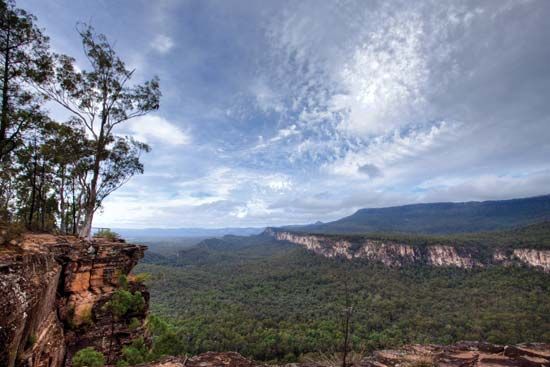
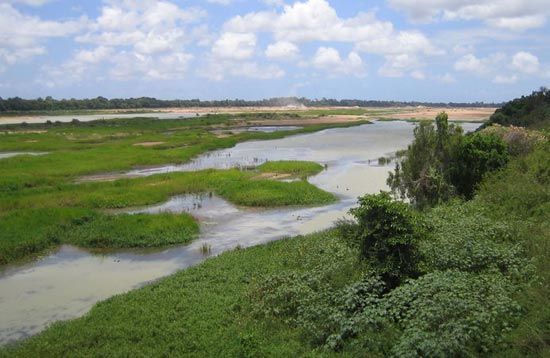
The Dawson River is a river located in eastern Queensland, Australia. It originates in the Carnarvon Range and flows for approximately 400 miles (640 km)…
What is Dawson River?
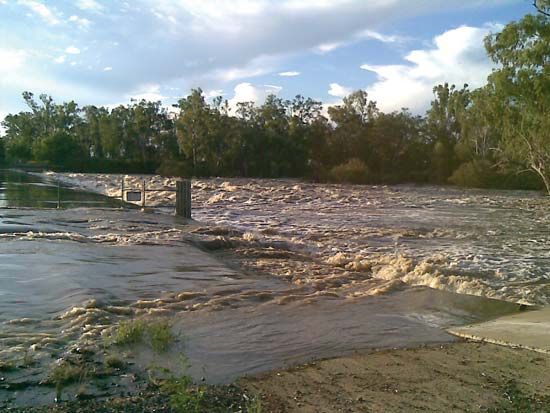
The Dawson River is a river located in eastern Queensland, Australia. It originates in the Carnarvon Range and flows for approximately 400 miles (640 km) through a valley before joining the Fitzroy River near Duaringa.1
The river was explored in 1844 by Friedrich Ludwig Leichhardt and was named in honor of Robert Dawson, one of the backers of the expedition. The Dawson Valley Irrigation Project, which began in 1923, utilizes several weirs along the river to support local cotton and dairy farming.1
Please note that “Dawson” also refers to a city in the Yukon, Canada, which is situated at the confluence of the Klondike and Yukon rivers, but this is a separate geographical entity from the Dawson River in Australia.23
What is the significance of the Dawson Valley Irrigation Project?
The Dawson Valley Irrigation Project, inaugurated in 1923, holds significant importance for the agricultural development of eastern Queensland, Australia. By constructing a series of weirs along the Dawson River, the project provides essential water management infrastructure to support the region’s primary industries.1
The project is specifically designed to sustain cotton and dairy farming within the 50-mile-wide valley, allowing for more consistent agricultural production in an area that might otherwise face water scarcity challenges. This initiative reflects the broader regional effort to utilize the Fitzroy River basin’s resources to foster economic stability through irrigation and land development.14
Who was Friedrich Ludwig Leichhardt and what was his role in exploring Australia?
Ludwig Leichhardt (1813–1848) was a Prussian-born naturalist and explorer who became one of Australia’s earliest national heroes. After studying natural science in Europe, he arrived in Sydney in 1842 to pursue his ambition of exploring the Australian interior.5
Leichhardt’s primary role in exploration included:
- The 1844–1845 Expedition: Impatient for official support, he organized a private expedition that successfully traveled from the Darling Downs to Port Essington. His return, after being presumed dead, brought him great acclaim and scientific recognition, including medals from the Royal Geographical Society.5
- Geographical Contributions: His expeditions identified extensive areas suitable for settlement and mapped numerous important streams, including the Dawson River, which he explored in 1844.51
- Final Expedition: In 1848, Leichhardt set out to cross the continent but disappeared without a trace. Despite search efforts lasting until the 1930s, his fate remains a mystery.5
His scientific contributions and dramatic disappearance cemented his legacy, later inspiring the protagonist of Patrick White’s novel Voss.5
How do river systems in Queensland support local agriculture?
In Queensland, river systems play a vital role in supporting agriculture, though their utility is often constrained by the irregularity, seasonality, and low volume of surface water in inland regions.6
To manage these challenges, the state utilizes various water infrastructure strategies:
- Irrigation Schemes: Because water is often scarce where it is most needed, irrigation is typically confined to small, targeted schemes. For example, the Dawson Valley Irrigation Project uses a series of weirs to support cotton and dairy farming. Extensive irrigation is also specifically employed in the state’s cotton industry.64
- Floodplain Agriculture: Along the lower floodplains of major rivers like the Fitzroy River, the land is used for experimental pasturing and rice farming.1
- Water Management Infrastructure: Following the mid-20th century, the government invested in large-scale irrigation and hydroelectric projects, such as the Burdekin River scheme, to improve agricultural stability.7
While these systems support production, they remain vulnerable to extreme weather. Queensland’s rivers are prone to both drought and record flooding, which can devastate crops and disrupt the transportation infrastructure essential for agricultural exports.78
Sources
- Dawson River — Encyclopædia Britannica
- Dawson — Encyclopædia Britannica
- Yukon River - Physiography and hydrology — Encyclopædia Britannica
- Fitzroy River — Encyclopædia Britannica
- Ludwig Leichhardt — Encyclopædia Britannica
- Queensland - Agriculture — Encyclopædia Britannica
- Queensland - Relief and drainage — Encyclopædia Britannica
- Queensland - Federation and the state of Queensland — Encyclopædia Britannica
- Queensland - Climate — Encyclopædia Britannica
- Fitzroy River — Encyclopædia Britannica
Published on · 3 min read