Derwent Water
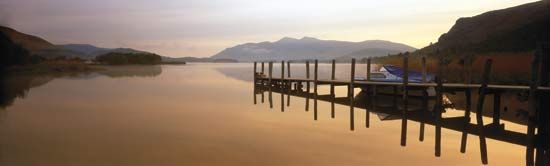
Derwent Water is a picturesque lake located within the Lake District National Park in Cumbria, England.
What is Derwent Water?
Derwent Water is a picturesque lake located within the Lake District National Park in Cumbria, England.12
Measuring approximately 3 miles (5 km) in length and up to 1.25 miles (2 km) in width, the lake reaches a maximum depth of 72 feet (22 metres). The River Derwent flows into the lake from the mountainous valley of Borrowdale and exits near the market town of Keswick, which sits at the base of the mountain Skiddaw.1
The lake is known for its well-wooded shores, many of which are managed by the National Trust and are popular destinations for tourists. It also features several islands, including Lords Island, which historically served as the residence for the earls of Derwentwater.1
What is the Lake District National Park?
The Lake District is a renowned scenic region and national park located in Cumbria, England. Established as a national park in 1951, it spans 866 square miles (2,243 square km) and encompasses the highest mountains and largest lakes in England, including Windermere and Scafell Pike.3
The region’s distinctive landscape is defined by a dome-like geologic structure shaped by glacial action, which carved out deep valleys and rock basins that now hold the area’s famous lakes. Historically, the district was shaped by Norse invasions, wool production, and mining, though it has since become a major hub for tourism, supported by improved social mobility in northern England.3
Beyond its natural beauty, the area has a rich cultural heritage, most notably as the home of the poet William Wordsworth. Today, the park remains a vital destination for visitors, with towns like Keswick serving as key centers for tourism and transportation.34
How are lakes like Derwent Water formed?
Lakes like Derwent Water are primarily formed through the process of glaciation. During the Pleistocene epoch, massive ice sheets and valley glaciers moved across the landscape, exerting powerful mechanical force that deepened existing valleys and scoured out rock basins.31
In the case of the Lake District, this glacial action was the defining factor in creating the region’s characteristic landscape. As glaciers flowed through mountain valleys, they eroded the bedrock, creating deep, elongated basins that eventually filled with water to become lakes. These are often categorized as piedmont or fjord-type lakes, which are typically long, narrow, and of substantial depth.31
Beyond direct erosion, lakes can also be formed by the damming effects of glacial activity. This occurs when glacial moraine—the debris left behind by retreating ice—or the ice masses themselves block drainage, trapping water in the newly created basins. Over time, these processes have resulted in the iconic lake-strewn valleys seen in regions like Cumbria today.513
What is the role of the National Trust in preserving landscapes?
The National Trust plays a vital role in the stewardship of the British landscape by promoting the preservation of, and public access to, land of natural beauty and sites of historic or architectural interest. Founded in 1895, the organization operates as a charitable body dedicated to protecting these assets for the benefit of the nation.8
The Trust’s approach to landscape preservation includes:
- Land Acquisition: The organization secures ownership of significant natural sites, ranging from coastal cliffs to forests and historic battlefields, ensuring they are protected from development or neglect.8
- Expert Management: A governing council and various committees staffed by experts oversee the care of these lands, buildings, and artifacts, applying professional standards to maintain their integrity.8
- Public Access: A core part of the Trust’s mission is to ensure that these preserved spaces remain open to the public, fostering a connection between people and their heritage.8
- Financial Stewardship: The Trust relies on voluntary support, including donations, legacies, and membership subscriptions, to fund its ongoing conservation efforts.8
Sources
- Derwent Water — Encyclopædia Britannica
- Derwent Water — Merriam-Webster
- Lake District — Encyclopædia Britannica
- Keswick — Encyclopædia Britannica
- glacial landform - Glaciolacustrine deposits — Encyclopædia Britannica
- lake - Basins formed by glaciation — Encyclopædia Britannica
- glacial landform - Meltwater deposits — Encyclopædia Britannica
- National Trust — Encyclopædia Britannica
Published on · 3 min read