Elk Island National Park
Elk Island National Park is a national park located in central Alberta, Canada, situated approximately 20 miles (32 km) east of Edmonton. Established in 1906…
What is Elk Island National Park?
Elk Island National Park is a national park located in central Alberta, Canada, situated approximately 20 miles (32 km) east of Edmonton. Established in 1906 as a game preserve, it spans 75 square miles (194 square km) and serves as a vital wildlife refuge.123
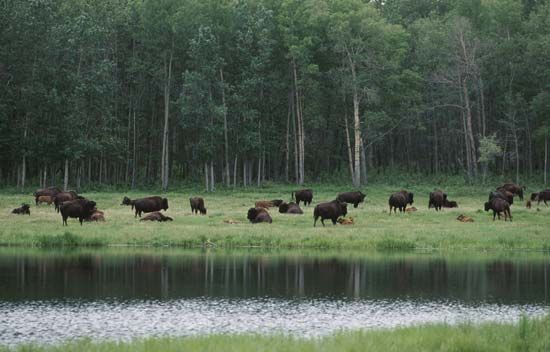
The park is primarily forested but includes designated areas for prairie grazing. It is a fenced enclosure that plays a significant role in conservation, protecting a large herd of buffalo, as well as wapiti, deer, and moose. Additionally, the park is home to approximately 200 species of birds, and Astotin Lake serves as its primary resort area for visitors. As one of Alberta’s five national parks, it is frequently utilized for recreational activities such as hiking and bird-watching.12
How does the park help with bison conservation?
Elk Island National Park contributes to bison conservation by serving as a protected wildlife refuge for a large herd of these animals. Established in 1906 as a game preserve, the park utilizes a fenced enclosure to safeguard the herd, providing a controlled environment that helps ensure the survival of the species.1
This approach is part of a broader effort by conservationists to protect remaining bison populations in government-managed preserves, zoos, and ranches following the near-extinction of the species in the early 20th century. By maintaining these protected herds, the park helps address the critical conservation goal of preserving genetic diversity among bison populations.4
What other animals live in Elk Island National Park?
In addition to the bison herds, Elk Island National Park serves as a habitat for several other mammal and bird species. The park’s fenced, forested, and prairie-like environment supports the following wildlife:
- Wapiti: Also known as elk, these large members of the deer family are a primary feature of the park’s fauna.1
- Moose: These large ungulates are well-adapted to the park’s forested regions.1
- Deer: Various deer species inhabit the area, contributing to the park’s diverse ecosystem.1
- Birds: The park is a significant sanctuary for avian life, hosting approximately 200 different species.1
While the broader region of Alberta is home to a wide variety of other animals—such as black bears, coyotes, and beavers—the specific wildlife documented within the protected boundaries of Elk Island National Park primarily includes the aforementioned mammals and a rich diversity of bird life.16
What are the differences between wapiti and other deer species?
The wapiti (Cervus elaphus canadensis), commonly known as the elk in North America, is a large member of the deer family (Cervidae) that exhibits several distinct biological and behavioral differences compared to other deer species, such as the white-tailed deer.
Key Differences
- Adaptation to Environment: Unlike many deer species that are forest-dwelling specialists, the wapiti is highly adapted to open plains, grazing, and cold, long winters. They evolved as fast endurance runners capable of navigating broken terrain, whereas species like the white-tailed deer are specialized for hiding in disrupted forest ecosystems and are generally poorer competitors in open areas.78
- Size and Morphology: Wapiti are significantly larger than most other deer. Large males can exceed 500 kg (1,100 pounds), whereas a large male white-tailed deer typically weighs up to 180 kg (400 pounds). Additionally, during winter, wapiti develop a distinctive dark neck mane that contrasts with their lighter body color.78
- Reproductive Biology: Wapiti have longer gestation periods (approximately 255 days) compared to the 202-day average of white-tailed deer. Furthermore, male wapiti retain their antlers for a longer duration—about 185 days—compared to the shorter cycles seen in other red deer subspecies.78
- Vocalization: During the mating season, male wapiti produce a high-pitched bugling call. This vocalization is a specific adaptation designed to carry sound over long distances in the open landscapes they inhabit, a feature not found in the same capacity among smaller, forest-dwelling deer.7
Sources
- Elk Island National Park — Encyclopædia Britannica
- Alberta - Sports and recreation — Encyclopædia Britannica
- Elk Island National Park — Merriam-Webster
- Wood Buffalo National Park — Encyclopædia Britannica
- bison — Encyclopædia Britannica
- Alberta - Plant and animal life — Encyclopædia Britannica
- elk — Encyclopædia Britannica
- wapiti — Merriam-Webster
- white-tailed deer — Encyclopædia Britannica
- deer - Morphology and behaviour — Encyclopædia Britannica
Published on · 3 min read