Environmental Policy
Environmental policies influence businesses and industries through a variety of regulatory and economic instruments designed to mitigate environmental impact…

How do environmental policies impact businesses and industries?
Environmental policies influence businesses and industries through a variety of regulatory and economic instruments designed to mitigate environmental impact and encourage sustainable practices.
Regulatory Frameworks
Governments often use regulation to set minimum environmental quality standards. While these rules are binding and ensure consistent compliance, their rigidity can sometimes hinder innovation if businesses focus solely on meeting the letter of the law. To counter this, many jurisdictions have shifted toward performance requirements, which allow companies to choose their own methods—such as developing new technologies—to meet specific emission targets, thereby fostering innovation. Additionally, environmental impact assessments (EIAs) are frequently required for industrial projects, forcing companies to evaluate and mitigate potential environmental damage before proceeding.12
Economic and Market-Based Incentives
Financial tools also play a significant role in shaping corporate behavior:
- Incentives and Disincentives: Governments use subsidies to promote clean technology adoption, while taxes and levies on pollutants (such as carbon) create financial pressure to reduce harmful emissions.34
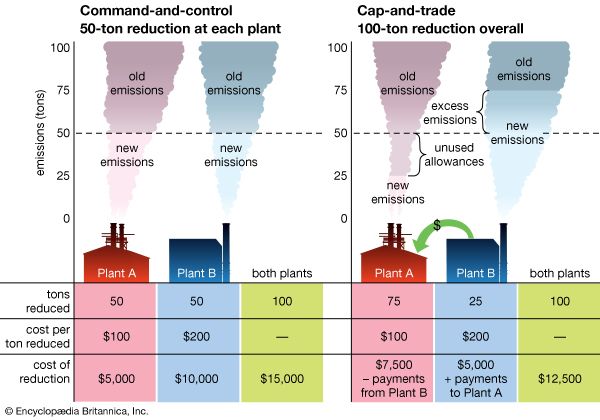
- Tradable Permits: Programs like the Clean Air Act allow companies to buy and sell “pollution credits,” rewarding cleaner operations that can sell excess credits while providing flexibility to others.4
- Reporting and Labeling: Ecolabels and ISO 14000 standards help businesses manage their environmental footprint and appeal to environmentally conscious consumers, which in turn stimulates market-driven innovation.2
How does environmental policy intersect with other areas like public health and economic development?
Environmental policy is deeply interconnected with public health and economic development, forming a complex triad where each element influences the others.
The Intersection of Environment and Public Health
Public health is fundamentally dependent on environmental quality. Historically, the rise of industrialization and urbanization necessitated government intervention to manage sanitation, sewage, and urban hygiene to prevent disease. Today, environmental degradation—such as air and water pollution—directly threatens human health by increasing the prevalence of disease and reducing life expectancy. Public health agencies, such as the World Health Organization, work to control these risks by monitoring environmental factors like food safety, water supplies, and toxic chemical exposure.6789
The Role of Economic Development
While environmental protection was once viewed as being at odds with economic growth, the concept of sustainable development has bridged this gap. This approach seeks to foster economic progress while preserving natural resources for future generations.657
The relationship is characterized by several key factors:
- Economic Consequences of Degradation: Environmental damage can hinder development by reducing agricultural productivity, damaging infrastructure, and increasing public health care costs.7
- Environmental Economics: This field applies economic tools to allocate resources efficiently, helping policymakers understand the costs of pollution and the value of natural assets.5
- Market-Based Solutions: Rather than relying solely on regulation, governments increasingly use economic instruments like taxation and permit markets to incentivize cleaner industrial practices.10
Ultimately, balancing these dimensions is a central challenge for modern governance, as environmental objectives often compete with the immediate demands for energy, housing, and industrial expansion.7
What are the main goals and objectives of environmental policy?
Environmental policy encompasses a broad range of goals and objectives aimed at protecting the natural world while balancing human needs. At its core, the primary objective is to ensure a minimum level of environmental quality by regulating harmful activities, such as limiting emissions and restricting the use of hazardous substances.6
Key Objectives of Environmental Policy
- Protection of Human Health: Historically, policy has focused on mitigating the risks posed by industrialization and urbanization, including managing sanitation, sewage, and pollution to prevent disease.612
- Conservation and Preservation: A major goal is the protection of natural landscapes, wildlife, and biodiversity. This includes “set-aside” schemes, such as the creation of national parks and wilderness areas, to prevent the overexploitation of natural resources.613
- Sustainable Development: Since the late 1980s, this has become a central concept, aiming to foster economic growth while preserving the environment for future generations. It seeks to balance social, economic, and environmental needs, often referred to as the three “pillars” of sustainability.614
- International Cooperation: Because environmental problems often cross borders, policy objectives include establishing global frameworks—such as the Kyoto Protocol and the Convention on Biological Diversity—to address issues like climate change and transboundary pollution.15
What are the challenges in creating effective environmental policies?
Creating effective environmental policy is a complex endeavor, as it must address fundamental economic, scientific, and political hurdles.
Economic and Structural Challenges
A primary challenge is that environmental values are often omitted from decision-making because environmental effects are economic externalities. Polluters rarely bear the full consequences of their actions, as the damage often occurs elsewhere or in the future. Furthermore, natural resources are frequently underpriced, leading to the “tragedy of the commons,” where individuals rationally exploit shared resources for short-term gain, resulting in long-term depletion.16
Scientific and Regulatory Hurdles
Policy often operates under high levels of scientific uncertainty, making it difficult to determine the precise impact of specific activities on human health or ecosystems. While regulation is a powerful tool, it can be rigid, potentially stifling innovation if actors focus only on meeting the letter of the law rather than developing cleaner technologies. Additionally, while regulations effectively address “point sources” of pollution, they struggle with diffuse, nonpoint sources—such as agricultural runoff or automobile exhaust—where the cumulative impact is harder to manage.131718
International and Political Obstacles
Environmental issues frequently ignore political boundaries, requiring cooperation among nations that may have conflicting interests. Achieving compliance is a significant challenge; international treaties often lack robust enforcement mechanisms because countries are reluctant to cede national sovereignty to foreign bodies. Moreover, the social and economic costs of environmental measures can lead to resistance, particularly in developing nations, necessitating complex frameworks for financial and technological cooperation.4
Sources
- environmental policy - Environmental reporting and ecolabeling — Encyclopædia Britannica
- environmental policy - Financial incentives — Encyclopædia Britannica
- Environmental law - Economic incentives — Encyclopædia Britannica
- environmental policy - Regulation — Encyclopædia Britannica
- environmental economics - Policy implications — Encyclopædia Britannica
- environmental policy - History of environmental policy making — Encyclopædia Britannica
- environmental economics - Future directions — Encyclopædia Britannica
- public health — Encyclopædia Britannica
- Environment and sustainable development in India - Ecological overview — Encyclopædia Britannica
- environmental economics — Encyclopædia Britannica
- public health - Concern regarding the quality of the environment — Encyclopædia Britannica
- sustainable development — Encyclopædia Britannica
- International law - Protection of the environment — Encyclopædia Britannica
- environmentalism - History of the environmental movement — Encyclopædia Britannica
- Environmental law - Set-aside schemes — Encyclopædia Britannica
- environmental policy — Encyclopædia Britannica
- Environmental law - Current trends and prospects — Encyclopædia Britannica
- Environmental law - The precautionary principle — Encyclopædia Britannica
Published on · 5 min read