Giant’s Causeway
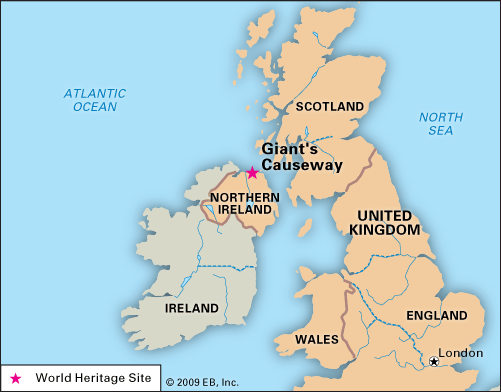
The Giant’s Causeway is a significant landmark in Northern Ireland that balances its role as a major tourist destination with essential conservation mandates.
How has the Giant’s Causeway impacted tourism and conservation efforts in Northern Ireland?
The Giant’s Causeway is a significant landmark in Northern Ireland that balances its role as a major tourist destination with essential conservation mandates.
Tourism
The site is a prominent attraction, drawing approximately 300,000 visitors annually. Its popularity has bolstered the regional tourism industry, with the nearby town of Portrush serving as a key hub for travelers exploring the northern coast.12
Conservation
To ensure the protection of its unique geological and ecological features, the site is managed under strict conservation frameworks:
- Institutional Oversight: The area was bequeathed to the National Trust in 1961, which oversees its preservation.1
- Global Recognition: In 1986, it was designated a UNESCO World Heritage site, providing international protection for its 200-acre landscape.1
- Biodiversity: Conservation efforts extend beyond the basalt columns to protect the diverse habitats of the cliffs, marshes, and grasslands, which support over 200 plant species and 50 bird species.1
What are the distinctive features of the Giant’s Causeway’s hexagonal basalt columns?
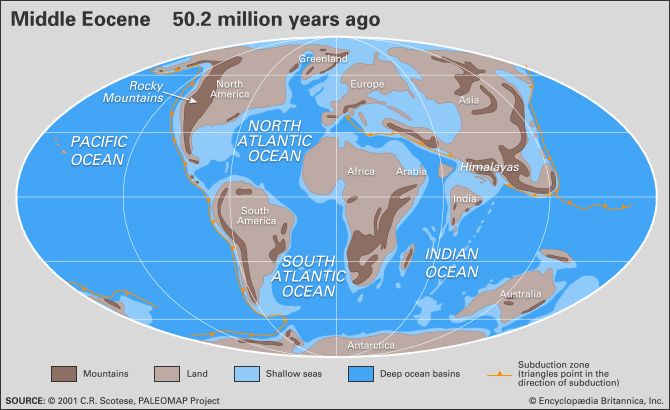
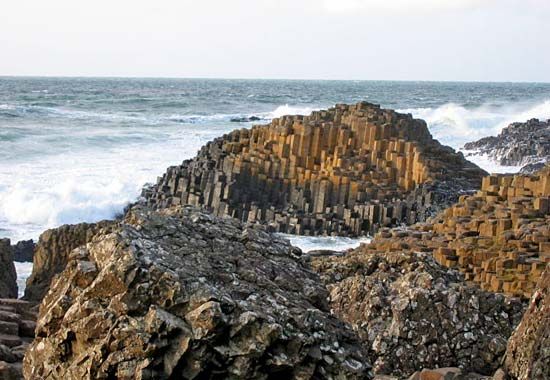
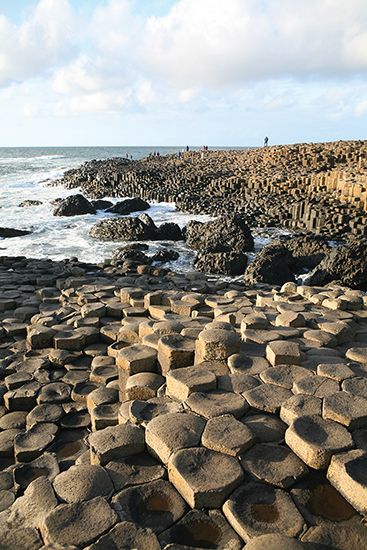
The Giant’s Causeway features approximately 40,000 stone pillars formed 50 to 60 million years ago during the Paleogene Period. These columns are the result of successive lava flows that cooled upon contact with the sea, causing the rock to shrink and fracture.13
Distinctive Features
- Polygonal Geometry: While often referred to as hexagonal, the columns typically possess five to seven irregular sides. The formation of these shapes is a physical response to cooling; as the lava shrinks, it creates surface tension that produces cracks. Cracks intersecting at 120-degree angles are the most efficient way to release this tension, naturally leading to the hexagonal pattern.134
- Dimensions: The columns vary in diameter from 15 to 20 inches (38 to 51 cm) and can reach heights of up to 82 feet (25 meters).1
- Uniformity: The regularity of the columns depends on the cooling rate of the lava. If the lava had cooled at a perfectly uniform rate, the columns would be regular hexagons; however, most are irregular due to variations in the cooling process.34
What types of rock make up the Giant’s Causeway?
The Giant’s Causeway is composed primarily of basalt, a type of igneous rock.
These formations were created approximately 50 to 60 million years ago during the Paleogene Period through successive lava flows. As the molten rock moved toward the coast and contacted the sea, it cooled and contracted, resulting in the characteristic prismatic or polygonal columns seen today.15
What flora and fauna can be found in the area surrounding the Giant’s Causeway?
The area surrounding the Giant’s Causeway supports a diverse range of wildlife within its cliffs, seashores, marshes, and grasslands.
The site is home to:
- Flora: The region hosts more than 200 species of plants, which thrive across the varied coastal habitats protected by the National Trust.1
- Fauna: The area provides a habitat for approximately 50 species of birds.1
While the site is currently uninhabited by humans, its designation as a UNESCO World Heritage site ensures the ongoing preservation of these ecological communities.1
Sources
- Giant’s Causeway — Encyclopædia Britannica
- Portrush — Encyclopædia Britannica
- hexagon — Encyclopædia Britannica
- joint — Encyclopædia Britannica
- Giant's Causeway — Merriam-Webster
- igneous rock - Flood basalts — Encyclopædia Britannica
Published on · 2 min read