Fingal’s Cave
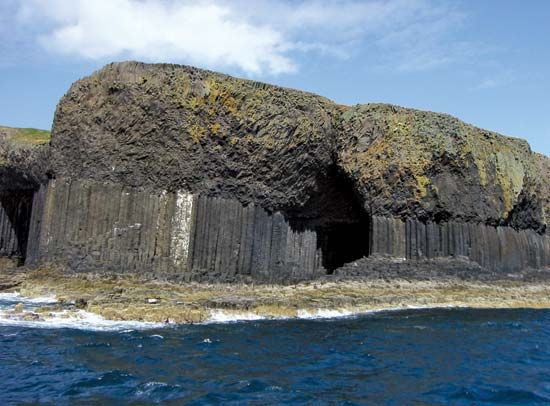
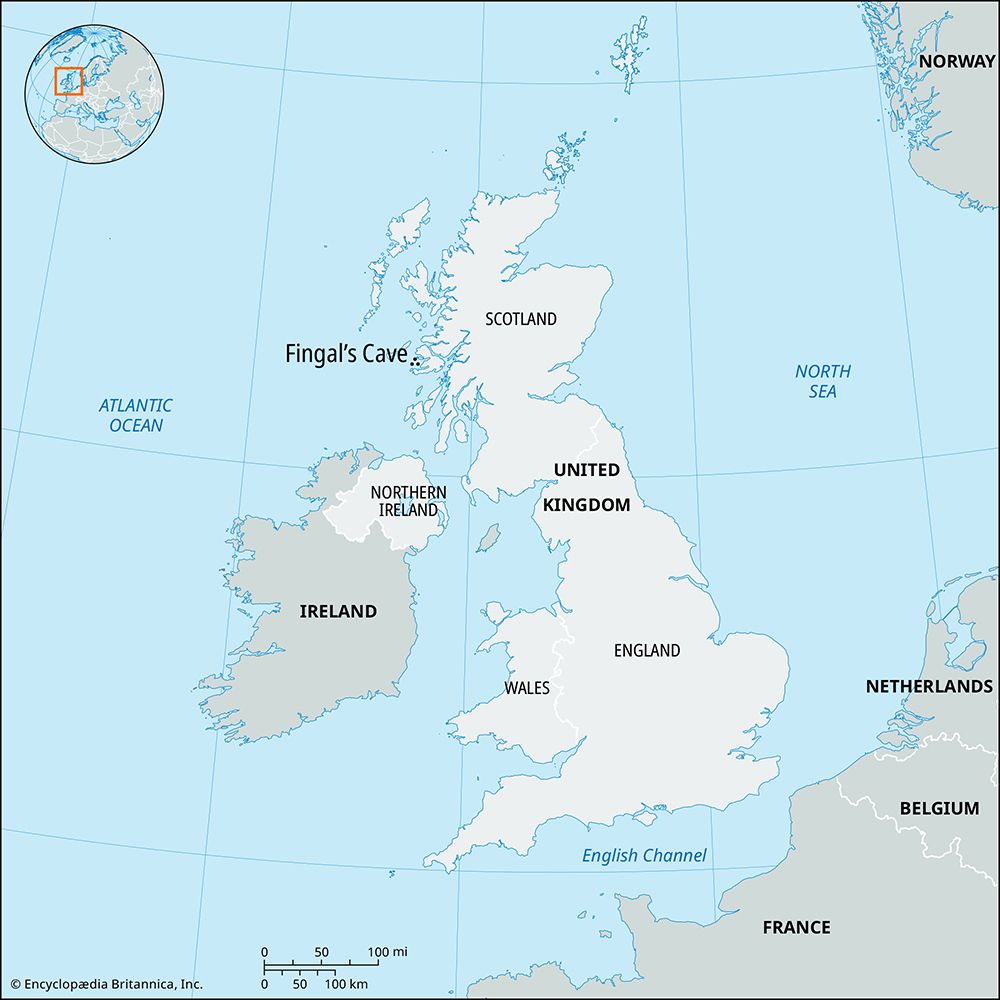
Fingal’s Cave is a renowned sea cave located on the island of Staffa in the Inner Hebrides of western Scotland. The cave is famous for its unique structure…
What is Fingal’s Cave?
Fingal’s Cave is a renowned sea cave located on the island of Staffa in the Inner Hebrides of western Scotland1. The cave is famous for its unique structure, consisting of symmetrical, hexagonally jointed basalt columns formed by ancient lava flows.12
Measuring approximately 227 to 270 feet in length, the cave features an arched roof that reaches up to 72 feet above sea level, creating remarkable natural acoustics that echo the surrounding ocean waves. Geologically, it shares origins with the Giant’s Causeway in Northern Ireland.2
Since its 1772 “rediscovery” by Sir Joseph Banks, the site has inspired numerous cultural figures, including J.M.W. Turner and Felix Mendelssohn, and is linked in legend to the hero Finn MacCumhaill of the Fenian cycle.2
How are basalt columns formed by cooling lava?
Basalt columns are formed through a process known as columnar jointing, which occurs when igneous rock contracts as it cools.3
When molten rock, such as lava or an intrusion, begins to solidify, it undergoes a reduction in volume. This contraction creates stress that leads to the development of fractures, or joints, which are brittle-fracture surfaces in the rock.34
The specific geometric pattern of these columns is determined by the intersection of three sets of joints perpendicular to the cooling surfaces. These joints typically meet at angles of approximately 120°, resulting in the characteristic polygonal columns. The dimensions of these columns—which can range from a few centimeters to several meters in diameter—are directly influenced by the rate of cooling:4
- Faster cooling: Produces smaller, narrower columns.4
- Slower cooling: Allows for the formation of larger, wider columns.4
This process is a primary structural feature often observed in mafic volcanic rocks and intrusive formations like sills and dikes.34
What is the legend of Finn MacCumhaill?
Finn MacCumhaill (also known as MacCool) is a central figure in the Fenian cycle of Irish literature. He is portrayed as a wise, nature-sensitive leader of the Fianna Éireann, an elite corps of warriors and huntsmen.56
According to legend, Finn was the posthumous son of the Fianna chief Cumhaill. He was raised in secret in a forest, where he earned his name—meaning “The Fair”—through his early exploits. He eventually triumphed over his father’s slayer to lead the Fianna himself.6
Beyond his role as a warrior, Finn is a figure of mythic scale in landscape folklore. He is famously credited with building the Giant’s Causeway in Northern Ireland as part of a path to the Scottish island of Staffa, where Fingal’s Cave is located. These geological formations are said to be the remnants of his construction, built for motives of love or war.71
The cycle also chronicles the eventual decline of the Fianna, culminating in the Battle of Gabhra, which led to the group’s destruction.6
What is the Giant’s Causeway in Northern Ireland?
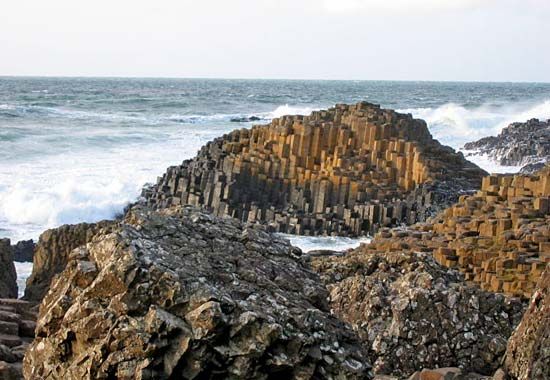
The Giant’s Causeway is a remarkable promontory located on the northern coast of Northern Ireland, consisting of approximately 40,000 interlocking basalt columns. These stone pillars, which typically feature five to seven sides, extend from the Antrim plateau toward the sea, creating a landscape that resembles a massive staircase.7
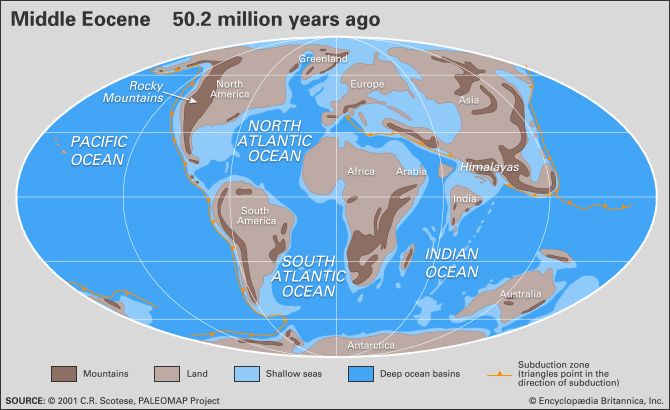
Formed 50 to 60 million years ago during the Paleogene Period, the site resulted from successive lava flows that cooled upon contact with the sea. This cooling process caused the basalt to contract and fracture into the distinct polygonal shapes seen today, with columns reaching up to 82 feet in height.7
Designated a UNESCO World Heritage site in 1986, the area is protected for its unique geology and diverse ecosystems, which support numerous bird and plant species. While geologically significant, the site is also steeped in legend, famously attributed to the giant Finn MacCumhaill, who is said to have built the path to reach the Scottish island of Staffa.7
Sources
- Fingal’s Cave — Encyclopædia Britannica
- Fingal's Cave — Merriam-Webster
- igneous rock - Fractures — Encyclopædia Britannica
- joint — Encyclopædia Britannica
- Finn — Encyclopædia Britannica
- Fenian cycle — Encyclopædia Britannica
- Giant’s Causeway — Encyclopædia Britannica
Published on · 3 min read