Paleogene Period
Following the mass extinction at the end of the Cretaceous Period, the Paleogene Period (66 million to 23 million years ago) served as a pivotal era for the…
How did the evolution and diversification of mammals progress during the Paleogene?
Following the mass extinction at the end of the Cretaceous Period, the Paleogene Period (66 million to 23 million years ago) served as a pivotal era for the adaptive radiation and diversification of mammals.123
The Paleocene Epoch
During the Paleocene Epoch, mammals rapidly proliferated into ecological niches vacated by dinosaurs. Early forms were often archaic or highly specialized, including multituberculates, marsupials, and condylarths. By the middle to late Paleocene, more modern groups emerged, including primitive carnivores, early primates, and ancestral rodentsanimal/primate-mammal), and ancestral rodents.13
The Eocene and Beyond
A major faunal turnover at the end of the Paleocene replaced many archaic groups with essentially modern lineages. By the early Eocene Epoch, more than 20 orders of mammals were established, including perissodactyls (such as early horses), artiodactyls, bats, and proboscideans. These groups dispersed widely across landmasses, and by the Oligocene Epoch, terrestrial communities were increasingly dominated by ancestors of modern mammalian groups.23
What were some of the major plant groups that evolved or diversified during the Paleogene?
During the Paleogene Period (66 million to 23 million years ago), terrestrial flora underwent significant evolutionary expansion, characterized primarily by the continued radiation and dominance of angiosperms (flowering plants).78
Key Developments in Plant Groups
- Angiosperm Dominance: Having begun their diversification in the Cretaceous Period, angiosperms solidified their role as the dominant land flora during the Paleogene. This success was driven by coevolutionary relationships with insects, birds, and mammals, which facilitated more efficient pollination and seed dispersal.898
- Evolution of Bilateral Symmetry: A major innovation during the late Paleocene and early Eocene was the emergence of bilaterally symmetrical flowers, such as those found in legumes and orchids. This adaptation allowed plants to direct the behavior of specialized pollinators, such as bees and certain birds, maximizing reproductive efficiency.1
- Rise of Grasses: Grasses (family Poaceae) appeared by the late Paleocene. While they remained relatively scarce initially, they began to diversify alongside the rise of grazing mammals. By the Eocene, simple grasslands had begun to form, setting the stage for the more complex, sod-forming grasslands that would appear in later epochs.108
- Energy-Rich Fruits and Seeds: The Eocene saw a significant radiation of plants producing energy-rich fruits and seeds, including acorns, walnuts, and grapes. This development coincided with the diversification of fruit- and seed-eating mammals and birds, which acted as dispersal agents.1
What major geological events occurred during the Paleogene Period?
The Paleogene Period (66 million to 23 million years ago) was a time of profound geological and climatic transformation, marking the transition from a warm, reptile-dominated world to one characterized by cooling and mammalian dominance.16
Major Tectonic and Paleogeographic Events
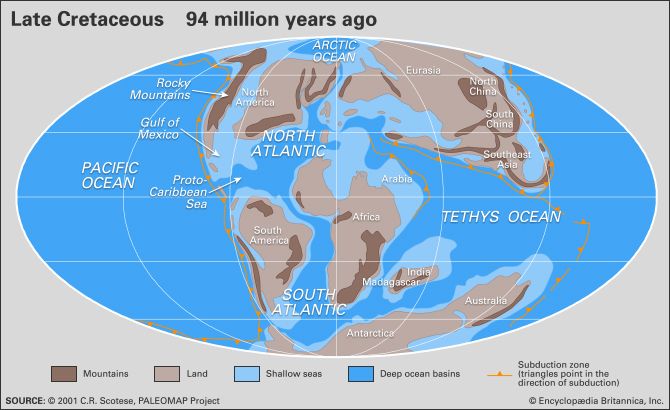
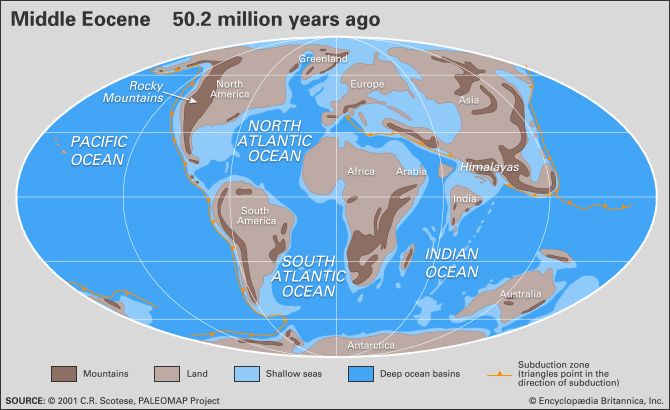
- Continental Fragmentation: The breakup of the supercontinent Gondwana continued, with Australia separating from Antarctica roughly 55–56 million years ago.17
- Himalayan Uplift: The collision between the Indian subcontinent and the Eurasian Plate began between 50 and 40 million years ago. This massive tectonic event initiated the formation of the Himalayas and the Plateau of Tibet, which significantly altered global wind patterns and climate by acting as a topographic barrier.1711
- Oceanic Isolation: The opening of the Drake Passage between South America and Antarctica, along with the subsidence of the South Tasman Rise, facilitated the development of the Antarctic Circumpolar Current. This current thermally isolated Antarctica, leading to the formation of continental ice sheets by the Oligocene Epoch.1817
Climatic Shifts
- Paleocene-Eocene Thermal Maximum (PETM): Occurring approximately 56 million years ago, this 100,000-year interval saw a rapid global temperature increase of over 5 °C (9 °F), causing widespread ecological disruption.1819
- Long-term Cooling: Following the Eocene Optimum, the Earth experienced a steady cooling trend, moving toward the polar glaciation that defines the modern climate.1816
What is the Paleogene Period, and where does it fit in the geological time scale?
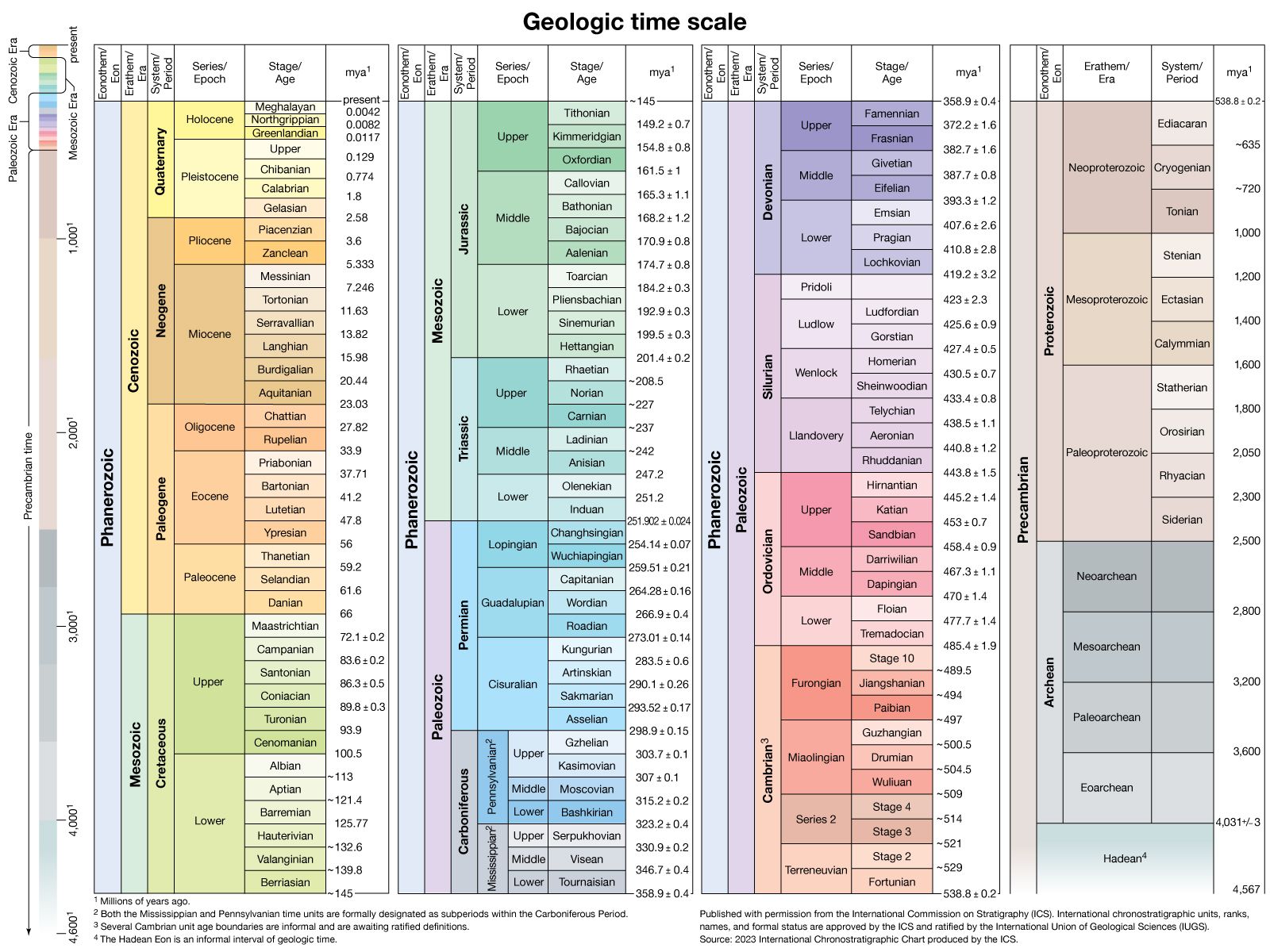
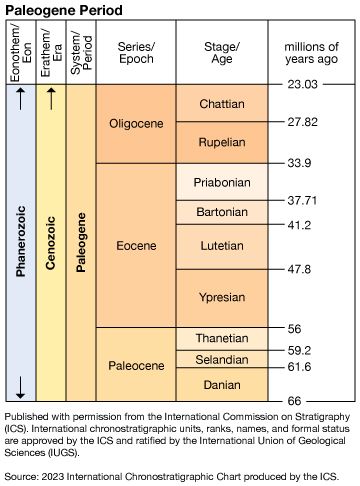
The Paleogene Period is the oldest of the three stratigraphic divisions of the Cenozoic Era, spanning the interval from 66 million to 23 million years ago. The name is derived from Greek, meaning “ancient-born,” a term coined in Europe to highlight the similarities among marine fossils found in the strata of its three constituent epochs.1122
Geological Time Scale Placement
The Paleogene is situated at the beginning of the Cenozoic Era, following the Cretaceous Period and preceding the Neogene Period. It is subdivided into the following epochs:1122
- Paleocene Epoch: 66 million to 56 million years ago.1122
- Eocene Epoch: 56 million to 33.9 million years ago.1122
- Oligocene Epoch: 33.9 million to 23 million years ago.1122
Historically, these intervals were grouped with the Neogene under the Tertiary Period, though the use of the Paleogene and Neogene designations has become the standard scientific classification. This period marked a critical transition in Earth’s history, shifting from a warm, reptile-dominated world toward the climatic and ecological conditions that define the modern era.1122
Sources
- Paleocene Epoch — Encyclopædia Britannica
- Tertiary Period - The rise of mammals — Encyclopædia Britannica
- human evolution - Hominin habitats — Encyclopædia Britannica
- Pangea: Top Questions — Encyclopædia Britannica
- mammal - Diversity — Encyclopædia Britannica
- Cenozoic Era - Cenozoic life — Encyclopædia Britannica
- plant - Evolution of seed plants and plant communities — Encyclopædia Britannica
- angiosperm - Paleobotany and evolution — Encyclopædia Britannica
- Poaceae - Evolution — Encyclopædia Britannica
- Oligocene Epoch — Encyclopædia Britannica
- A Journey Through Time Since the Precambrian - Paleogene Period: 66 million to 23 million years ago, and Neogene Period: 23 million to 2.6 million years ago — Encyclopædia Britannica
- Holocene Epoch - Floral change — Encyclopædia Britannica
- Pleistocene Epoch - Pleistocene fauna and flora — Encyclopædia Britannica
- Tertiary Period - Flowering plants and grasses — Encyclopædia Britannica
- Permian Period - Marine and terrestrial life — Encyclopædia Britannica
- Climate change - Cenozoic climates — Encyclopædia Britannica
- Paleocene-Eocene Thermal Maximum — Encyclopædia Britannica
- Tertiary Period - Paleogeography — Encyclopædia Britannica
- Climate change - Phanerozoic climates — Encyclopædia Britannica
- Himalayas - Geologic history — Encyclopædia Britannica
- Earth sciences - The theory of plate tectonics — Encyclopædia Britannica
- Paleogene Period — Encyclopædia Britannica
Published on · 4 min read