Goatfish
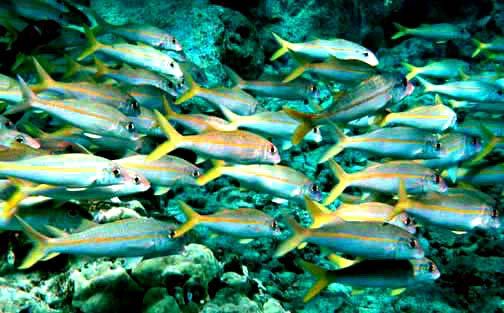
Goatfish are primarily found in warm and tropical regions across the world's oceans. These marine fish typically inhabit shallow waters, where they are…
Where are goatfish commonly found in the world’s oceans?
Goatfish are primarily found in warm and tropical regions across the world’s oceans. These marine fish typically inhabit shallow waters, where they are commonly spotted along reefs or swimming over mud and sand bottoms.1
While they are distributed throughout these tropical environments, specific species are well-known in particular regions, such as the red surmullet, which is famously found in the Mediterranean.1
Are there any cultural or economic significance to goatfish in different parts of the world?
Goatfish have held significant cultural and economic value as a food source since ancient times. Their importance varies by region:
- Ancient Rome: The red surmullet (Mullus barbatus) was one of the most highly prized food fishes among the ancient Romans, appearing frequently in their historical archives as a delicacy.12
- Japan: Goatfish maintain a strong market presence today. They are commonly consumed raw as sashimi or processed into steamed fish cakes known as kamaboko.2
- Global Fisheries: Beyond their specific cultural roles, goatfish are part of the broader commercial fishing industry, where many species are valued as edible commodities.12
While they are widely appreciated for their culinary qualities, they are also recognized for their distinct biological characteristics, such as the sensory chin barbels used to locate prey.1
What family of fish do goatfish belong to, and how many species are there?
Goatfish belong to the family Mullidae (order Perciformes). There are more than 60 known species of these elongated marine fishes.14
What are the distinctive physical characteristics of goatfish?
Goatfish are characterized by several distinct physical features that aid in their survival within shallow, tropical, and warm-water environments:
- Body Shape: They possess an elongated body structure.14
- Dorsal Fins: A defining trait is the presence of two well-separated dorsal fins.14
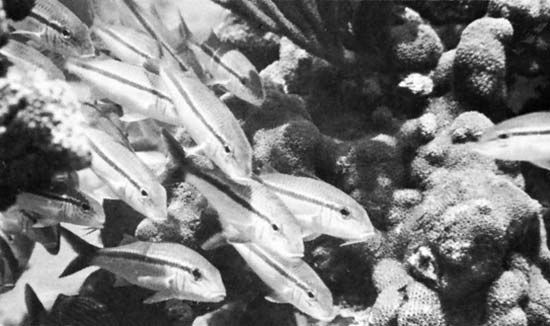
- Sensory Barbels: They feature a pair of long, sensory chin barbels used to locate small, bottom-dwelling invertebrates. When these barbels are not in use, they are tucked into a specialized groove on the fish’s throat.14
- Coloration: These fish are often brightly colored, frequently appearing in shades of red and yellow. Notably, some species possess the ability to change their colors.14
- Size: While they are generally medium-sized, the largest species reach approximately 60 cm (2 feet) in length, though most are significantly smaller.14
Sources
- goatfish — Encyclopædia Britannica
- perciform - Use as food — Encyclopædia Britannica
- commercial fishing - Dragged gear — Encyclopædia Britannica
- goatfish — Merriam-Webster
- rodent - Evolution and classification — Encyclopædia Britannica
- Mullidae — Merriam-Webster
Published on · 2 min read