Goliath Grouper
The goliath grouper (Epinephelus itajara) is a massive sea bass belonging to the family Serranidae. Found in the shallow waters of the tropical Americas and…
What is goliath grouper?
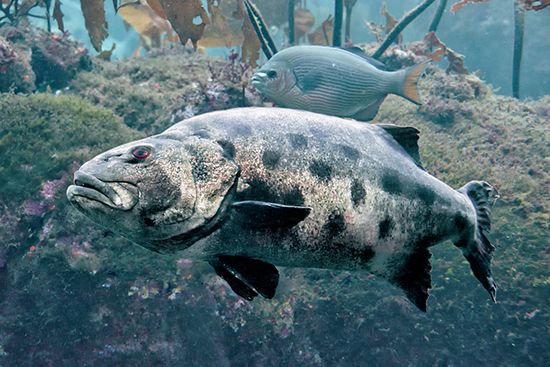
The goliath grouper (Epinephelus itajara) is a massive sea bass belonging to the family Serranidae. Found in the shallow waters of the tropical Americas and the eastern Atlantic Ocean, these solitary fish can reach lengths of 2.5 metres (8.2 feet) and weigh up to 455 kg (1,000 pounds). Adults are typically dull olive-brown with faint markings and tend to remain in the same area for long periods.123
It is important to note that the species was formerly known by a name that was widely considered anti-Semitic. In 2001, the American Fisheries Society officially renamed the fish to “goliath grouper” to address the offensiveness of the historical term, reflecting a commitment to inclusive and respectful scientific nomenclature.13
Like other groupers, this species is a protogynous hermaphrodite, meaning individuals function as females first before transitioning into males.2
What does it mean for a fish to be a protogynous hermaphrodite?
A fish that is a protogynous hermaphrodite functions as a female during the early part of its life and later transitions into a male. This form of consecutive hermaphroditism is relatively common among bony fishes, including sea basses, parrot fishes, and wrasses.45
The evolutionary advantage of this strategy is often linked to the energy requirements of reproduction. Producing eggs is energetically costly, and it may be advantageous for smaller, younger individuals to function as females. Conversely, in certain mating systems, it may be more beneficial for an individual to function as a male once it has reached a larger body size and gained more experience.4
This process is distinct from protandry, where an individual begins as a male and later becomes a female, and from simultaneous hermaphroditism, where an individual possesses both male and female reproductive organs at the same time.465
How do groupers use color to camouflage or communicate?
Groupers utilize color for both concealment and social interaction, employing mechanisms that range from long-term physiological changes to rapid, hormonally mediated shifts.
Camouflage
Groupers often rely on background matching and disruptive coloration to avoid predation or to remain inconspicuous while hunting. Many species, such as the Nassau grouper, are noted for their ability to shift between various color patterns to blend into their surroundings. Disruptive patterns, which break up the body’s outline, are common in reef-dwelling fishes; these patterns can change depending on the environment, such as shifting from mottled “saddles” to horizontal stripes when a fish moves from a textured background to an evenly colored area.89
Communication
Coloration also serves as a vital tool for social signaling:
- Reproductive Signals: During courtship, many fishes undergo dramatic, short-term color changes involving melanophores. A male’s sexual arousal can often be measured by the intensity of these color shifts as he interacts with a female.10
- Territoriality: Bright coloration is frequently used to intimidate intruders or defend territory. In some reef species, juveniles exhibit radically different coloration than adults, which allows them to live within an adult’s territory without being attacked, as they do not yet compete for the same food resources.3
- Environmental Adaptation: Some color variations are long-term adaptations to habitat depth; for example, individuals of certain species living in deeper waters are often much redder than those found near the shore.8
What is ciguatera poisoning and how does it affect humans?
Ciguatera poisoning is a form of fish poisoning caused by the ingestion of normally edible tropical fish that have accumulated a toxic substance in their flesh. This toxin, known as ciguatoxin, is believed to originate in marine plants and is passed through the food chain from herbivores to carnivores, eventually affecting humans. More than 400 species of tropical reef fishes, such as sea bass and snapper, have been implicated in these cases.151617
Symptoms and Effects
Symptoms of ciguatera poisoning can appear immediately or be delayed for up to 30 hours after consumption. Common effects include:
- Nausea, vomiting, and diarrhea1517
- Muscle pain, weakness, and numbness1517
- Tingling sensations around the lips, tongue, and throat17
- Visual impairment and skin rashes17
- A characteristic sensory reversal where hot objects feel cold and vice versa, sometimes described as an “electric shock” or “dry ice” sensation17
While death is rare—occurring in approximately 12 percent of cases—it is typically caused by respiratory paralysis.1517
Sources
- goliath grouper — Encyclopædia Britannica
- goliath grouper — Merriam-Webster
- grouper — Encyclopædia Britannica
- Reproductive behaviour - Fishes — Encyclopædia Britannica
- Sex - Sex patterns — Encyclopædia Britannica
- bivalve - Reproduction and life cycles — Encyclopædia Britannica
- Animal reproductive system - Gonads, associated structures, and products — Encyclopædia Britannica
- coloration - Short-term changes — Encyclopædia Britannica
- coloration - Background matching — Encyclopædia Britannica
- coloration - Disruptive coloration — Encyclopædia Britannica
- coloration - Schooling signals — Encyclopædia Britannica
- coloration - Reproductive signals — Encyclopædia Britannica
- golden grouper — Merriam-Webster
- coloration - Territorial advertising — Encyclopædia Britannica
- fish poisoning — Encyclopædia Britannica
- ciguatera — Merriam-Webster
- poison - Animal poisons ( zootoxins ) — Encyclopædia Britannica
Published on · 3 min read