Grackle
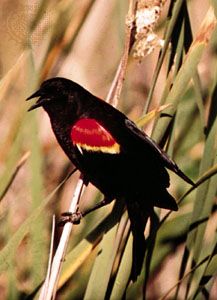
Grackles are members of the Icteridae family characterized by their iridescent black plumage, which often reflects purple, green, or bronze hues in adult…
What are the defining physical characteristics of grackles?
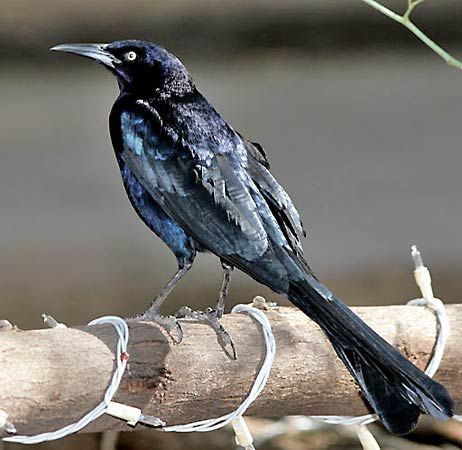
Grackles are members of the Icteridae family characterized by their iridescent black plumage, which often reflects purple, green, or bronze hues in adult males. A defining feature of these birds is their long tail; in species such as the great-tailed and boat-tailed grackles, the male possesses a notably long, deeply keeled tail.123
Physically, grackles are equipped with stout, pointed bills that allow them to forage for insects, dig for grubs, kill small vertebrates, and crack hard seeds. Their size varies by species: the common grackle of North America typically measures about 30 cm (12 inches) in length, while larger species like the great-tailed grackle can reach total lengths of up to 43 cm.1
How many species of grackles are there, and where are they commonly found?
The term “grackle” refers to several species within the Icteridae family, rather than a single, fixed number of species. While the provided information highlights specific examples, it does not define a total count of all existing species.1
These birds are commonly found across various regions in the Americas:
- Common Grackle (Quiscalus quiscula): Widely distributed throughout North America.1
- Great-tailed Grackle (Cassidix mexicanus): Found in arid lands ranging from the southwestern United States down to northern South America and Peru.13
- Boat-tailed Grackle (C. major): Typically inhabits salt marshes along the coast from New Jersey to Texas.1
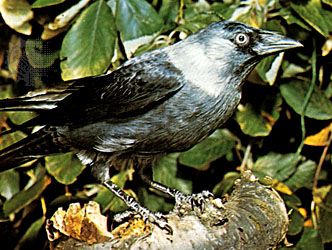
- Local Populations: A separate species (C. minor), often referred to as jackdaws, is also found in similar coastal regions.1
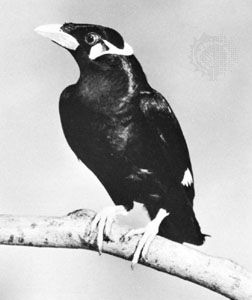
Note that the birds referred to as grackles in southern Asia are distinct and are classified as mynah.1
What role do grackles play in human culture and folklore?
Sorry, the Britannica knowledge base does not contain information regarding the role of grackles in human culture and folklore.
How are grackles related to other members of the Icteridae family?
Grackles are members of the Icteridae family, a diverse group of approximately 100 species of songbirds found throughout the Americas. Within this family, grackles belong to the genus Quiscalus and share several defining characteristics with their relatives, such as blackbirds, orioles, meadowlarks, cowbirds, and bobolinks.1
Like other icterids, grackles possess strong feet, long, pointed wings, and conical bills, though they are specifically distinguished by their iridescent black plumage and long tails. While the family exhibits significant variation in size—ranging from 16 to 54 cm—grackles are generally recognized for their ability to use their stout, pointed bills to forage for insects, small vertebrates, and seeds. They share the order Passeriformes with other icterids, all of which are classified as oscine birds, meaning they are capable of complex vocalizations.512
Sources
- Grackle — Encyclopædia Britannica
- common grackle — Merriam-Webster
- great-tailed grackle — Merriam-Webster
- grackle — Merriam-Webster
- Icteridae — Encyclopædia Britannica
- Icteridae — Merriam-Webster
Published on · 2 min read