Sturnidae
The Sturnidae family, which includes starlings and mynahs, is a well-defined group of songbirds within the order Passeriformes. They are distinguished by…
What are the main characteristics that distinguish the Sturnidae family from other bird families?
The Sturnidae family, which includes starlings and mynahs, is a well-defined group of songbirds within the order Passeriformes. They are distinguished by several key physical and behavioral characteristics:
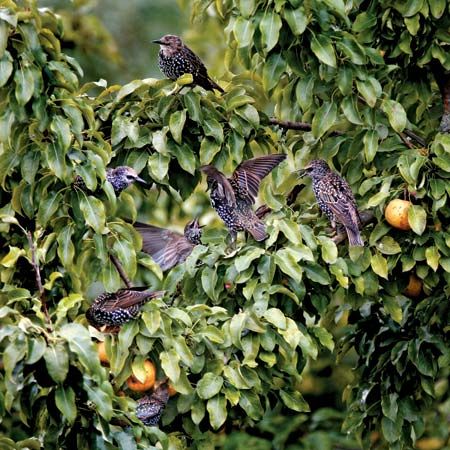
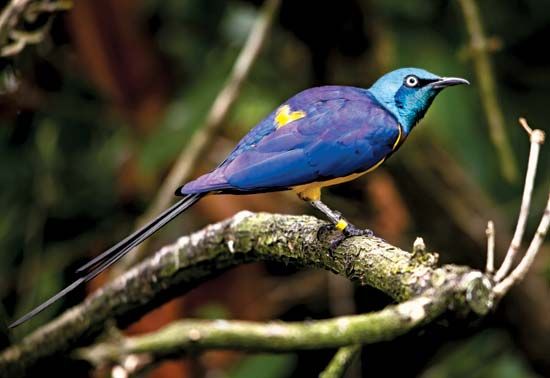
- Physical Traits: Members range from 16.5 to 42 cm in length and possess slightly downcurved bills, long, pointed wings, and strong legs and feet. Their plumage is often dark with a metallic sheen, though some species exhibit crests, wattles, or bare patches of skin.12
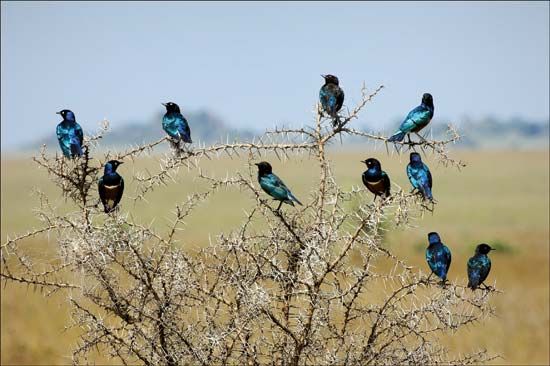
- Behavior: These birds are known for being jaunty and aggressive. They are highly vocal, chattering continually while in flight and at roosts. They frequently gather in spectacular numbers, forming large, synchronized flocks known as murmurations to avoid predators.12
- Taxonomy: They are characterized by having ten primary feathers and possess traits that are somewhat intermediate between crows and American grackles.3
What are the feeding habits of Sturnidae birds and how do they vary among different species?
Members of the Sturnidae family are generally opportunistic feeders, though their specific habits can vary by species and environment.
The most well-studied member, the common starling (Sturnus vulgaris), is an omnivorous ground-feeder. Its diet consists of a significant amount of insects, which makes it beneficial in some contexts, but it also consumes grain and small fruits. Because of this varied diet, the common starling is often viewed as a competitor with other native songbirds and can become a nuisance in agricultural areas due to its tendency to damage crops.12
While the provided information highlights the common starling’s ground-foraging behavior, the family’s dietary flexibility is a hallmark of their success as a group. During periods of migration, these birds interrupt their travel with dedicated stops specifically to hunt for food, ensuring they have the energy required for their long-distance flights.4
How do Sturnidae birds build their nests and what materials do they typically use?
Members of the Sturnidae family, which includes starlings and mynahs, are known for their nesting habits, though specific construction techniques can vary across the family. Many species within this group are cavity nesters, frequently utilizing natural crevices in trees or rocks, as well as existing holes previously excavated by other animals, such as woodpeckers.51
When building their nests, these birds typically construct them using a variety of plant materials, including grasses, twigs, and leaves. They often line these structures with softer substances like feathers, hair, or other available fibers to create a comfortable environment for their young. While some passerines are known for highly elaborate, woven, or domed nests, starlings and mynahs generally focus on utilizing available cavities or sheltered sites to provide protection for their offspring.5
What role do Sturnidae birds play in various cultural traditions and folklore?
While Sturnidae birds do not hold a singular, universal role in global folklore, they are deeply embedded in cultural narratives, particularly in the West.
The most prominent cultural association involves the common starling and its connection to literature. A popular, though debated, myth suggests that the species was introduced to North America in 1890 by Eugene Schieffelin specifically to populate New York City’s Central Park with every bird species mentioned in the plays of William Shakespeare. While historians continue to debate the accuracy of this motivation, the story has cemented the starling’s place in American cultural history as a “literary” bird.1
Additionally, certain species have gained fame for their unique abilities. The hill mynah is renowned in Asian traditions as a “talker,” celebrated for its remarkable capacity to mimic human speech, which has made it a subject of fascination and a popular cage bird for centuries.6
Sources
- Sturnidae — Encyclopædia Britannica
- Starling — Encyclopædia Britannica
- Sturnidae — Merriam-Webster
- Migration - Modes of migration — Encyclopædia Britannica
- Passeriform - Nesting — Encyclopædia Britannica
- Mynah — Encyclopædia Britannica
- Common starling — Encyclopædia Britannica
- starling — Merriam-Webster
- mynah — Merriam-Webster
Published on · 3 min read