Halmahera
The people of Halmahera, the largest island in the Moluccas, maintain diverse cultural traditions shaped by the island's unique geography and history.
What are some of the unique cultural practices or traditions of the people living on Halmahera?
The people of Halmahera, the largest island in the Moluccas, maintain diverse cultural traditions shaped by the island’s unique geography and history.
Notable cultural and traditional practices include:
- Traditional Architecture: In northern Halmahera, the traditional house is distinctively octagonal. Villages are typically organized with one-family homes grouped around a central square, which features a temple at its heart.1
- Livelihood Practices: The island’s interior inhabitants traditionally sustain themselves through hunting, fishing, and the collection of sago starch. In contrast, coastal communities focus on cultivating rice in temporary forest clearings and growing cash crops such as cloves, nutmeg, cocoa, and coconuts.1
- Social Diversity: The population is highly diverse, comprising various ethnic groups such as the Galela, Ternate, Makian, and Tobelo, alongside communities of Arab and Chinese descent. While Islam is the predominant religion, Christianity is also widely practiced, and a small portion of the population continues to follow local religions.1
How does Halmahera’s location impact its strategic importance in the region?
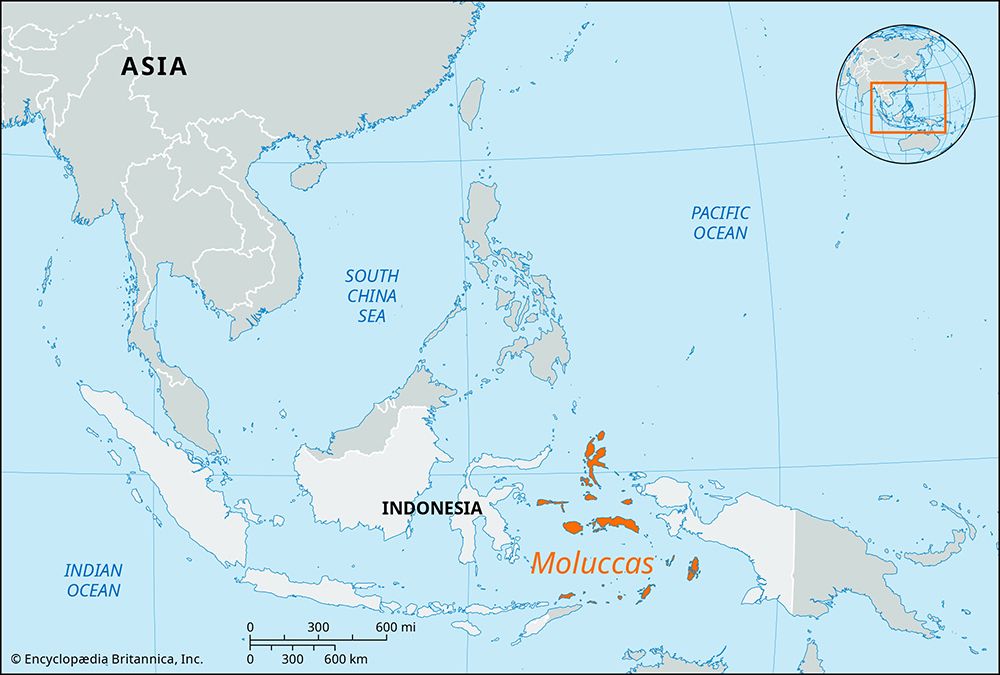
Halmahera’s strategic importance is defined by its position between the Molucca Sea to the west and the Pacific Ocean to the east. As the largest island in the Moluccas, its geography—characterized by four peninsulas and three major bays—has historically facilitated maritime interaction and control.1
The island’s proximity to Ternate and Tidore is particularly significant. Historically, these neighboring islands served as the seats of powerful sultanates that vied for regional dominance, often involving European colonial powers like the Portuguese, Spanish, and Dutch who sought to control the spice trade. The sultan of Ternate, for instance, once held claim over the northern half of Halmahera, while the sultan of Tidore controlled the south, illustrating how the island served as a territorial extension of these influential maritime states. Today, the island remains a central component of the province of North Maluku, maintaining its role as a vital hub within the Republic of Indonesia role as a vital hub within the Republic of Indonesia.13
What are some of the main economic activities and industries on Halmahera island?
The economy of Halmahera is primarily rooted in agriculture and the extraction of natural resources.
Agricultural Activities
The island’s economic life is divided between subsistence and commercial farming:
- Subsistence Farming: Inhabitants of the island’s interior rely on hunting, fishing, and the collection of sago starch. Coastal communities practice agriculture by cultivating rice in temporary forest clearings.
- Cash Crops: Coastal regions are significant producers of various cash crops, including coconuts, cocoa, cloves, nutmeg, and coffee, which are grown for trade and export.
Mining and Industry
Beyond agriculture, Halmahera plays a notable role in Indonesia’s broader mining sector. The island is recognized as a source of nickel, contributing to the nation’s status as a significant producer of mineral resources. While mining is a vital component of the regional economy, it is part of a larger national industry that, despite its substantial contribution to the country’s GDP through exports, employs only a small fraction of the total workforce.
How has Halmahera’s volcanic activity shaped its landscape and affected its inhabitants?
Halmahera’s landscape is significantly shaped by its volcanic activity, particularly along the northern peninsula. This region features a chain of mountains reaching heights of 3,000 to 5,000 feet (900 to 1,500 meters), with several active volcanoes integrated into the terrain, including Mount Gamkonora, which stands at 5,364 feet (1,635 meters).1
The presence of these volcanoes introduces ongoing geological risks for the inhabitants. Active volcanoes pose a constant threat of volcanic eruption, which can release extreme heat, lava, and ash. Furthermore, the accumulation of ash and debris on volcanic slopes creates the danger of lahars—deadly mudslides that can be triggered by volcanic activity, earthquakes, or heavy rainfall, even when the volcano is not actively erupting. Despite these hazards, human settlement near such geological features is common, necessitating careful monitoring and safety precautions to protect local communities.8
Sources
- Halmahera — Encyclopædia Britannica
- North Maluku — Encyclopædia Britannica
- Tidore Island — Encyclopædia Britannica
- Maluku — Encyclopædia Britannica
- Halmahera — Merriam-Webster
- Borneo - People and economy — Encyclopædia Britannica
- Indonesia - Resources and power — Encyclopædia Britannica
- Are Volcanoes Dangerous When They’re Not Erupting? — Encyclopædia Britannica
Published on · 3 min read