Moluccas
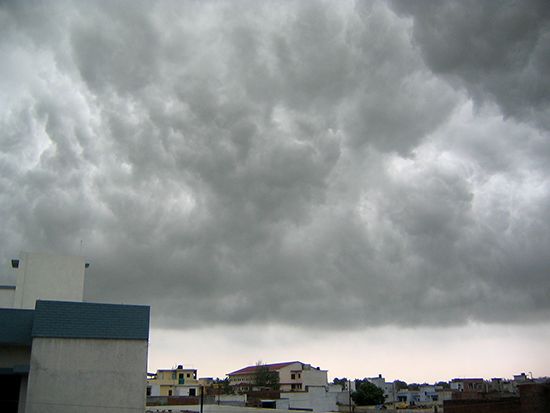
The Moluccas (also known as the Spice Islands) feature a tropical climate characterized by high, consistent temperatures typical of their equatorial location.
What is the climate like in the Moluccas islands?
The Moluccas (also known as the Spice Islands) feature a tropical climate characterized by high, consistent temperatures typical of their equatorial location.12
Key aspects of the climate include:
- Precipitation: Rainfall is abundant, generally ranging from 80 to 150 inches (2,000 to 3,800 mm) annually. While most of the region receives significant moisture, local variations occur due to the islands’ diverse geography.12
- Temperature: As with much of Indonesia, temperatures remain high and stable throughout the year, with coastal areas typically experiencing mean annual readings in the mid-70s to upper 80s °F (low 20s to low 30s °C).1
- Seasonal Patterns: The climate is influenced by monsoon winds, which dictate seasonal shifts in precipitation. While the region does not experience the extreme dry seasons found further east toward Australia, rainfall patterns can fluctuate based on the movement of tropical air masses.1
- Weather Phenomena: Strong cyclones and typhoons are absent in this part of the archipelago, though afternoon thunderstorms are a common occurrence.1
How many islands make up the Moluccas archipelago, and what are some of the major ones?
The Moluccas, historically known as the Spice Islands, comprise a vast archipelago that includes more than 600 islands. Administratively, the region is divided into two Indonesian provinces: North Maluku and Maluku.24
The major islands and archipelagos are categorized by their respective provinces:
North Maluku
- Halmahera
- Obi
- Morotai
- Bacan
- Sula archipelago (including Taliabu, Mangole, and Sulabesi)
- Ternate and Tidore
Maluku
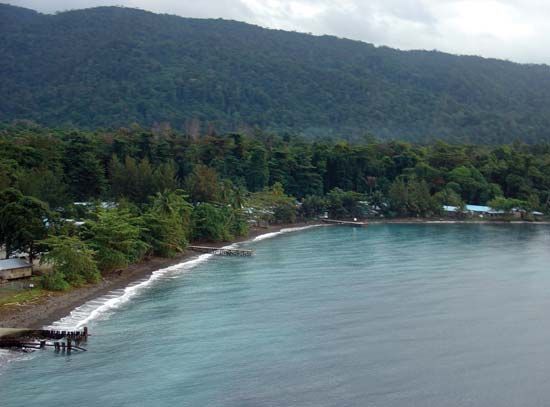
While some of these islands are mountainous and volcanic, others, such as the Aru and Tanimbar groups, are characterized by low, swampy terrain. Many of the smaller islands in the region remain uninhabited.42
What is the historical significance of the Moluccas in terms of spice trade?
The Moluccas, historically known as the Spice Islands, held immense global significance as the primary source of highly valued spices, particularly cloves, nutmeg, and mace.567
Long before European arrival, these islands were integrated into extensive Asian trade networks, with merchants from across the region collecting spices for distribution in major port cities. By the 16th century, the islands became the focal point of intense European competition. The Portuguese were the first to establish a presence in 1512, followed by the Spanish, English, and Dutch, all vying for control of the lucrative trade.526
The Dutch East India Company, chartered in 1602, eventually secured a dominant monopoly, which served as the foundation for their territorial empire in the East Indies. territorial empire in the East Indies. This era of European imperialism profoundly shaped the region’s history, though some historians emphasize that the company initially operated within existing indigenous commercial patterns rather than immediately replacing them. By the 19th century, the economic importance of the spice trade had significantly declined, leaving the islands as an economic backwater.526
What is the geographical location of the Moluccas islands in Indonesia?
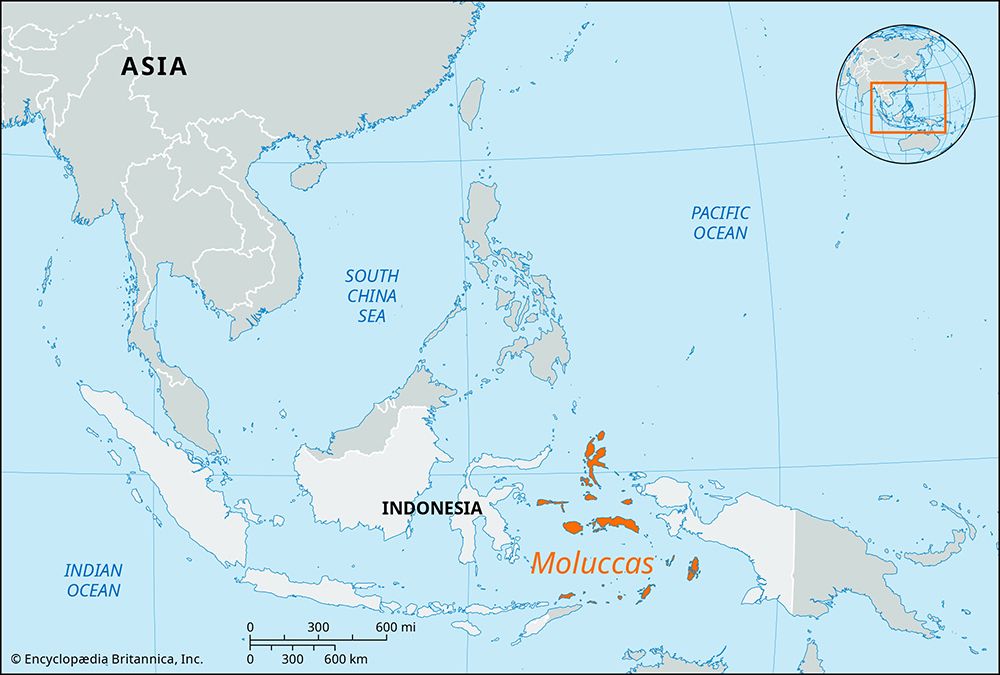
The Moluccas, also known as the Spice Islands, are a group of islands within the Malay Archipelago in eastern Indonesia.2
Geographically, they are situated between the islands of Celebes to the west and New Guinea to the east. Their broader regional boundaries are defined as follows:2
- North: The Philippines, the Philippine Sea, and the Pacific Ocean.2
- South: The Arafura Sea and the island of Timor.2
The archipelago is administratively divided into two provinces: North Maluku and Maluku. While the islands are part of the Indonesian archipelago, the eastern Moluccas are geologically associated with the Sahul Shelf, a structural extension of Australia, rather than the Asian continental shelf.28
Sources
- Indonesia - Climate — Encyclopædia Britannica
- Moluccas — Encyclopædia Britannica
- Indian Ocean - Monsoon zone — Encyclopædia Britannica
- Maluku — Encyclopædia Britannica
- spice trade — Encyclopædia Britannica
- Spice Islands — Merriam-Webster
- history of Indonesia - Expansion of European influence — Encyclopædia Britannica
- Indonesia - Celebes and the Moluccas — Encyclopædia Britannica
- Southeast Asia - Insular Southeast Asia — Encyclopædia Britannica
Published on · 3 min read