Pacific Ocean
Human activity has significantly impacted the health of the Pacific Ocean through pollution and intensive resource extraction.
How has human activity, such as pollution and overfishing, impacted the Pacific Ocean’s health?
Human activity has significantly impacted the health of the Pacific Ocean through pollution and intensive resource extraction.
Pollution
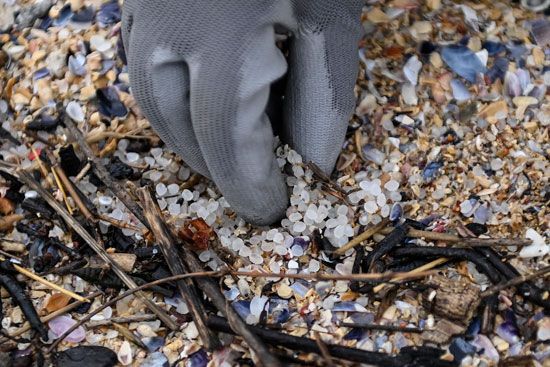
The ocean acts as a sink for terrestrial waste, leading to severe contamination in nearshore waters and confined areas. A major concern is plastic pollution, which accumulates in the North Pacific subtropical gyre, forming the Great Pacific Garbage Patch. This area is characterized by a high concentration of microplastics that absorb toxic chemicals, posing lethal risks to marine life through ingestion and entanglement. Additionally, industrial runoff, raw sewage, and heavy metals have degraded water quality near ports and coastal cities.123
Overfishing
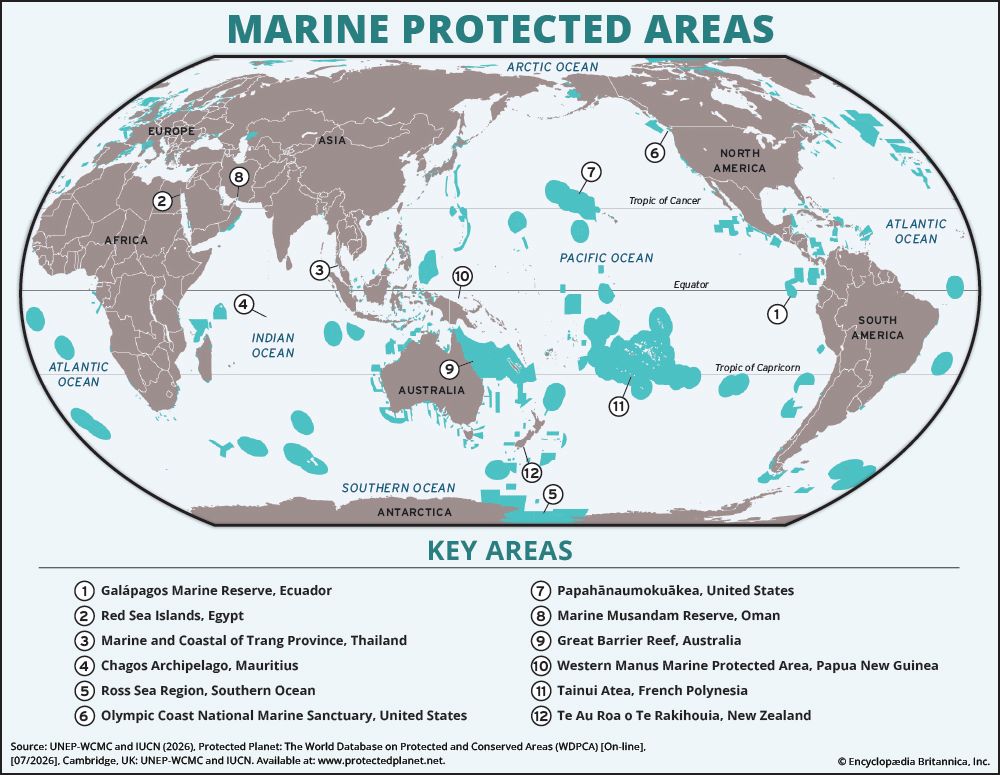
The Pacific supports the world’s largest fisheries, but intense economic pressure has led to the depletion of many species, including sardines, herring, and anchovies, which are often harvested at or beyond sustainable limits. This overfishing, combined with habitat impairment, threatens the stability of marine ecosystems. To mitigate these impacts, marine protected areas have been established to safeguard biodiversity and allow fish populations to recover.45
How do Pacific Island nations deal with the challenges of rising sea levels due to climate change?
Pacific Island nations face an existential threat from climate change, as rising sea levels and warming temperatures lead to coastal erosion, the loss of agricultural land due to saltwater intrusion, and the destruction of vital ecosystems like coral reefs.7
To address these challenges, nations are implementing various adaptation strategies:
- Relocation: Governments are working to relocate communities from low-lying coastal areas and other highly vulnerable regions to safer ground.8
- Resource Management: Efforts are underway to improve the management of water sources to ensure availability despite environmental changes.8
- Food Security: Countries are taking measures to improve crop resilience to protect local food supplies.8
- Regional Cooperation: Through organizations like the Pacific Islands Forum, heads of government discuss common issues and coordinate responses to regional problems.9
While these nations are actively working to adapt, the scale of the threat remains significant, with some island states like Tuvalu and Kiribati facing the prospect of land loss.7
How was the Pacific Ocean formed, and what are its major geological features?
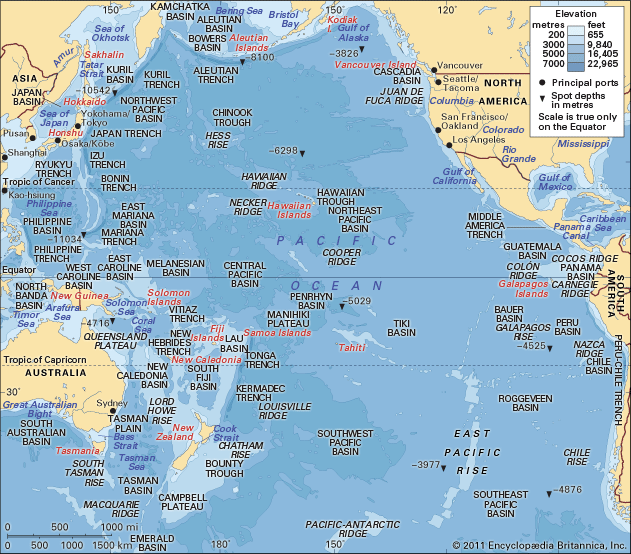
The formation and geological evolution of the Pacific Ocean are primarily driven by the theory of plate tectonics. While the ocean basin has existed for a vast period, its current configuration is the result of ongoing seafloor spreading and the consumption of plates through subduction. The oldest remaining oceanic crust in the Pacific, located in the western equatorial region, dates back approximately 200 million years.1112
Major Geological Features
The Pacific basin is defined by several distinct and dynamic geological structures:
- Subduction Zones and Trenches: The western Pacific is characterized by convergent plate boundaries where dense oceanic plates are forced beneath others. This process creates deep-sea trenches, such as the Mariana Trench, and associated volcanic island arcsTrench), and associated volcanic island arcs.11
- The Ring of Fire: This horseshoe-shaped belt fringes the Pacific basin and is the world’s most seismically active region. It is home to the majority of the Earth’s volcanoes and strongest earthquakes, driven by the subduction of oceanic plates beneath continental landmasses.13
- Seamounts and Guyots: The Pacific floor is dotted with thousands of seamounts—submerged volcanic mountains—and guyots, which are flat-topped seamounts. These features often occur in linear chains, reflecting the movement of plates over volcanic hotspots or rifts.1411
- Spreading Centres: The East Pacific Rise serves as an active spreading centre where new crust is continuously generated.11
- Fracture Zones: The northeastern Pacific floor features extensive fracture zones that extend for thousands of miles, marking areas where plates have moved laterally.11
What are some of the most significant islands and archipelagos in the Pacific Ocean?
The Pacific Ocean contains a vast array of islands and archipelagos, which are generally categorized into three major ethnogeographic regions: Melanesia, Micronesia, and Polynesia. These regions are defined by their unique cultural histories and geological characteristics.1718
Major Island Groupings
- Melanesia: Located north and east of Australia, this region is dominated by large, continental-style islands. Key groups include New Guinea, the Bismarck Archipelago, the Solomon Islands, Vanuatu, New Caledonia, and Fijiiji](https://www.britannica.com/place/Fiji-republic-Pacific-Ocean).17
- Micronesia: Situated north of the Equator, this region consists primarily of small, coralline islands and atolls. Principal groups include the Mariana Islands, the Marshall Islands, the Caroline Islands, Kiribati, and Palau.1817
- Polynesia: Spanning a vast triangle in the eastern Pacific, this region includes the Hawaiian Islands, New Zealand, Easter Island, Samoa, Tonga, the Cook Islands, and French Polynesia, which encompasses the Society Islands, Tuamotu Archipelago, and Marquesas Islands Marquesas Islands.1719
Geological Classification
Geologically, these islands are often divided by the Andesite Line, which separates the western “continental” islands—formed of complex rocks and sediment—from the eastern “oceanic” islands, which are primarily basaltic volcanic formations or coral atolls. Additionally, many of these islands are surrounded by archipelagic aprons, which are fanlike slopes of volcanic rock.181720
Sources
- Great Pacific Garbage Patch — Encyclopædia Britannica
- plastic pollution - Plastic pollution in oceans and on land — Encyclopædia Britannica
- Pacific Ocean - Environmental impact of human activity — Encyclopædia Britannica
- marine protected area — Encyclopædia Britannica
- Pacific Ocean - Fisheries — Encyclopædia Britannica
- Pacific Ocean - Biological resources — Encyclopædia Britannica
- Pacific Islands - Into the 21st century — Encyclopædia Britannica
- ASEAN - Political-security challenges — Encyclopædia Britannica
- Pacific Islands Forum — Encyclopædia Britannica
- history of Solomon Islands - Climate change concerns — Encyclopædia Britannica
- How was the Mariana Trench formed? — Encyclopædia Britannica
- Central Pacific Basin — Encyclopædia Britannica
- seamount — Encyclopædia Britannica
- Pacific Ocean - Geology — Encyclopædia Britannica
- Ring of Fire — Encyclopædia Britannica
- ocean basin - Evolution of the ocean basins through plate movements — Encyclopædia Britannica
- Pacific Ocean - Islands — Encyclopædia Britannica
- Pacific Islands — Encyclopædia Britannica
- world’s largest islands — Encyclopædia Britannica
- Pacific Islands - Independence movements — Encyclopædia Britannica
- Polynesian culture — Encyclopædia Britannica
- archipelagic apron — Encyclopædia Britannica
- island arc — Encyclopædia Britannica
Published on · 4 min read