Hawk Owl
The term "hawk owl" refers to several distinct species of birds of prey rather than a single taxonomic entity. All are classified within the family Strigidae…
What is the hawk owl’s scientific name and taxonomic classification?
The term “hawk owl” refers to several distinct species of birds of prey rather than a single taxonomic entity. All are classified within the family Strigidae and the order Strigiformes.12
The most prominent species include:
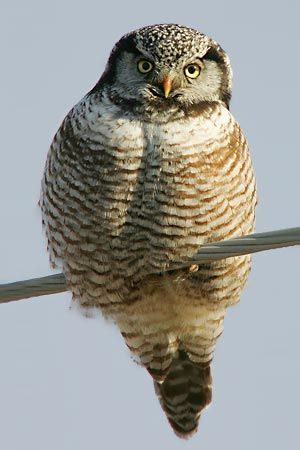
- Northern hawk owl: Surnia ulula1
- New Guinea hawk owl: Uroglaux dimorpha1
- Oriental hawk owl: Ninox scutulata1
- Great hawk owl: Ninox strenua1
Additionally, there are approximately 18 other species within the genus Ninox that are commonly referred to as hawk owls. While the northern hawk owl is primarily diurnal, many other species categorized as hawk owls are nocturnal or crepuscular.1
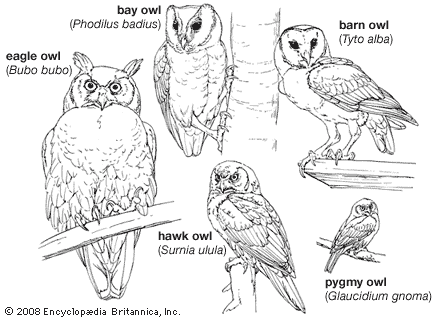
What are the distinguishing physical characteristics of a hawk owl?
The term “hawk owl” encompasses various species within the family Strigidae, meaning they do not share a single set of physical traits. However, the northern hawk owl (Surnia ulula) is the most notable for its hawk-like appearance, characterized by a long, rounded tail and short, pointed wings. Unlike many other owls, its facial disk does not extend above the eyes, and it lacks “ear” tufts.13
Other species, such as the Oriental hawk owl (Ninox scutulata), also exhibit a poorly differentiated facial disk. While owls generally share features like a flat face, a small hooked beak, and large, forward-facing eyes, hawk owls are distinguished by their specific variations in size and plumage. For instance, the New Guinea hawk owl and various Ninox species differ significantly in size, ranging from approximately 20 cm in smaller species to 50 cm in the great hawk owl (N. strenua).134
What are the main prey species of hawk owls?
The diet of hawk owls varies significantly depending on the specific species and its size. Because these birds occupy diverse environments, their prey is generally dictated by their physical dimensions and the local availability of food sources.15
Common prey items for various hawk owl species include:
- Small Mammals: Many species, including the northern hawk owl and the Oriental hawk owl, regularly consume small mammals. Larger species, such as the great hawk owl (N. strenua), are capable of hunting larger prey, including rabbits, rats, and possums.1
- Birds: Smaller birds, such as magpies, are included in the diet of larger hawk owls.1
- Insects: Insects are a primary food source for many hawk owls. The Oriental hawk owl, for example, is known to sally from perches to capture flying insects.15
While some species like the northern hawk owl are primarily diurnal, others are nocturnal or crepuscular, adapting their hunting strategies to the activity patterns of their prey.15
How does the hawk owl’s hunting behavior differ from other owl species?
The hunting behavior of hawk owls distinguishes them from many other owl species primarily through their activity patterns and specific capture techniques. While most owls are nocturnal, the northern hawk owl is notably diurnal, meaning it hunts during the day. Other hawk owls, such as the Oriental hawk owl and various Ninox species, are nocturnal or crepuscular.1
Regarding hunting methods, hawk owls often utilize a “sallying” technique, where they launch from a perch to capture flying insects in mid-air. This contrasts with many other woodland owls that typically drop from perches to secure prey on the ground, or grassland species like the short-eared owl that hunt via sustained, low-altitude flight. Furthermore, while most owls rely on short bursts of speed to surprise ground-dwelling prey, some Ninox species have been observed flying high in the air, occasionally soaring in circles, which is a departure from the typical forest-dwelling owl behavior of staying below the canopy.56
Sources
- Hawk owl — Encyclopædia Britannica
- Owl - Annotated classification — Encyclopædia Britannica
- hawk owl — Merriam-Webster
- Owl - General features — Encyclopædia Britannica
- Owl - Ecology — Encyclopædia Britannica
- Owl - Locomotion — Encyclopædia Britannica
Published on · 3 min read