Meadowlark
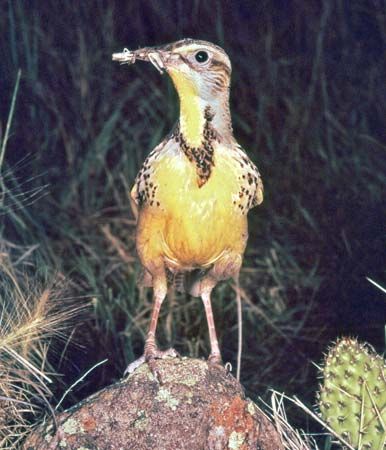
Meadowlarks are plump, sharp-billed birds belonging to the family Icteridae, typically measuring between 20 and 28 cm (8 to 11 inches) in length.
What are the distinguishing physical characteristics of meadowlarks?
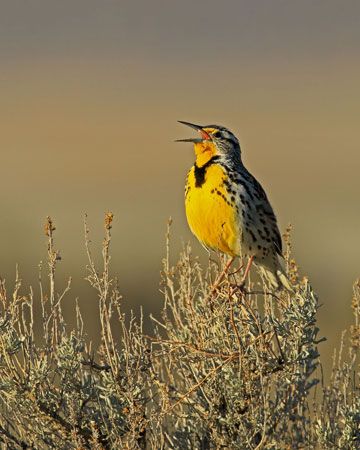
Meadowlarks are plump, sharp-billed birds belonging to the family Icteridae, typically measuring between 20 and 28 cm (8 to 11 inches) in length.1
Their physical appearance is characterized by the following features:
- Plumage: They are streaked brown on their upper bodies.12
- Breast: In North American species, they possess a yellow breast marked by a distinctive black V-shaped or crescent-shaped patch.12
- Tail: They have a short tail that displays noticeable white outer feathers.1
While the eastern and western meadowlark share these similar physical traits, they are often distinguished by their unique vocalizations rather than their appearance. Other related species, such as the red-breasted meadowlark, exhibit different coloration patterns.1
Where are meadowlarks typically found in North America?
In North America, the two primary species of meadowlarks occupy distinct geographic ranges across the continent:
- Eastern Meadowlark (Sturnella magna): This species is found throughout a broad range extending from eastern Canada down through the United States and into South America as far as Brazil.1
- Western Meadowlark (Sturnella neglecta): This species inhabits regions from western Canada southward into Mexico. Additionally, it has been introduced to Hawaii.1
Both species are typically found in open habitats, where they construct their nests as grass domes hidden within fields.1
What are the different species of meadowlarks, and how do they differ?
Meadowlarks are members of the genus Sturnella within the family Icteridae. While the name “lark” is often applied to various birds based on habitat, true larks belong to the family Alaudidae, whereas meadowlarks are distinct songbirds.13
The primary meadowlark species include:
- Eastern Meadowlark (S. magna): Found from eastern Canada to Brazil, this species is identified by a simple four-note whistle.1
- Western Meadowlark (S. neglecta): Ranging from western Canada to Mexico (and introduced to Hawaii), this species is distinguished by its intricate, fluting song.1
- Red-breasted Meadowlark (Pezites militaris): Occurring from Ecuador southward, this species and its subtropical relative (P. defilippi) are sometimes grouped with red-breasted blackbirds breasted blackbirds.1
The North American species (S. magna and S. neglecta) are physically similar, featuring streaked brown upper bodies, yellow breasts with a black V-shaped patch, and short tails with white outer feathers. They differ primarily in their vocalizations rather than their appearance.1
How do the songs of eastern and western meadowlarks differ?
The songs of the two primary North American meadowlark species are their most reliable distinguishing feature, as the birds are otherwise nearly identical in appearance.
- Eastern Meadowlark (Sturnella magna): This species is characterized by a relatively simple, clear four-note whistle.1
- Western Meadowlark (Sturnella neglecta): This species produces a more complex and melodic song described as an intricate, fluting sound.1
Because these vocalizations are so distinct, they serve as a primary behavioral barrier that helps keep the two species separate in areas where their ranges overlap.
Sources
- Meadowlark — Encyclopædia Britannica
- meadowlark — Merriam-Webster
- Lark — Encyclopædia Britannica
Published on · 2 min read