What Is the Coldest Temperature Ever Recorded on Earth?
The lowest temperature ever recorded on Earth occurred at Vostok Station in Antarctica. On July 21, 1983, the temperature at this research installation…
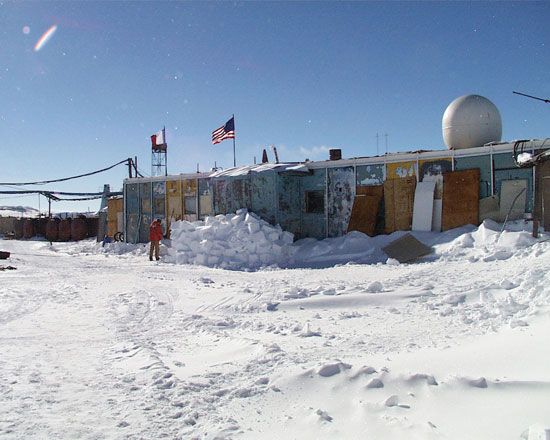
What is the coldest temperature ever recorded on Earth?
The lowest temperature ever recorded on Earth occurred at Vostok Station in Antarctica. On July 21, 1983, the temperature at this research installation dropped to −128.6 °F (−89.2 °C).1
This extreme cold is characteristic of the snow and ice climate, which is found over the ice caps of Antarctica and Greenland. In these regions, the presence of ice and snow at the surface keeps temperatures below freezing throughout the year, with the coldest conditions typically occurring at the end of the long polar night.2
What are katabatic winds and how do they affect Antarctic weather?
A katabatic wind is a gravity-driven wind that flows downslope. It occurs when air in contact with high, cold terrain radiates heat and cools, becoming denser than the surrounding air at the same elevation. This dense, cold air then drains downhill. While these winds can be gentle, they may become intense depending on the terrain’s incline and atmospheric pressure conditions.32
In Antarctica, katabatic winds are a primary weather factor, particularly in coastal regions where cold, dense air drains off the steep slopes of the interior ice sheets. Their effects include:4
- Blizzard Conditions: When these winds exceed a critical velocity, they become highly turbulent and sweep up loose snow. This can create localized “blizzards” where the sky above remains clear and no new snow is falling.4
- Extreme Wind Speeds: These winds can reach destructive velocities; gusts exceeding 110 miles per hour have been recorded at stations like Mirny, and speeds at Commonwealth Bay have averaged 45 miles per hour.4
- Wind Chill: As a major debilitating factor for expeditions, these winds significantly increase the cooling power of the air on exposed surfaces.4
How do scientists survive and conduct research at Vostok Station?
Scientists at Vostok Station operate in one of the most extreme environments on Earth, requiring significant adaptation to survive and conduct research. Because the station is located on the high inland ice sheet, researchers must endure temperatures that can drop to −128.6 °F (−89.2 °C), the lowest ever recorded on the planet.64
To manage these conditions, scientific efforts rely on modern technological advancements. Research at the station has historically focused on ice core drilling to study climate history and the exploration of Lake Vostok, a massive subglacial lake located 2.5 miles beneath the station.6
Survival and operational logistics include:
- Seasonal Planning: Due to the severity of the Antarctic winter, scientists often leave the station before the coldest period sets in to ensure safety.6
- Technological Adaptation: Modern polar research utilizes advanced equipment, such as satellite-linked data acquisition systems and specialized drilling technology, to minimize the need for manual labor in the harshest conditions.7
- Environmental Protection: During drilling operations, strict protocols are followed to prevent the contamination of unique subglacial ecosystems, such as the use of specialized fluids that are managed to avoid contact with the lake water.6
What is the Köppen climate classification system?
The Köppen climate classification is a widely used, vegetation-based, empirical system developed by German botanist-climatologist Wladimir Köppen. His goal was to create formulas that define climatic boundaries corresponding to the world’s biomes.8
The system divides terrestrial climates into five major types, represented by the letters A, B, C, D, and E. Except for type B, which is defined by dryness, these types are determined by temperature criteria.910
- A (Tropical): Warmest climates; differentiated by precipitation seasonality.910
- B (Dry): Defined by the relationship between precipitation and evaporation; includes arid (BW) and semiarid (BS) subtypes.10
- C (Mid-latitude): Mild climates with specific seasonal temperature ranges.10
- D (Mid-latitude): Severe mid-latitude climates with colder winters.10
- E (Polar): Coldest climates, separated into tundra (ET) and snow/ice (EF).910
Subtypes are designated by additional letters indicating precipitation patterns and temperature extremes. While sometimes criticized for not accounting for extreme events or factors like wind, it remains the most popular climate classification system today.10
Sources
- What is the coldest temperature ever recorded on Earth? — Encyclopædia Britannica
- Snow and ice climate — Encyclopædia Britannica
- Katabatic wind — Encyclopædia Britannica
- Antarctica - Climate of Antarctica — Encyclopædia Britannica
- Climate - Local wind systems — Encyclopædia Britannica
- Lake Vostok — Encyclopædia Britannica
- Antarctica - Post-IGY research — Encyclopædia Britannica
- Köppen climate classification: Top Questions — Encyclopædia Britannica
- Köppen climate classification — Encyclopædia Britannica
- Köppen climate classification - System — Encyclopædia Britannica
Published on · 3 min read