How High Do Birds Fly?
Most birds typically fly at altitudes of 150 meters (500 feet) or lower, though many species increase their elevation during migration, often ranging between…
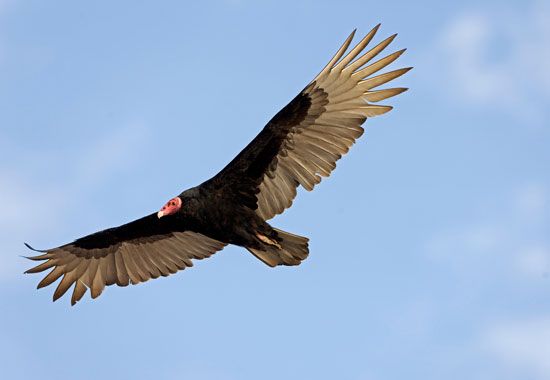
How high do birds fly?
Most birds typically fly at altitudes of 150 meters (500 feet) or lower, though many species increase their elevation during migration, often ranging between 610 and 1,525 meters (2,000 to 5,000 feet). Some migratory passerines have been observed at altitudes as high as 4,000 meters (14,000 feet), and geese have been recorded at 9,000 meters (29,500 feet).12
The highest recorded altitude for a bird is 11,300 meters (37,000 feet), achieved by a Rüppell’s griffon vulture. Birds are able to reach these heights due to highly efficient respiratory systems that extract oxygen effectively even when atmospheric pressure is low. Additionally, many species utilize thermal updrafts to soar and conserve energy, while others, like the bar-headed goose, possess specific metabolic adaptations to thrive in oxygen-limited environments.13
How do birds navigate during long-distance migration?
Birds navigate during long-distance migration using a combination of celestial cues, magnetic sensitivity, and, for shorter distances, familiar landmarks. Their navigational abilities are categorized into two types: compass orientation, which allows them to maintain a constant direction, and true navigation, which enables them to orient toward a specific goal.4
Celestial and Magnetic Navigation
Birds utilize celestial bearings to determine their position. During the day, they use the Sun as a compass, compensating for its movement across the sky using an internal clock. Theories suggest they may gauge the Sun’s horizontal angle or its arc to determine latitude and time. At night, many migrants use stars to determine their bearings, effectively performing celestial navigation to calculate their position. Additionally, birds are believed to possess a sensitivity to the intensity and direction of the Earth’s magnetic field, which serves as a vital navigational aid.4
Landmarks and Homing
For shorter distances or when nearing their destination, birds rely on familiar landmarks, including topographical features like mountain ranges, coastlines, and river systems, as well as ecological and climatic cues. While these landmarks are essential for homing, they do not fully explain how birds successfully navigate routes spanning thousands of miles.5
What are the advantages of flying in a V-formation?
The V-formation is a characteristic migratory flight pattern used by birds such as geese, ducks, pelicans, and cranes. The primary advantage of this formation is energy conservation.7
By flying in the wake of another bird, individuals reduce the air resistance they encounter, which helps them maintain flight efficiency over long distances. This cooperative behavior is further enhanced by the group’s social dynamics: members of the flock take turns leading the formation, allowing those behind the leader to benefit from the reduced effort before rotating to the front themselves.7
It is important to note that while vultures also maintain a V-shape with their wings—known as a dihedral—to improve stability in windy conditions, this is an individual anatomical adaptation for soaring rather than a group formation for migratory travel.2
How do birds’ respiratory systems differ from those of mammals?
Birds possess a highly specialized respiratory system that is significantly more efficient than that of mammals, supporting the high oxygen demands required for flight. While mammalian lungs inflate and deflate in a bidirectional, tidal flow, bird lungs maintain a constant volume and are ventilated unidirectionally.8
Key differences include:
- Air Sacs: Bird lungs are connected to a system of voluminous air sacs that act as bellows. These sacs ensure that fresh air flows through the lungs continuously during both inspiration and expiration.8
- Gas Exchange: Instead of the alveolar surfaces found in mammals, birds utilize fine air capillaries. The arrangement of gas and blood flow within these capillaries maximizes gas exchange efficiency.8
- Ventilation Control: Bird ventilation is often synchronized with wing motion, and the system also plays a role in thermoregulation and vocalization via the syrinx.8
This unique anatomy allows birds to maintain high metabolic rates, enabling feats such as high-altitude flight in species like Himalayan geese.8
Sources
- How high do birds fly? — Encyclopædia Britannica
- Migration - Modes of migration — Encyclopædia Britannica
- Biosphere - Atmospheric pressure — Encyclopædia Britannica
- Migration - Birds — Encyclopædia Britannica
- Migration - Navigation and orientation — Encyclopædia Britannica
- Migration - Other animals — Encyclopædia Britannica
- Why do vultures circle? — Encyclopædia Britannica
- Respiratory system - Birds — Encyclopædia Britannica
Published on · 3 min read