Hume Reservoir
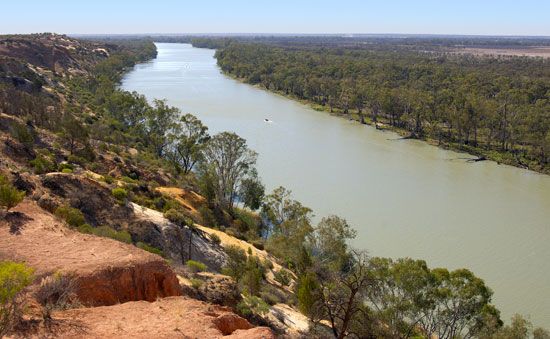
Hume Reservoir is a major reservoir located on the border between Victoria and New South Wales, Australia. Situated at the confluence of the Murray and…
What is Hume Reservoir?
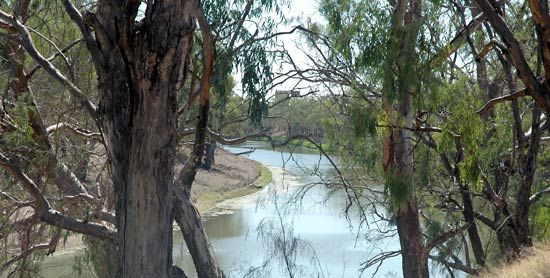
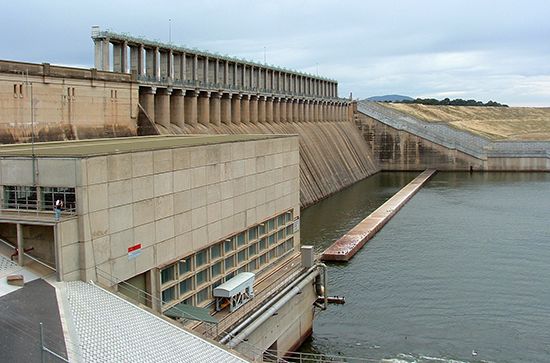
Hume Reservoir is a major reservoir located on the border between Victoria and New South Wales, Australia. Situated at the confluence of the Murray and Mitta-Mitta rivers, it lies approximately 10 miles (16 km) upstream from Albury.1
The project was completed in 1934 and named in honor of the explorer Hamilton Hume. Following an expansion in 1961, the reservoir reached a capacity of 2,500,000 acre-feet (3,100,000,000 cubic meters), a development that required the relocation of the township of Tallangatta.1
As a key component of the Murray River Scheme, the reservoir serves as a vital water source for both states, supporting domestic needs, livestock, irrigation, and the generation of hydroelectric power.1
Who was the explorer Hamilton Hume?
Hamilton Hume (1797–1873) was a prominent Australian explorer instrumental in opening the Berrima–Bong Bong district. Born near Parramatta, New South Wales, he began his exploration career at age 17, eventually discovering the Yass Plains in 1822.2
Hume is best known for his 1824–1825 expedition with William Hovell. Despite a lack of government funding, the pair traveled from Gunning to Corio Bay, discovering the Murray River and significant agricultural lands. Later, in 1828, he accompanied Charles Sturt on the expedition that discovered the Darling River.2
Following his expeditions, Hume settled in Yass and served as a magistrate. In 1860, he was elected a fellow of the Royal Geographical Society. His later years were marked by a public dispute with Hovell over the credit for their earlier discoveries, which Hume addressed in his 1855 publication, A Brief Statement of Facts in Connection with an Overland Journey from Lake George to Port Phillip.2
How does a hydroelectric power plant work?
A hydroelectric power plant generates electricity by converting the potential energy of water into mechanical energy and, ultimately, into electric power.5
The Generation Process
Most hydroelectric systems utilize a dam to store water at a higher elevation. This stored water is directed downward through large pipes or tunnels known as penstocks. The vertical distance between the reservoir and the turbine is called the head.3
As the water flows through the penstocks, its pressure and velocity increase, causing turbines to rotate. These turbines are connected to generators, which convert the mechanical rotation into electricity. Finally, transformers increase the voltage for efficient long-distance transmission.3
Specialized Systems
- Pumped-storage: To manage varying daily power demands, these stations pump water into an elevated reservoir during off-peak hours and release it through turbines during periods of high demand.3
- Tidal and Wave Power: These plants harness the kinetic energy of tides or ocean waves to drive turbines, offering alternative methods for generating renewable electricity.3
While hydroelectricity is a clean, renewable resource, it is important to acknowledge that the construction of dams can significantly disrupt natural systems, including fish migration and local ecosystems.43
What is the Murray River Scheme?
There is no project officially titled the “Murray River Scheme.” It is likely you are referring to the Snowy Mountains Hydro-Electric Scheme, a massive engineering project completed in 1974 that significantly impacts the Murray River system.67
The Snowy Mountains scheme involves impounding the waters of the Snowy River at high elevations and diverting them through tunnels under the Australian Alps. This process serves two primary purposes:
- Power Generation: It generates large quantities of electrical power, particularly for peak load periods.67
- Water Management: The diverted water is discharged into the Murray and Murrumbidgee rivers, increasing the volume available for irrigation in the Murray-Darling Basin.67
While this project was vital for Australia’s post-World War II development, it has faced criticism due to the environmental impact of reducing the natural flow of the Snowy River. Additionally, irrigation efforts within the broader Murray-Darling Basin have led to significant salinity issues, necessitating ongoing legislative and environmental management.76
Sources
- Hume Reservoir — Encyclopædia Britannica
- Hamilton Hume — Encyclopædia Britannica
- Did you know? — Merriam-Webster
- turbine — Encyclopædia Britannica
- hydroelectric power — Encyclopædia Britannica
- Murray River — Encyclopædia Britannica
- Snowy River — Encyclopædia Britannica
- Darling River — Encyclopædia Britannica
Published on · 3 min read