Hunter Island
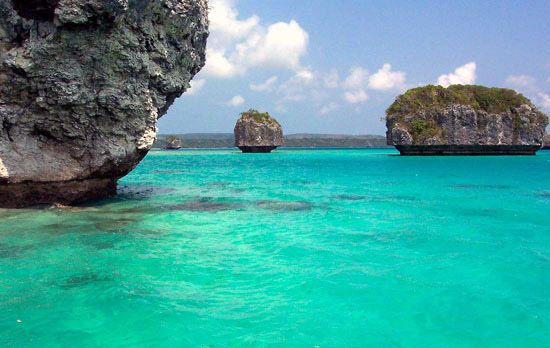
Hunter Island is a small, volcanic island located in the southwestern Pacific Ocean. Situated approximately 350 miles (560 km) east of the mainland of New…
What is Hunter Island?
Hunter Island is a small, volcanic island located in the southwestern Pacific Ocean. Situated approximately 350 miles (560 km) east of the mainland of New Caledonia, the island is part of a territory claimed by France, though this claim is disputed by Vanuatu.1
Measuring less than 1 mile (1.6 km) in diameter, the island sits atop the Hunter Island Ridge, a submarine shelf. It features an intermittently active volcano that reached an elevation of about 1,000 feet (300 meters) in the late 1950s. Due to its volcanic nature, the island is not suitable for human habitation and has no permanent residents. It was discovered in 1798 by Captain John Fearn, who named it after his ship, the Hunter; consequently, it is sometimes known as Fearn Island.1
Why do France and Vanuatu both claim Hunter Island?
The dispute over Hunter Island arises from conflicting territorial claims between France and Vanuatu, primarily driven by the desire to expand their respective exclusive economic zones (EEZs) in the southwestern Pacific OceanEEZs) in the southwestern Pacific Ocean.3
France maintains its claim to the island as part of its overseas collectivity of New Caledonia. Conversely, Vanuatu formally asserted its claim to Hunter Island—along with the nearby Matthew Island—in 1982. Vanuatu bases its position on the argument that these islands are part of the same archipelago as its own territory, located approximately 155 miles (250 km) southeast of the island of Anatom.123
Because these islands are uninhabited and hold strategic value for maritime jurisdiction, the competing claims have remained unresolved since they were first contested in the early 1980s.13
How do volcanic islands form in the middle of the ocean?
Volcanic islands form in the middle of the ocean primarily through three distinct geologic processes:
- Subduction Zones: When two tectonic plates converge, one is forced beneath the other into the mantle. This process triggers melting in the mantle wedge, producing magma that rises to the surface. When this occurs between two oceanic plates, it creates a curved chain of islands known as an island arc, such as the Mariana Islands.45
- Hotspots: Some volcanoes form far from plate boundaries due to a hotspot—a region where mantle material upwells and melts through the crust. As a lithospheric plate moves over a stationary hotspot, it creates a chain of volcanic islands. The Hawaiian Islands are the classic example, where the age of the islands increases with their distance from the active hotspot.46
- Oceanic Ridges: Along oceanic ridge systems, plates move apart and magma wells up to create new seafloor. While most of this activity is underwater, some ridges are sufficiently elevated to emerge above sea level, as seen in Iceland4.
What are some other disputed territories in the Pacific Ocean?
Beyond the dispute over Hunter Island, the Pacific Ocean contains several other significant territorial contentions, often driven by strategic location, access to natural resources, and the establishment of exclusive economic zones (EEZs).
The Kuril Islands
The Kuril Islands are a chain of islands separating the Sea of Okhotsk from the Pacific. Following World War II, the islands were ceded to the Soviet Union. Japan continues to claim the southernmost islands, which it calls the Northern Territories. This ongoing dispute has prevented Russia and Japan from formally concluding a peace treaty to end the war.8
South China Sea Disputes
The South China Sea is the site of complex, overlapping claims involving China, Taiwan, Vietnam, the Philippines, Malaysia, and Brunei. Key areas of contention include:910
- Paracel Islands: Claimed by China, Taiwan, and Vietnam, these islands have been under Chinese control since 1974.11
- Spratly Islands: This large group of reefs and islets is claimed in whole or in part by several regional nations. The area is highly contested due to its strategic importance and potential natural gas and crude oil reserves.912
In 2016, an arbitral tribunal ruled that China’s “nine-dash line” claim was invalid under the United Nations Convention on the Law of the Sea, though China has rejected this ruling.1013
Sources
- Hunter Island — Encyclopædia Britannica
- Vanuatu — Encyclopædia Britannica
- Vanuatu - History of Vanuatu — Encyclopædia Britannica
- volcanism — Encyclopædia Britannica
- hotspot — Encyclopædia Britannica
- plate tectonics - Island arcs — Encyclopædia Britannica
- volcano - Submarine volcanoes — Encyclopædia Britannica
- Kuril Islands — Encyclopædia Britannica
- territorial disputes in the South China Sea - Physiography and economic factors — Encyclopædia Britannica
- Paracel Islands — Encyclopædia Britannica
- Spratly Islands — Encyclopædia Britannica
- Pacific Islands - Into the 21st century — Encyclopædia Britannica
- territorial disputes in the South China Sea — Encyclopædia Britannica
- territorial disputes in the South China Sea - Early 21st-century developments — Encyclopædia Britannica
Published on · 3 min read