Ipomoea
The genus Ipomoea is a prominent member of the Convolvulaceae family, commonly known as the morning glory family. Within this family, Ipomoea stands out as…
How does the Ipomoea genus fit into the broader plant family classification?
The genus Ipomoea is a prominent member of the Convolvulaceae family, commonly known as the morning glory family. Within this family, Ipomoea stands out as the largest genus, encompassing approximately 500 species of mostly warm-climate trees, shrubs, and twining or trailing herbaceous plants.123
The Convolvulaceae family itself is classified within the order Solanales, which is part of the core asterid clade of flowering plants. The order Solanales includes five families, with Convolvulaceae and Solanaceae (the nightshade family) being the most significant in terms of cultivated species.43
As a genus, Ipomoea fits into this broader hierarchy as a key representative of the morphological and ecological diversity found within Convolvulaceae, ranging from the economically vital sweet potato (I. batatas) to various ornamental morning glories.123
What are the defining characteristics of plants in the Ipomoea genus?
The genus Ipomoea is a diverse group of approximately 500 species within the Convolvulaceae family, primarily found in warm climates. While they are most commonly recognized as twining or trailing herbaceous vines, the genus also includes various shrubs and trees.153
The defining characteristics of Ipomoea include:
- Leaves: The plants typically possess simple leaves, which can be entire, lobed, or divided depending on the specific species.1
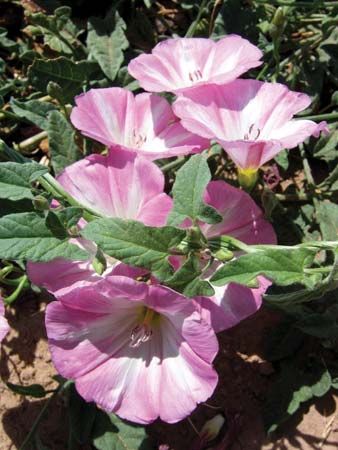
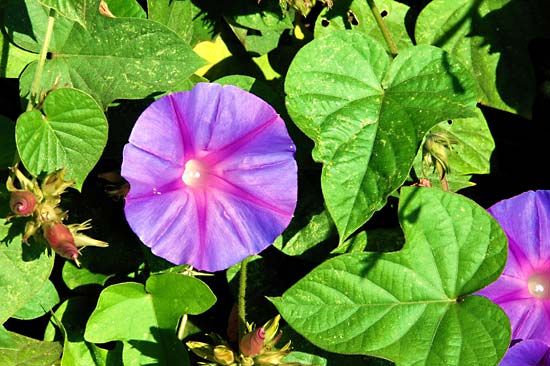
- Flowers: A hallmark of the genus is its showy, trumpet- or funnel-shaped flowers. These are often borne in the axils of the leaves and vary significantly in size and color across species.15
- Fruit and Seeds: The fruit is generally a capsule that typically contains four to six seeds.1
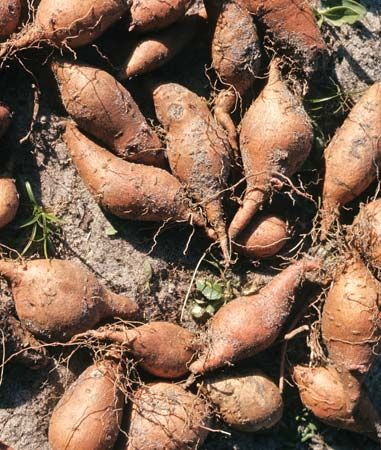
- Root Systems: Many species exhibit specialized root structures, such as the enlarged, edible roots of the sweet potato (I. batatas) or the tuberous roots found in species like the bush morning glory.153
- Chemical Properties: Certain species are noted for specific chemical compounds, such as the milky juice in the moonflower used for rubber coagulation, or the ergoline alkaloids found in the seeds of species like I. violacea.153
Are there any Ipomoea species that are considered invasive or problematic?
Yes, some species within the Ipomoea genus are considered problematic. Specifically, the common morning glory (Ipomoea purpurea) is widely cultivated as an ornamental plant, but it has become a troublesome weed in parts of southeastern North America.11
While many Ipomoea species are valued for their aesthetic appeal or agricultural utility, their vigorous growth habits can lead them to become invasive in environments where they are not native or are not properly managed.51
How are Ipomoea plants used in agriculture and horticulture?
Plants in the Ipomoea genus are utilized in both agriculture and horticulture for their nutritional, industrial, and aesthetic value.
Agricultural Uses
The most significant agricultural species is the sweet potato (Ipomoea batatas), a vital food crop grown globally in tropical and warm temperate climates. Its enlarged, tuberous roots are consumed as a vegetable and used in the production of starch and alcohol. Other species have specialized applications:18
- Medicinal: The roots of the jalap (I. purga) are used as a traditional purgative.1
- Industrial: The milky juice of the moonflower (I. alba) has been used for the coagulation of rubber.1
Horticultural Uses
Many Ipomoea species are cultivated as ornamental plants due to their attractive, trumpet-shaped flowers. Popular choices include:1
- Morning Glories: Species such as the common morning glory and the heavenly blue morning glory are widely grown as garden annuals or vines for their showy blooms.1
- Varied Forms: The genus includes diverse growth habits, ranging from trailing vines to shrubs and trees, such as the morning glory tree (I. arborescens), which are used in landscaping.17
Sources
- Ipomoea — Encyclopædia Britannica
- Solanales — Encyclopædia Britannica
- Solanales - Convolvulaceae — Encyclopædia Britannica
- Convolvulaceae — Encyclopædia Britannica
- morning glory — Encyclopædia Britannica
- palm - Inflorescences — Encyclopædia Britannica
- tree ipomoea — Merriam-Webster
- Sweet potato — Encyclopædia Britannica
Published on · 3 min read