Kentucky Coffeetree
The Kentucky coffeetree (Gymnocladus dioicus) is a deciduous tree belonging to the pea family (Fabaceae). Native to North America, its range extends from New…
What is Kentucky coffeetree?
The Kentucky coffeetree (Gymnocladus dioicus) is a deciduous tree belonging to the pea family (Fabaceae). Native to North America, its range extends from New York and southern Ontario down to Oklahoma.1
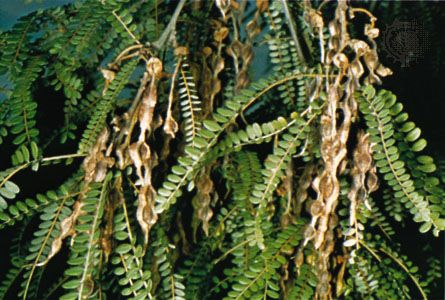
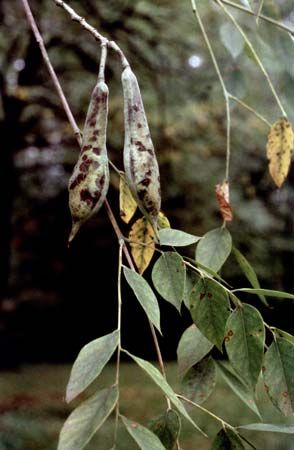
The tree can reach heights of approximately 30 meters (100 feet) and is characterized by rough, gray-brown bark and large, bipinnate leaves. It produces clusters of small, greenish-white, unisexual flowers and woody, dark brown seed pods that can grow up to 25 cm (10 inches) long.1
Historically, the tree earned its name because its roasted seeds were used as a coffee substitute during colonial times. Today, it is often grown as an ornamental plant, and its durable, heavy wood is utilized in construction and cabinetry.1
What are some other trees in the pea family?
The Fabaceae family, commonly known as the pea family, is incredibly diverse and includes thousands of species of trees, shrubs, vines, and herbs. While many members are famous for their food crops, such as soybeans, peanuts, and peas, the family also contains numerous notable tree species.234
Some examples of trees within the pea family include:
- Locust: This genus (Robinia) includes the black locust (Robinia pseudoacacia), which is often cultivated as an ornamental and used for timber and erosion control.5
- Honey locust: (Gleditsia triacanthos) A North American tree frequently used in landscaping and hedges.53
- Acacia: A large group of trees and shrubs, some of which are used for fodder, soil improvement, and the production of tannin and pulpwood the production of tannin and pulpwood.6
- Redbud: Trees in the genus Cercis, such as the Judas tree (Cercis siliquastrum), are well-known for their ornamental value.34
- Tamarind: (Tamarindus indica) A tree valued for its edible fruits, medicinal uses, and industrial gums.34
- Carob: (Ceratonia siliqua) A Mediterranean tree whose fruits serve as both human and animal food.34
- Royal poinciana: (Delonix regia) A tree often grown for its showy appearance.3
- Pagoda tree: (Styphnolobium japonicum) Another species frequently utilized as an ornamental.3
How do bipinnate leaves differ from simple leaves?
The primary difference between a simple leaf and a bipinnate leaf lies in the structure of the blade.
A simple leaf consists of a single, undivided blade attached to the stem by a petiole. While the margins of a simple leaf may be smooth, serrated, or lobed, the blade remains a single unit.7
In contrast, a bipinnately compound leaf is a highly elaborated structure where the blade is divided into multiple subunits called leaflets. In a standard pinnately compound leaf, leaflets form along an extension of the petiole known as the rachis. A bipinnate leaf takes this a step further: the primary leaflets branch again, developing a second set of smaller leaflets.7
Because of this complexity, bipinnate leaves can often resemble entire shoot systems. However, they can be distinguished from actual branches because true axillary buds are found only in the angle between the stem and the petiole of the entire leaf, not at the base of the individual leaflets.7
Why were the seeds roasted to make a coffee substitute?
The seeds of the Kentucky coffeetree were roasted for use as a coffee substitute primarily due to their historical role as a readily available alternative during colonial times. While the seeds were consumed in this manner, it is important to note that the raw seeds and pods of the Kentucky coffeetree are considered toxic; roasting was a necessary process to prepare them for consumption and to mimic the flavor profile of coffee.1
The term “coffee” in the name of the tree directly reflects this historical practice of utilizing the seeds as a beverage ingredient. Similarly, other plants, such as the chickpea, have been referred to as “coffee peas” for the same reason—their seeds were historically roasted and brewed as a substitute when traditional coffee was scarce or expensive.111
Sources
- Kentucky coffeetree — Encyclopædia Britannica
- Fabaceae — Encyclopædia Britannica
- locust — Encyclopædia Britannica
- List of plants in the family Fabaceae — Encyclopædia Britannica
- Fabales - Characteristic morphological features — Encyclopædia Britannica
- Fabaceae - Food and fodder crops — Encyclopædia Britannica
- angiosperm - Leaves — Encyclopædia Britannica
- compound leaf — Merriam-Webster
- Caryophyllales - Characteristic morphological features — Encyclopædia Britannica
- fern - Venation — Encyclopædia Britannica
- coffee pea — Merriam-Webster
Published on · 3 min read