Japanese Knotweed
Japanese knotweed (Fallopia japonica) is a herbaceous perennial plant in the buckwheat family (Polygonaceae). Native to East Asia, it is considered one of…
What is Japanese knotweed?
Japanese knotweed (Fallopia japonica) is a herbaceous perennial plant in the buckwheat family (Polygonaceae). Native to East Asia, it is considered one of the world’s most destructive invasive species in regions like North America and Europe.
Physical Characteristics
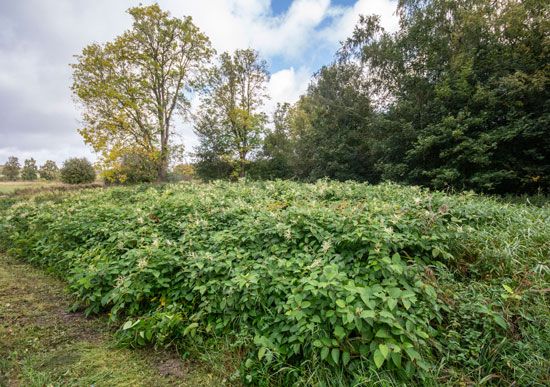
The plant grows rapidly into a dense shrub, reaching heights of 3–4.5 meters. Its hollow, bamboo-like stems emerge from an extensive network of underground rhizomes and a deep taproot. It is allelopathic, meaning it releases chemicals that inhibit the growth of surrounding vegetation, allowing it to form vast, ecologically damaging monospecies stands.
Management Challenges
Japanese knotweed is notoriously difficult to eradicate. Because it can regenerate from tiny root fragments, mechanical removal is often ineffective and can inadvertently spread the plant. Management typically requires years of persistent effort, such as repeated cutting to deplete the rhizomes’ energy reserves and the targeted use of herbicides.
Where does Japanese knotweed originally come from?
Japanese knotweed (Fallopia japonica) is native to East Asia, specifically China, Korea, and Japan.1
What does Japanese knotweed look like?
Japanese knotweed (Fallopia japonica) is a tall, dense herbaceous perennial that can reach heights of 3–4.5 meters (10–15 feet). Its appearance is characterized by several distinct features:
- Stems: The plant features hollow, jointed stems that resemble bamboo. When mature, these stems take on an orange hue.
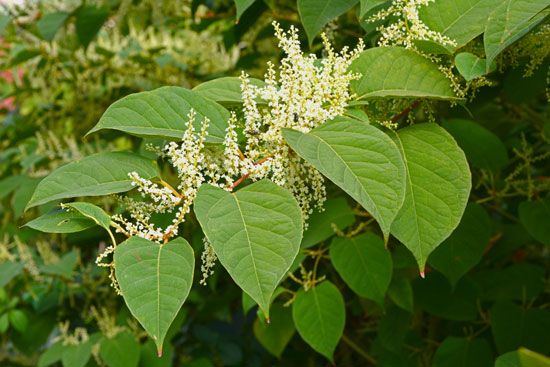
- Leaves: It has simple, ovate leaves that grow up to 15 cm (6 inches) in length and are arranged alternately along the stems. When they first emerge, the leaves are red-purple, eventually fading to green.
- Flowers: In late summer, the plant produces showy clusters of small white or light green flowers.
- Growth Habit: It grows from a deep taproot and an extensive network of underground rhizomes, often forming dense, monospecies thickets.2
The plant dies back to its rhizomes during the fall, leaving behind its characteristic stems.2
Why is Japanese knotweed considered an invasive species?
Japanese knotweed is considered one of the world’s worst invasive species due to its aggressive growth and ability to dominate ecosystems. Its status as a noxious weed is driven by several key factors:
- Competitive Advantage: The plant is allelopathic, meaning it releases chemicals into the soil that inhibit the growth and survival of surrounding native plants. This allows it to form vast, dense monospecies thickets that provide little support for local wildlife.1
- Resilience and Adaptability: It thrives in various conditions, including drought, deep shade, and high soil salinity. Its rapid growth and ability to spread through both seeds and an extensive network of underground rhizomes make it exceptionally difficult to contain.1
- Persistence: Because the plant can regenerate from even a tiny fragment of root left in the soil, traditional removal methods like digging are often ineffective and can inadvertently promote further spread.1
These traits have allowed it to escape cultivation and outcompete native vegetation across North America and Europe, where it lacks the natural checks and balances present in its native range.1
Sources
- Japanese knotweed — Encyclopædia Britannica
- Japanese knotweed — Merriam-Webster
Published on · 2 min read