Emerald Ash Borer
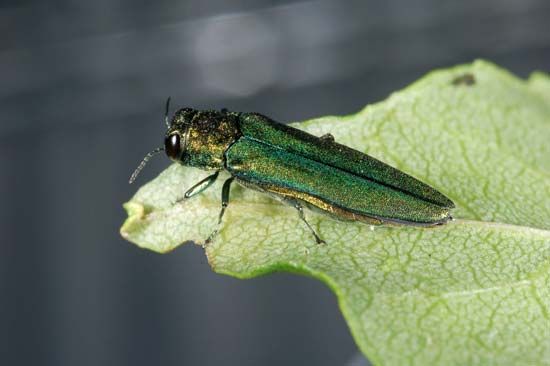
The emerald ash borer (Agrilus planipennis) is a metallic-green beetle native to East Asia that has become one of the most destructive invasive species in…
What is emerald ash borer?
The emerald ash borer (Agrilus planipennis) is a metallic-green beetle native to East Asia that has become one of the most destructive invasive species in North America. Accidentally introduced via wooden shipping materials in the 1990s, it was first detected in the U.S. and Canada in 2002.123
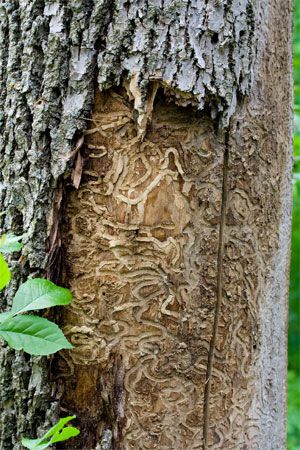
The insect’s life cycle is devastating to ash trees. Adult females lay eggs on the bark, and the hatching larvae bore into the tree to feed on the phloem and sapwood. They create S-shaped tunnels that disrupt the tree’s vascular system, typically killing it within a few years. Because North American ash species lack evolutionary defenses against the beetle, fewer than 1 in 1,000 trees survive an attack.12
Control efforts have shifted from attempted eradication to management, as the pest has spread across much of the U.S. and Canada and was recently detected in the European Union. While insecticides are used for individual trees, biological control using parasitoid wasps is considered the most promising long-term strategy.12
Why are North American ash trees so vulnerable to this beetle compared to Asian species?
North American ash trees are highly vulnerable to the emerald ash borer because they lack the evolutionary defenses that Asian ash species have developed over time.41
In their native East Asian range, emerald ash borers typically attack only stressed or weakened trees, as the local ash species have evolved mechanisms to resist or tolerate the beetle’s presence. Conversely, North American ash species have no such evolutionary history with the insect. As a result, the beetle does not distinguish between healthy and stressed trees in North America, and the larvae are able to successfully infest and kill both.1
Because these trees lack natural resistance, the infestation is almost universally fatal, with fewer than 1 in 1,000 trees surviving an attack. This lack of defense has allowed the beetle to cause the death of hundreds of millions of trees, leading to significant ecological and economic consequences across the continent.14
How do parasitoid wasps help control the emerald ash borer population?
To manage the emerald ash borer population, researchers have deployed stingless parasitoid wasps native to Asia as a form of biological control. These wasps target the beetle at different stages of its life cycle to reduce its numbers.2
The four species approved for release in North America function as follows:
- Egg Parasitoid: The species Oobius agrili targets the beetle’s eggs. The female wasp lays its own eggs inside the emerald ash borer eggs, providing a food source for the developing wasp larvae.2
- Larval Parasitoids: The species Spathius agrili, S. galinae, and Tetrastichus planipennisi target the beetle’s larvae. The female wasps lay their eggs on or inside the larvae, which then serve as a food source for the emerging young.2
Since 2007, more than five million of these wasps have been released in the United States. In some areas, this strategy has proven effective, with up to 80 percent of emerald ash borer larvae becoming parasitized.2
What are some other examples of invasive species that have damaged North American ecosystems?
North American ecosystems have been significantly altered by numerous invasive species over the past two centuries. These organisms often outcompete native species for resources, disrupt food chains, or cause direct ecological and economic damage.7
Key examples of invasive species in North America include:
- Zebra mussel: Native to the Black, Aral, and Caspian seas, this mollusk arrived in the Great Lakes via ship ballast water around 1986. They clog water-intake pipes, deplete algae populations, and have driven many native mussel species toward extinction.78
- Sea lamprey: A primitive fish from the North Atlantic that gained access to the Great Lakes through canal systems. They use a specialized sucker to latch onto and drain the blood of native game fish.7
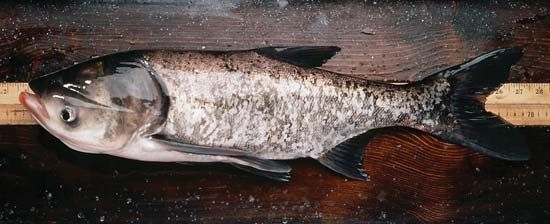
- Asian carp: Introduced to control algae on catfish farms, these fish escaped into the Mississippi River system. They are fierce competitors that consume massive amounts of zooplankton and algae, often accounting for 90 percent of the biomass in certain river stretches.7
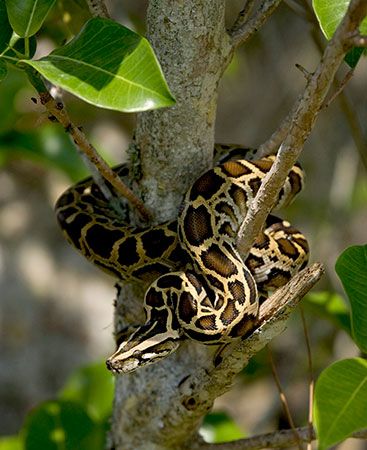
- Burmese python: Established in Florida’s wetlands after escaping captivity, these large constrictors have become dominant predators, causing local declines in species like the wood stork and Key Largo wood rat.7
- Kudzu and Japanese knotweed: These fast-growing plants form dense monocultures that deprive native vegetation of sunlight and are notoriously difficult to eradicate.7
- Common buckthorn: Brought from Eurasia, this plant creates dense thickets that displace native flora by blocking light.9
- Red imported fire ant: An aggressive, biting species from South America that has spread across large parts of the United States, likely through the transport of soil and landscaping materials.7
Sources
- Emerald Ash Borer: At a Glance — Encyclopædia Britannica
- emerald ash borer — Encyclopædia Britannica
- emerald ash borer — Merriam-Webster
- emerald ash borer: Top Questions — Encyclopædia Britannica
- ash — Encyclopædia Britannica
- braconid wasp — Encyclopædia Britannica
- invasive species - A global problem — Encyclopædia Britannica
- habitat loss — Encyclopædia Britannica
- mussel — Encyclopædia Britannica
- stink bug — Encyclopædia Britannica
Published on · 4 min read