Ecosystem
Ecological succession is the process by which the structure of a biological community evolves over time. This progression is not random; rather, it follows a…

What is ecological succession and how does it occur?
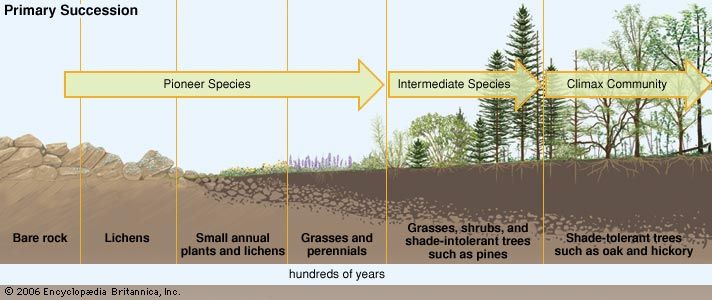
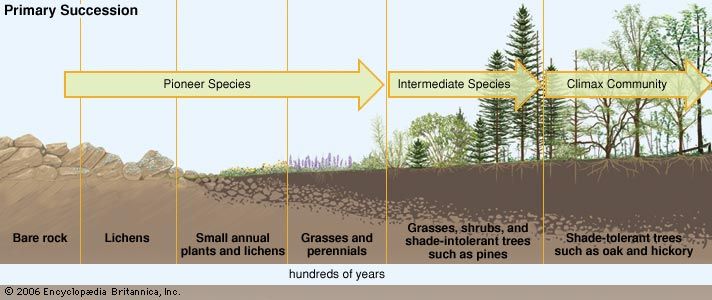
Ecological succession is the process by which the structure of a biological community evolves over time. This progression is not random; rather, it follows a partially predictable sequence as species modify their environment, making it more suitable for others to follow.1
Succession is categorized into two types:
- Primary succession: Occurs in essentially lifeless areas where soil is incapable of sustaining life, such as regions affected by lava flows or retreating glaciers. Pioneer species—such as lichens, mosses, and bacteria—colonize these barren environments, breaking down rock and forming soil.12
- Secondary succession: Occurs in areas where a previous community was removed by a disturbance, such as a wildfire or flood, but where soil and nutrients remain.13
As intermediate species establish themselves, they often outcompete pioneers for resources like sunlight. Eventually, the community may reach a climax community, a stable state of equilibrium dominated by a small number of prominent species.21
How do keystone species influence ecosystem stability?
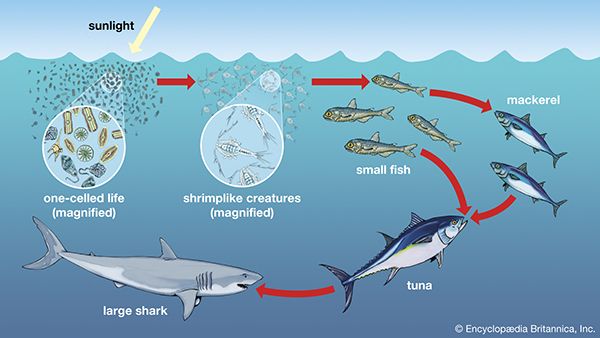
Keystone species are organisms that exert a disproportionately large influence on their environment relative to their abundance, playing a critical role in maintaining ecosystem structure and biodiversity. They stabilize communities through two primary mechanisms:45
- Population Control: Many keystone species are apex predators that regulate the populations of species that might otherwise dominate and exclude others. For example, the starfish Pisaster ochraceus prevents mussels from monopolizing rocky intertidal shores, thereby allowing a wider variety of species to coexist.45
- Resource Provisioning: Some species act as keystone resources. In tropical forests, figs provide essential food year-round, supporting numerous birds and mammals during periods when other food sources are unavailable.45
The removal of these species often triggers a trophic cascade, leading to dramatic shifts in food webs, nutrient cycling, and overall ecosystem health. Because these species are fundamental to the stability of their biological communities, their conservation is vital for preserving the natural processes that provide essential services to the environment.6
How do climate change and global warming affect different ecosystems?
Climate change and global warming exert profound and often destabilizing effects on ecosystems worldwide by altering physical conditions, biological interactions, and resource availability.78
Marine Ecosystems
The world’s oceans absorb more than 90 percent of the heat trapped by greenhouse gases, leading to significant ocean warming. This heat causes thermal expansion and contributes to sea level rise, while also disrupting ocean currents and reducing dissolved oxygen levels.8
- Coral Reefs: Rising temperatures and ocean acidification trigger coral bleaching, a process where corals lose their symbiotic algae. Because reefs support roughly 25 percent of all marine species, their decline threatens widespread biodiversity loss.89
- Food Webs: Warming waters force many species to migrate toward the poles, disrupting established food chains and threatening global food security.8
Tundra and Polar Ecosystems
Arctic and alpine regions are warming at rates significantly higher than the global average.10
- Permafrost and Carbon: Thawing permafrost releases stored carbon as methane and CO₂, creating a positive feedback loop that accelerates further warming.10
- Habitat Shifts: Melting sea ice and the northward migration of tree species are reducing the geographic extent of the tundra, diminishing habitats for native wildlife like caribou.10
Terrestrial and Soil Systems
Climate change increases the frequency and severity of extreme weather, including wildfires, floods, and heat waves. These disturbances can force secondary succession, though in some regions, such as the tropics, repeated destruction can lead to permanently impoverished landscapes. Furthermore, changes in rainfall and temperature patterns directly impact soil health and the carbon cycle, as soils act as both sources and repositories for greenhouse gases.71112
What are the main components of an ecosystem?
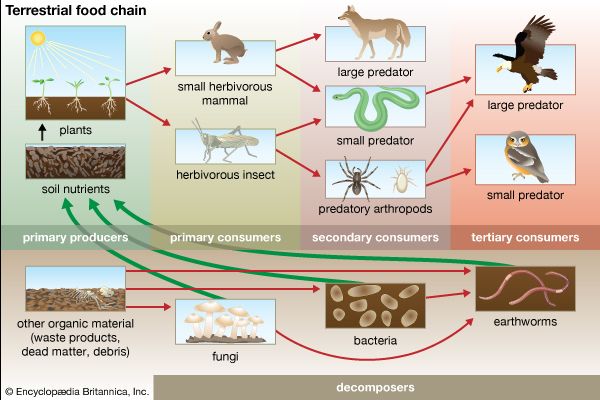
An ecosystem is a complex unit consisting of living organisms, their physical environment, and the interrelationships between them. Its structure is defined by two primary components:13
Abiotic Components
The abiotic, or nonliving, portion provides the physical and chemical foundation for life. It includes:
- Environmental factors: Climate, sunlight, water, and soil.13
- Substances and flows: The concentration of organic and inorganic substances, as well as the flow of energy, gases, and nutrients.1415
Biotic Components
The biotic, or living, portion consists of all organisms within the ecosystem, categorized by how they acquire energy:1415
- Producers (Autotrophs): Primarily green plants that use photosynthesis to convert solar energy into food.1316
- Consumers (Heterotrophs): Organisms, such as animals, that rely on producers or other consumers for energy.1317
- Decomposers: Organisms like bacteria and fungi that break down dead organic matter, recycling nutrients back into the environment.1317
These components are linked by the continuous flow of energy and the cycling of essential elements, such as carbon, nitrogen, and phosphorus14.15
Sources
- ecological succession — Encyclopædia Britannica
- pioneer species — Encyclopædia Britannica
- secondary succession — Encyclopædia Britannica
- keystone species — Encyclopædia Britannica
- trophic cascade — Encyclopædia Britannica
- community ecology - Keystone species — Encyclopædia Britannica
- Climate change - Effects of climate change — Encyclopædia Britannica
- Tundra - Effects of human activities and climate change — Encyclopædia Britannica
- plant - Succession and zonation — Encyclopædia Britannica
- soil - Soils and global warming — Encyclopædia Britannica
- ocean warming — Encyclopædia Britannica
- Coral bleaching — Encyclopædia Britannica
- Biosphere: Top Questions — Encyclopædia Britannica
- ecosystem — Encyclopædia Britannica
- trophic pyramid — Encyclopædia Britannica
- ecology - Areas of study — Encyclopædia Britannica
- Biosphere — Encyclopædia Britannica
- trophic level — Encyclopædia Britannica
Published on · 4 min read