Jerusalem Artichoke
The Jerusalem artichoke (Helianthus tuberosus) is a species of sunflower native to North America, specifically the United States and Canada. Despite its…
What is the origin and native habitat of the Jerusalem artichoke?
The Jerusalem artichoke (Helianthus tuberosus) is a species of sunflower native to North America, specifically the United States and Canada. Despite its name, it is not related to the artichoke, which is native to the Mediterranean and North Africa.123
The name “Jerusalem” is a result of folk etymology, likely derived from the Italian word girasole, meaning sunflower. Unlike the common artichoke, which is grown for its edible flower buds, the Jerusalem artichoke is a perennial plant cultivated primarily for its edible tubers, which are rich in the carbohydrate inulinscience/tuber), which are rich in the carbohydrate inulin.213
How have Jerusalem artichokes been used historically for non-food purposes?
Historically, the Jerusalem artichoke (Helianthus tuberosus) has been utilized for purposes beyond human consumption. Most notably, the plant has long been cultivated in France as a source of stock feed for livestock.12
While the plant is primarily recognized for its edible tubers, which are rich in the carbohydrate inulin, its use as animal fodder highlights its versatility as an agricultural crop. In the United States, where large-scale cultivation is less common, the tubers are occasionally used in the production of dietary preparations, in addition to their culinary applications in pickles and relishes.1
Why is the Jerusalem artichoke sometimes called a ‘sunchoke,’ and how is it related to sunflowers?
The Jerusalem artichoke is called a “sunchoke” as a modern marketing term, popularized around the mid-20th century to make the vegetable more appealing to consumers by highlighting its botanical relationship to the sunflower.1
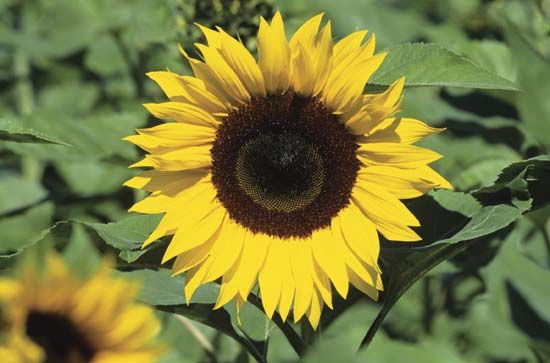
The plant is directly related to the common sunflower (Helianthus annuus) because both belong to the same genus, Helianthus, within the Asteraceae family. While the common sunflower is primarily cultivated for its seeds and oil, the Jerusalem artichoke (Helianthus tuberosus) is a perennial species specifically valued for its edible underground [tubers]. Both plants share similar physical characteristics, such as showy yellow flower heads, though the Jerusalem artichoke is distinguished by its ability to produce these starchy, carbohydrate-rich tubers.45
We could dive deeper into the differences in cultivation between these two Helianthus species or explore the history of other North American native crops.
What are the unique characteristics of the Jerusalem artichoke plant’s appearance and growth habits?
The Jerusalem artichoke (Helianthus tuberosus) is a distinct species that does not resemble the common artichoke. Its unique characteristics are defined by its growth as a coarse, usually multibranched, frost-tender perennial that reaches heights of 2 to 3 metres (7 to 10 feet).13
Aboveground Appearance
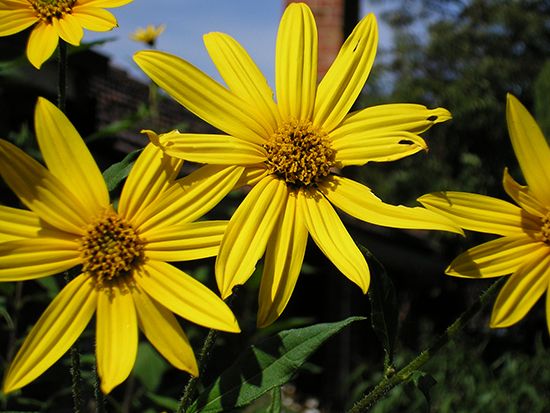
The plant produces numerous showy flower heads that typically appear in late summer or early autumn. These heads feature yellow ray flowers surrounding disk flowers that can be yellow, brownish, or purplish in colour.3
Underground Growth and Propagation
The plant is primarily noted for its edible tubers, which develop underground. These tubers exhibit significant variety:
- Shape: They range from oblong to much-elongated and from regular to rough and branched.3
- Size and Color: They vary from very small to approximately 110 grams (4 ounces), with skin colors spanning light buff, yellow, brown, red, and purple.3
- Texture: The tubers have very thin skin and crisp, white flesh. Because they are thin-skinned, they tend to shrivel quickly when exposed to dry air.3
The plant is propagated by planting these tubers.3
Sources
- Jerusalem artichoke — Encyclopædia Britannica
- Jerusalem artichoke — Merriam-Webster
- Artichoke — Encyclopædia Britannica
- Sunflower — Encyclopædia Britannica
- sunchoke — Merriam-Webster
Published on · 2 min read