Medlar
The genus Mespilus, a member of the Rosaceae family, consists of two distinct species of medlar plants:
What are the different varieties of medlar plants?
The genus Mespilus, a member of the Rosaceae family, consists of two distinct species of medlar plants:
- Common Medlar (M. germanica): A small, deciduous, and spinous tree native to Europe and southwestern Asia. It produces white or pink-tinged flowers and brown, globular fruits that must undergo a softening process called bletting before they are edible.1
- Stern’s Medlar (M. canescens): Discovered in Arkansas in 1990, this species grows as a tree or shrub reaching up to 6 meters in height. It features showy white flowers and produces a glossy red pome. This species is currently considered critically endangered, with only a small number of individuals remaining in its natural habitat.1
While the common medlar has several cultivated varieties, both species share the requirement of bletting to develop their characteristic acidic and astringent flavor.1
What is the history and cultural significance of the medlar plant?
The medlar (Mespilus germanica) has a long history in Europe and southwestern Asia, dating back to at least the 14th century in English records. While it was once a common garden fruit, it has largely faded from modern popularity because the fruit cannot be eaten immediately upon harvest.13
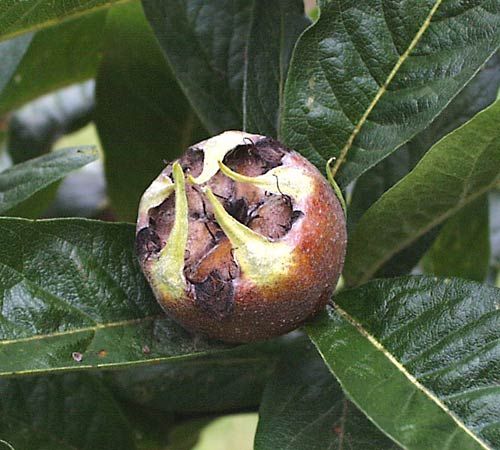
Culturally, the medlar is perhaps most famous for its unusual appearance. The fruit features a wide, gaping apex with persistent calyx lobes, a characteristic that inspired various ribald nicknames among medieval writers, including Geoffrey Chaucer. These “cheeky sobriquets” were a common form of nomenclatural humor in the Middle Ages, reflecting the fruit’s distinctive, open-ended shape.23
Despite its reputation for being a “quirky” fruit, the medlar was historically valued for its culinary uses, particularly in preserves. To be edible, the fruit must undergo bletting, a process of softening through frost or storage that transforms the flesh into a sweet, acidic, and astringent treat. Today, it remains a fascinating, if largely forgotten, relic of ancient European horticulture.1342
In which regions of the world is the medlar plant most commonly found?
The distribution of the medlar plant depends on the specific species:
- Common Medlar (M. germanica): This species is native to Europe, ranging from the Netherlands southward, and to southwestern Asia. It is widely recognized as a Eurasian tree.13
- Stern’s Medlar (M. canescens): This rare species is found in Arkansas, where it was discovered in 1990. It is currently considered critically endangered, with only about 25 individuals remaining in its natural habitat.1
What are the unique characteristics of the medlar fruit?
The medlar fruit is a unique member of the Rosaceae family, characterized by several distinct physical and culinary traits:
- Appearance: The fruit is typically globular and resembles a small, crab apple-like pome. A defining feature is its wide, gaping apex, which is surrounded by persistent, leafy calyx lobes that remain flared open at the end opposite the stem.12
- The Bletting Process: Unlike most fruits, the medlar is not edible immediately upon harvest. It must undergo a process called bletting, where the fruit is stored or exposed to frost until the flesh turns soft and brown. This process is essential to transform the fruit’s texture and develop its characteristic acidic, astringent, and sweet flavor.12
- Species Variation: While the common medlar (M. germanica) produces a brown fruit, the rare, critically endangered Stern’s medlar (M. canescens) bears a glossy red pome.1
Historically, the fruit’s unusual, open-ended shape inspired various ribald nicknames among medieval writers, though it remains a notable example of traditional, if unconventional, horticulture.2
Sources
- medlar — Encyclopædia Britannica
- 8 Delicious Words for Uncommon Fruits and Vegetables | Medlar — Merriam-Webster
- medlar — Merriam-Webster
- Even More Words That Sound Like Insults But Aren't | Medlar — Merriam-Webster
Published on · 3 min read