Kafue National Park
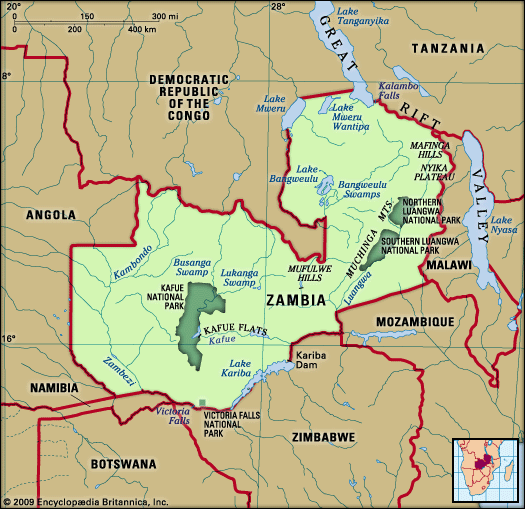
Kafue National Park is located in south-central Zambia and was officially established as a protected area in 1950.
How was Kafue National Park established, and when did it become a protected area?
Kafue National Park is located in south-central Zambia and was officially established as a protected area in 1950.1
Spanning 8,650 square miles (22,400 square km), the park is situated along the middle reaches of the Kafue River and its tributaries, the Lufupa and the Lunga. The landscape is characterized by a vast, gently undulating plateau that supports a diverse range of wildlife, including lions, elephants, and various antelope species, as well as rich birdlife. The park’s basin is a significant ecological feature of the region, benefiting from the river system that flows through central Zambia.12
Which notable species of wildlife can be found in Kafue National Park?
Kafue National Park is home to a diverse array of wildlife, particularly noted for its wide variety of antelope species. The park’s fauna includes the following notable animals:
- Large Mammals: Hippopotamus, buffalo, zebra, elephant, black rhinoceros, and lion.1
- Antelope Species: Sable, oribi, kudu, impala, roan antelope, eland, lechwe, gnu, sitatunga, and duiker.1
- Reptiles: Crocodile.1
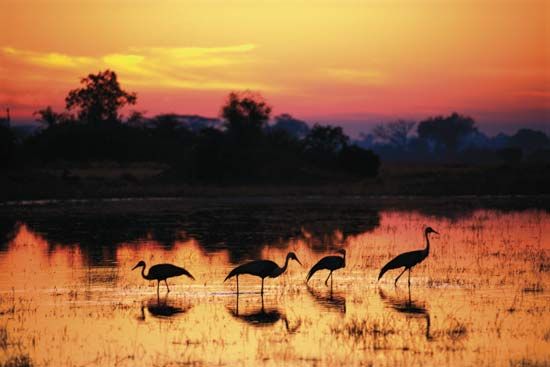
- Birdlife: Numerous species, including the fish eagle, marabou stork, vulture, openbill, saddlebill, wattled crane, crested crane, jacana, cormorant, Ross’s lourie, Boehm’s bee eater, and black-collared barbet.1
While the park hosts a broad range of species, it is important to note that human activities outside the park and poaching have historically threatened wildlife populations in the region, leading to significant conservation efforts.3
What are the main ecosystems and habitats found within Kafue National Park?
Kafue National Park features a diverse range of ecosystems and habitats shaped by its location on a vast, gently undulating plateau in central Zambia. The park’s vegetation and terrain vary significantly across its geography:
- Southern Region: This area is characterized by a mix of mixed forest, thickets, woodlands, and grasslands.
- Northern Region: The landscape transitions into broad alluvial grasslands interspersed with patches of evergreen forests.
- Wetlands and Floodplains: The park contains perennial swamps in the northwest that drain into the Lufupa River via the Busanga floodplains. Additionally, the Kafue River and its tributaries, the Lufupa and the Lunga, create vital riparian habitats. Parts of the park have also been altered by the creation of Lake Itezhi-Tezhi, a reservoir formed by a regulating dam.
These varied environments support a wide array of wildlife, ranging from large mammals to numerous bird species, all thriving within the park’s protected boundaries.132
How does tourism impact the economy of the surrounding areas and Zambia as a whole?
Tourism serves as a significant contributor to the economy of Zambia, primarily centered on game viewing and visits to Victoria Falls, which also provides opportunities for activities like white-water rafting. Additionally, hunting safaris represent a major source of income for the country.45
The development of the tourism industry was historically constrained by limited infrastructure, such as a shortage of hotel beds and poor communications, as well as a lack of diverse attractions. However, the sector has expanded following privatization efforts, which have successfully contributed to an increase in tourist arrivals. The promotion of these activities is currently coordinated by the Ministry of Tourism, Environment, and Natural Resources and the National Tourist Board.4
While tourism provides economic benefits, the government also manages extensive protected areas, including national parks and game-management areas, which cover approximately one-third of the country to preserve its natural heritage.5
Sources
- Kafue National Park — Encyclopædia Britannica
- Kafue River — Encyclopædia Britannica
- Zambia - Plant and animal life — Encyclopædia Britannica
- Zambia - Forestry — Encyclopædia Britannica
- Zambia - Services — Encyclopædia Britannica
- Mozambique - Services — Encyclopædia Britannica
Published on · 3 min read