Kaieteur Falls
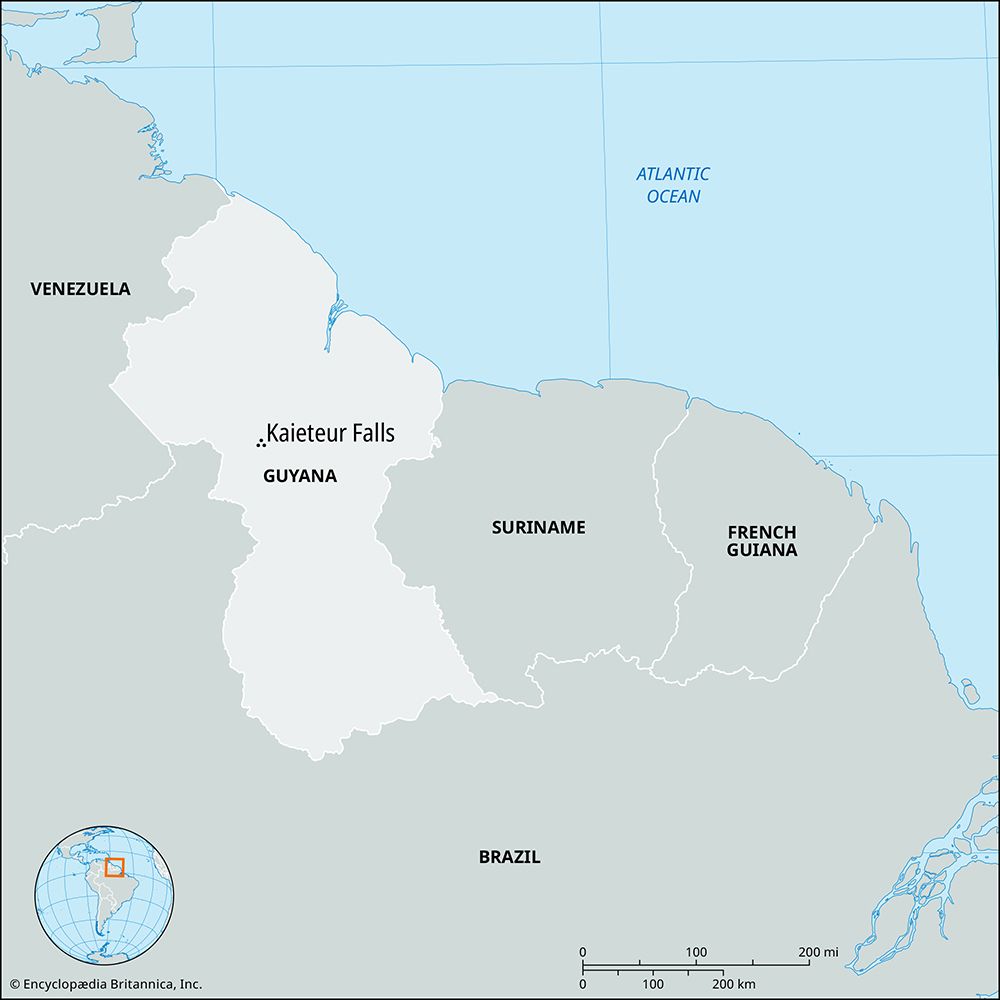
Kaieteur Falls is a magnificent cataract located on the Potaro River in west-central Guyana. It is renowned for its impressive scale, featuring a sheer drop…
What is Kaieteur Falls?
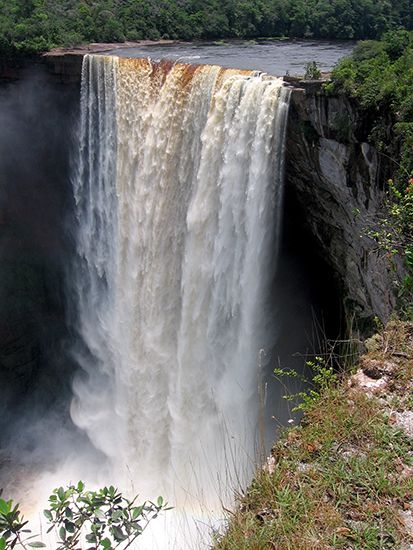
Kaieteur Falls is a magnificent cataract located on the Potaro River in west-central Guyana. It is renowned for its impressive scale, featuring a sheer drop of 741 feet (226 meters) over the edge of a sandstone plateau.12
At its crest, the falls measure between 300 and 350 feet (90 to 105 meters) in width. Below the main drop, the water has carved a gorge that extends 5 miles (8 km) and descends an additional 81 feet (25 meters). The falls serve as the primary attraction of the Kaieteur National Park, which was established in 1930. While the site is most commonly accessed via chartered aircraft from Georgetown, visitors can also reach it through road and river expeditions. The falls were first documented by the British geologist C. Barrington Brown in 1870.12
What kind of wildlife lives in Kaieteur National Park?
Sorry, the Britannica knowledge base does not contain information regarding the specific wildlife found in Kaieteur National Park.
How do waterfalls like Kaieteur form over time?
Waterfalls are generally temporary features in a river’s life cycle, as the natural tendency of flowing water is to smooth out irregularities in its gradient through erosion and deposition.5
Waterfalls like Kaieteur Falls often form due to differential erosion, where a river flows over rock layers of varying resistance. In such cases, a harder, more durable rock layer—often called a cap rock—overlies softer, more easily eroded strata. As the river wears away the weaker supporting rock from beneath, the cap rock is left to form a vertical drop.15
Over time, these falls typically migrate upstream through a process called headward erosion. The energy of the water at the base of the falls often scours out a plunge pool, which undermines the cliff face and causes it to collapse, forcing the waterfall to retreat. While differential erosion is a common cause, waterfalls can also be created by tectonic activity, glaciation, or the constructional damming of rivers by volcanic or glacial debris.567
What are some other famous waterfalls in South America?
South America is home to several world-renowned waterfalls, many of which are located along the margins of the continent’s high plateaus.
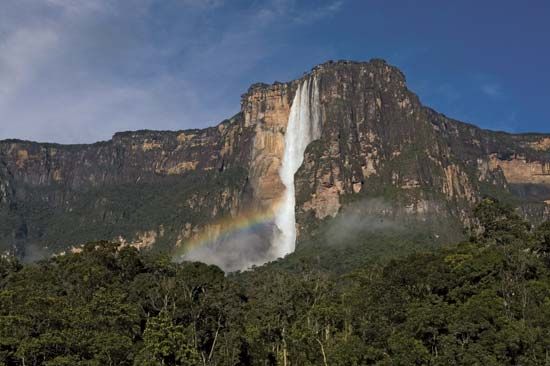
- Angel Falls: Located in the Guiana Highlands of Venezuela, this is the highest waterfall in the world. It drops 3,212 feet (979 metres) from the flat-topped plateau known as Auyán-Tepuí.94
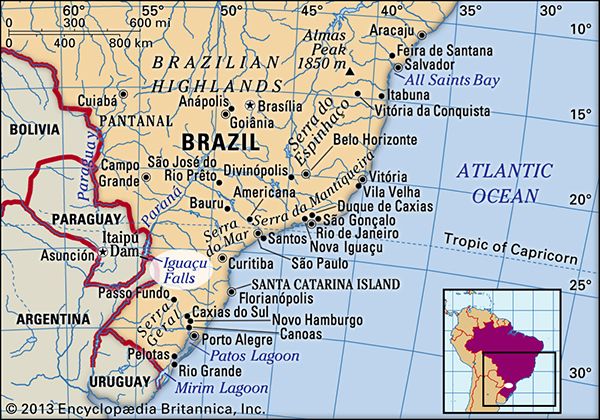
- Iguaçu Falls: Situated on the border between Argentina and Brazil, this series of cataracts forms an elongated horseshoe shape spanning 1.7 miles (2.7 km). It consists of approximately 275 individual waterfalls, including the dramatic “Devil’s Throat” (Garganta del Diablo).1011
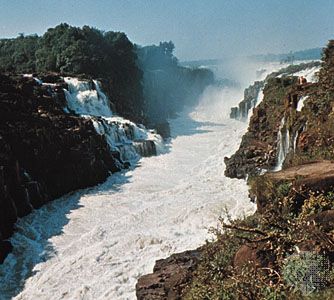
- Guaíra Falls: Historically located on the Paraná River between Brazil and Paraguay, these falls were once notable for having the largest known average discharge of any waterfall. They were submerged in 1982 following the construction of the Itaipu Dam.11
Sources
- Kaieteur Falls — Encyclopædia Britannica
- Kaieteur Falls — Merriam-Webster
- Jamaica - Plant and animal life — Encyclopædia Britannica
- Guiana Highlands — Encyclopædia Britannica
- river - Falls attributable to differential erosion — Encyclopædia Britannica
- waterfall — Encyclopædia Britannica
- river - Falls attributable to discordance of river profile — Encyclopædia Britannica
- river - Falls attributable to constructional processes — Encyclopædia Britannica
- Angel Falls — Encyclopædia Britannica
- Iguaçu Falls — Encyclopædia Britannica
- river - High plateaus — Encyclopædia Britannica
- river - Glaciated mountains — Encyclopædia Britannica
Published on · 2 min read