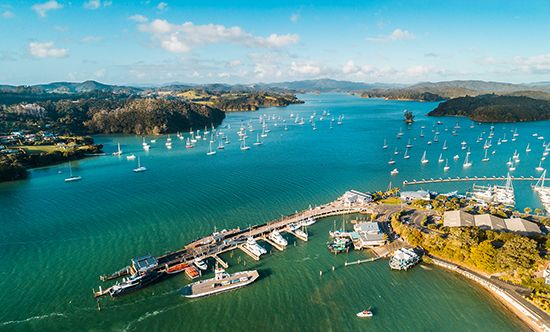
Kaipara Harbour
Kaipara Harbour is a large inlet of the Tasman Sea located on the northwestern coast of the North Island in New Zealand.
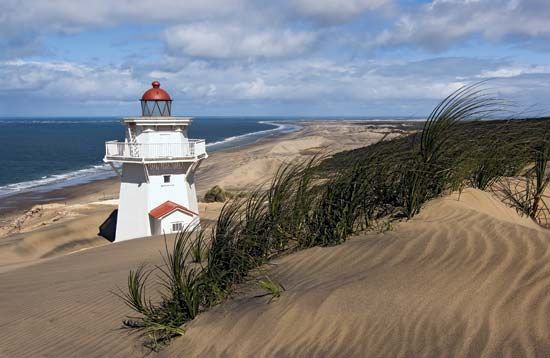
What is Kaipara Harbour?
Kaipara Harbour is a large inlet of the Tasman Sea located on the northwestern coast of the North Island in New Zealand.1
It is recognized as the largest drowned river system on the North Auckland Peninsula, created when rising sea levels flooded the lower valleys of several rivers, including the Wairoa, Kaipara, and Hoteo. The harbour covers an area of approximately 200 square miles (520 square km) and features a complex coastline with over 2,000 miles (3,200 km) of shoreline.1
Historically, the harbour functioned as a vital port for the region before the development of modern road and rail infrastructure. Today, the primary settlements situated along the inlet include Helensville, Ruawai, and Paparoa.1
How do drowned river systems form?
Drowned river systems, often referred to as drowned river estuaries or rias, form primarily through the interplay between sea level changes and geomorphology.23
The process typically occurs in the following stages:
- Entrenchment: During glacial periods, global sea levels drop significantly as water is locked in massive ice sheets. As the baselevel falls, rivers flow more rapidly and cut deeper into the continental shelf, creating entrenched valleys.24
- Inundation: As glaciers melt and sea levels rise, marine waters flood these previously carved river valleys.24
- Modification: In some regions, glaciers further deepen these valleys through erosion before they are submerged, resulting in deep, narrow fjords.254
While sea-level rise is the most common cause, similar effects can be produced by tectonic activity, such as the downfaulting or subsidence of a coastal area, which causes the land to sink relative to the sea.24
What kind of wildlife lives in the Kaipara Harbour ecosystem?
Sorry, the Britannica knowledge base does not contain information regarding the specific wildlife that inhabits the Kaipara Harbour ecosystem.
Why were harbours so important for early trade in New Zealand?
Harbours were essential to early trade in New Zealand because the country’s rugged terrain made overland travel difficult, rendering maritime shipping the primary method for moving people and goods throughout the 19th and much of the 20th century. Consequently, most major towns were established on or near natural harbours, which served as vital gateways for economic activity.1
These harbours facilitated the early extraction and export of resources such as timber, sealskins, New Zealand flax, and products from the whaling industry. For example, the Bay of Islands became a significant hub for international whalers, while Wellington Harbour was selected as the site for the initial New Zealand Company settlement. In areas like the Kaipara Harbour, the inlet functioned as a critical port for local commerce long before the development of extensive road and rail networks. As the economy grew, these ports became the foundation for both internal distribution and international trade, eventually supporting the export of refrigerated goods like meat, butter, and cheese.678910111
Sources
- Kaipara Harbour — Encyclopædia Britannica
- estuary - Geology and geomorphology — Encyclopædia Britannica
- ria — Encyclopædia Britannica
- coast — Encyclopædia Britannica
- river - Origin and classification — Encyclopædia Britannica
- Wellington Harbour — Encyclopædia Britannica
- history of New Zealand - Early European settlement of New Zealand — Encyclopædia Britannica
- New Zealand - Early European settlement — Encyclopædia Britannica
- history of New Zealand - Fluctuation of the economy — Encyclopædia Britannica
- Bay of Islands — Encyclopædia Britannica
- New Zealand - Transportation and telecommunications — Encyclopædia Britannica
Published on · 2 min read