Bay of Islands
The provided search results do not contain information regarding how the Bay of Islands received its name. While the records confirm that Captain James Cook…
How did the Bay of Islands get its name?
The provided search results do not contain information regarding how the Bay of Islands received its name. While the records confirm that Captain James Cook was the first European to enter the inlet in 1769, they do not specify the origin of the name itself.1
For context, the search results do note that Captain Cook named other New Zealand locations, such as the Bay of Plenty in recognition of the generous provisions received from local Māori, and Hawke Bay in honor of Sir Edward Hawke.23
What is the historical significance of the Bay of Islands for New Zealand?
The Bay of Islands holds profound historical significance as a focal point for early European contact and the formal establishment of the British presence in New Zealand.
Key historical milestones include:
- Early Exploration and Settlement: Captain James Cook first entered the inlet in 1769. By 1814, the Reverend Samuel Marsden established the first permanent European settlement in the country at Rangihoua.1
- Economic Hub: During the 1830s, the bay became a vital center for whaling, with the town of Kororareka (now Russell) serving as a major port for American, British, and French vessels.14
- The Treaty of Waitangi: The region is most notably the site where the Treaty of Waitangi was signed in 1840 between the British Crown and native Māori chiefs, a foundational document in New Zealand’s history.1
- Conflict: The area was also a site of significant tension during the 19th century, including the 1845 conflict sometimes referred to as the First Māori War, as Māori tribes resisted the increasing encroachment of European government and settlement.5
What are the main geographical features of the Bay of Islands?
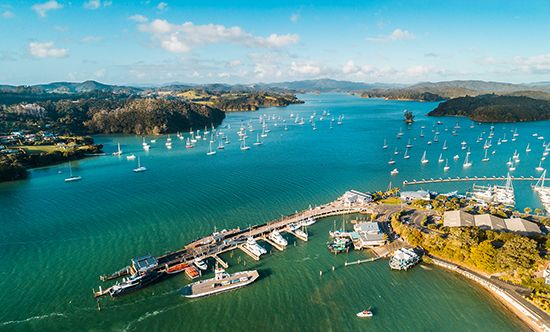
The Bay of Islands is a prominent geographic region located in the northern part of the North Island of New Zealand. Its primary geographical features include:
- Formation: The bay was created when the sea flooded an ancient river valley system, resulting in a complex, indented coastline.1
- Scale and Scope: It features a shoreline spanning approximately 500 miles (800 km) and contains about 150 islands.1
- Access: The bay connects to the Pacific Ocean through an 11-mile (18-kilometre) wide passage. This entrance is defined by two prominent landmarks: Brett Cape on the east and Wiwiki Cape on the west.1
- Coastal Character: Situated within the Northland region, the bay is part of an east coast characterized by rocky shorelines and deep-encroaching inlets, which provide significant natural anchorages.18
What are some popular activities and attractions in the Bay of Islands?
The Bay of Islands is a popular resort destination known for its blend of historical significance and outdoor recreation. Visitors can enjoy a variety of activities and attractions, including:
- Historical Sites: The region is home to the Waitangi Treaty House, where the foundational treaty between the British Crown and the Māori was signed. Other historic areas include the early settlement sites at Rangihoua and the charming town of Russell, which served as a major whaling port in the 1830s.
- Water-Based Recreation: The bay is a premier location for deep-sea fishing and exploring the scenic beauty of its 150 islands. Urapukapuka Island serves as a dedicated tourist center for those looking to experience the region’s natural landscape.
- Outdoor Adventure: Beyond the water, the area offers opportunities for hunting and exploring the diverse coastal geography of the North Island.
- Towns and Ports: Travelers often base themselves in the principal towns of Paihia, Kerikeri, or Russell, while Opua functions as a deepwater port of entry for international vessels.
Sources
- Bay of Islands — Encyclopædia Britannica
- Bay of Plenty — Encyclopædia Britannica
- Hawke Bay — Encyclopædia Britannica
- New Zealand - Early European settlement — Encyclopædia Britannica
- Māori — Encyclopædia Britannica
- history of New Zealand - Early European settlement of New Zealand — Encyclopædia Britannica
- Wellington Harbour — Encyclopædia Britannica
- New Zealand - Relief of New Zealand — Encyclopædia Britannica
- Northland — Encyclopædia Britannica
- French Polynesia - Plant and animal life — Encyclopædia Britannica
Published on · 3 min read