Lake Chargoggagoggmanchauggauggagoggchaubunagungamaugg
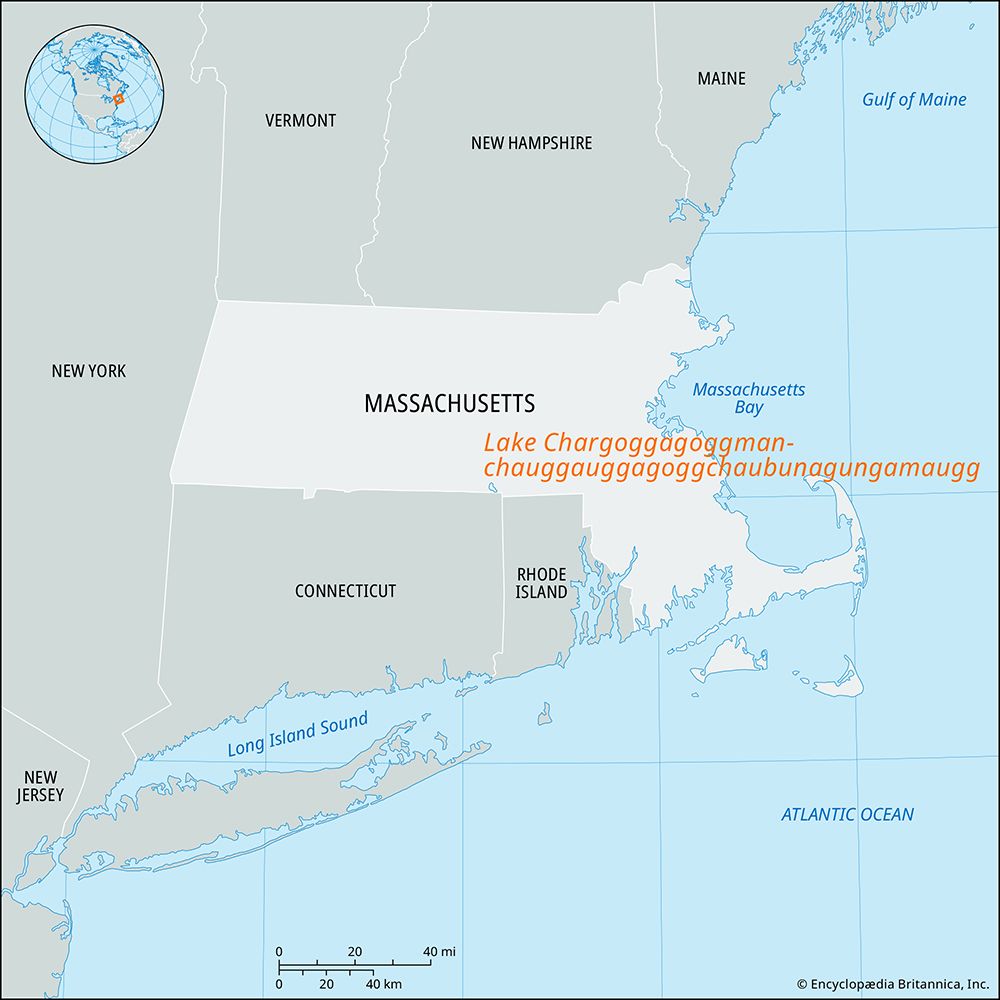
Lake Chargoggagoggmanchauggauggagoggchaubunagungamaugg is a lake located in southern Worcester County, near the town of Webster, Massachusetts. Commonly…
What is Lake Chargoggagoggmanchauggauggagoggchaubunagungamaugg?
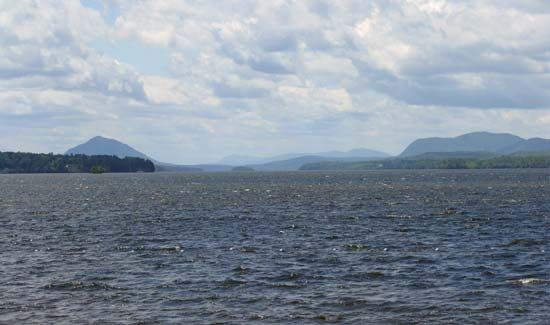
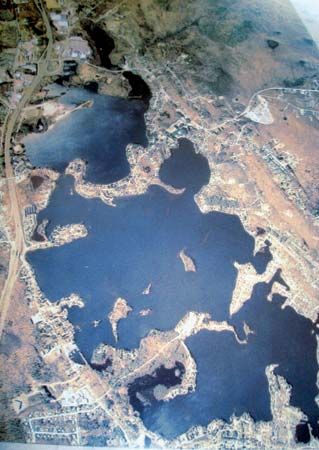
Lake Chargoggagoggmanchauggauggagoggchaubunagungamaugg is a lake located in southern Worcester County, near the town of Webster, Massachusetts. Commonly referred to as Webster Lake, it is the second-largest natural body of water in the state.1
While popular culture often claims the name is Nipmuc for “You fish on your side; I fish on my side; nobody fishes in the middle,” this translation is widely considered a 20th-century fabrication. Historical evidence suggests the name originated from a mapmaker’s hoax in 1795, which combined nonsense syllables with the authentic Indigenous name Chaubunagungamaug.12
Linguists suggest Chaubunagungamaug likely derives from elements meaning “lake divided by islands,” a description fitting the lake’s geography. The extended, humorous version of the name was later contrived by appending this authentic term to the cartographer’s original, fraudulent creation.2
Who were the Nipmuc people and where did they live?
The Nipmuc are an Algonquian-speaking Indigenous people who historically inhabited the central plateau of Massachusetts, with territories extending into parts of modern-day Rhode Island and Connecticut.3
Their society was organized into territorial bands of related families living in villages, each governed by a leader known as a sachem. Rather than maintaining a unified political alliance, individual villages typically formed alliances with neighboring groups, such as the Massachuset, Wampanoag, Narragansett, and Mohegan. The Nipmuc practiced a semi-sedentary lifestyle, moving seasonally between sites to hunt, fish, and cultivate corn.3
Following their involvement in King Philip’s War in 1675, many Nipmuc fled to Canada or joined other tribes along the Hudson River. In the early 21st century, the population of individuals of Nipmuc descent was estimated at approximately 1,500.3
How do mapmakers sometimes accidentally create historical myths?
Mapmakers have historically contributed to the creation of myths through several factors, including limited exploration, cultural bias, and the repetition of errors.
- Filling the Unknown: Early mapmakers often faced the challenge of terra incognita, or unknown lands. When faced with gaps in geographical knowledge, they frequently filled these spaces with artistic renderings of monsters or fanciful beasts rather than leaving them blank, which fueled popular myths about the nature of distant regions.5
- Cultural and Political Bias: Maps often reflect the worldview of their creators. Early maps were frequently “egocentric,” placing the mapmaker’s own city or culture at the center of the world. This practice reinforced the idea that the mapmaker’s society was the focal point of existence, a bias that persists in modern conventions, such as the arbitrary decision to place north at the “top” of a map.5
- Repetition of Errors: Because early maps were often hand-copied, errors were frequently passed down and amplified over centuries. A notable example is Ptolemy, whose underestimation of the Earth’s size influenced explorers for over 1,300 years. Christopher Columbus relied on these flawed calculations, leading him to believe he had reached India when he had actually arrived in the Americas.56
What are some other places in the United States with long or unusual names?
While the lake mentioned in our previous discussion, Lake Chargoggagoggmanchauggagoggchaubunagungamaugg, is frequently cited as the longest place name in the United States, it is important to clarify that its extreme length is largely the result of a historical cartographic hoax and later embellishments rather than an authentic Indigenous name. The original, legitimate name used by the Nipmuc people was Chaubunagungamaug, which likely translates to “lake divided by islands”.2
Beyond this famous example, the United States features several other locations with notably long or unusual names:
- Taumatawhakatangihangakoauauotamateaturipukakapikimaungahoronukupokaiwhenuakitanatahu: While this is the world-famous long name in New Zealand, the U.S. has its own share of lengthy, often descriptive names derived from various linguistic traditions, particularly in regions with strong Native American heritage.
- Winchester-on-the-Severn, Maryland: Examples of hyphenated or multi-word names often reflect colonial naming conventions or specific geographic descriptions.
- Rancho Santa Margarita y Las Flores, California: Reflecting the Spanish influence on American place names, these often result in long, multi-part titles.
Sources
- Lake Chargoggagoggmanchauggauggagoggchaubunagungamaugg — Encyclopædia Britannica
- Chargoggagoggmanchauggagoggchaubunagungamaugg, Lake — Merriam-Webster
- Nipmuc — Encyclopædia Britannica
- Nauset — Encyclopædia Britannica
- Did you know? — Merriam-Webster
- world map — Encyclopædia Britannica
- map - The Roman period — Encyclopædia Britannica
- How to Spell the Longest Place Name in the United States — Merriam-Webster
- The Longest Long Words List | 49 Letters — Merriam-Webster
Published on · 3 min read